Media framing
Denominator framing examples for media claims
Organization byline: Measurement Press editorial desk. This page does not list an individual author or reviewer. Read the editorial method and corrections policy.
About 9 min read
A numerator can be true and still push readers toward the wrong judgment. The frame changes when the denominator changes: all residents, eligible cases, completed transactions, inspected locations, filed reports, responding survey participants, or prior-period baseline.
This guide gives practical examples for spotting denominator substitutions before they harden into a headline, social post, memo, or editorial position. Use it alongside the media claim audit worksheet, public records and denominator checklist, and source quality scorecard.
Method sources for this guide
The distinctions here follow methods guidance rather than a rule that every claim needs a single universal base. The CDC Field Epidemiology Manual explains that rates correct counts for differences in population size or study period, and that the counted event should be tied to the population used as the denominator. The CDC rate definitions show why the denominator changes with the event being measured: a visit rate uses the population that could have had the event, while infant mortality uses live births as its base.
For changes over time, the Bureau of Labor Statistics percent-change guidance defines the calculation from the earlier value, requires a consistent reference base, and warns that annual-average and same-month year-over-year comparisons answer different questions. For survey and public-data quality, the Census Bureau Statistical Quality Standard F1 treats response, coverage, and combined rates as signals that can limit how confidently an estimate should be released or interpreted. These sources define useful inspection questions; they do not validate the simulated five-incident example or select a denominator for a real claim without knowing the event, eligible population, and collection process.

First identify the number's job
| The number is trying to show | Denominator to ask for | Why it matters |
|---|---|---|
| How common something is | The eligible population or rate base, not only the count of visible cases. | A large count can be a small rate in a large universe, or a small count can be a meaningful rate in a small one. |
| Whether something changed | The prior level, time window, reporting rule, and comparable population. | A percent change can sound large when the starting number is small or when reporting volume changed. |
| Whether one group differs from another | The same denominator for each group, adjusted for exposure, eligibility, or opportunity. | Different opportunity levels can make one group look better or worse before behavior is compared. |
| Whether a system is failing | The workload, transaction count, inspection count, request count, or case mix. | Raw incidents can rise because the system handled more cases, looked harder, or changed its intake process. |
| Whether a survey shows consensus | The sampled population, respondent base, subgroup size, and exact question base. | A result among respondents is not automatically a result among the whole public, customer base, or workforce. |
Common denominator substitutions
The first safe move is not to pick one denominator too quickly. List the bases that could make the number meaningful, then choose the one that matches the claim's job.

Population base
The claim uses a total count but hides how many people, households, customers, or cases could have been counted.
Ask: per person, per household, per customer, per eligible case, or per transaction?
Opportunity base
The claim compares outcomes without showing who had the same chance to experience the event.
Ask: were the groups equally exposed, eligible, inspected, contacted, or reachable?
Reporting base
The claim treats visible records as the full universe even though records depend on reporting, filing, enforcement, or processing.
Ask: did the process create more records, miss records, delay records, or redefine records?
Time-window base
The claim highlights a change over a convenient period while omitting seasonality, longer trends, or prior volatility.
Ask: what happens under a full-year, multi-year, or pre-specified window?
Composition base
The claim compares aggregate results while the mix of cases, people, geographies, or products changed.
Ask: did the underlying mix shift before the outcome changed?
Decision base
The claim uses a dramatic number that does not match the decision readers are being asked to make.
Ask: which denominator would a reasonable decision-maker need before acting?
Translation examples
| If the claim says | Likely missing denominator | More careful read |
|---|---|---|
| "Complaints doubled this quarter." | Starting count, total transactions, outreach changes, complaint channels, and backlog handling. | Reported complaints doubled from a stated base during this quarter; the complaint rate and intake changes determine whether the system worsened. |
| "Dozens of incidents occurred near the facility." | Nearby population, daily traffic, eligible sites, time period, and comparison locations. | The record shows reported incidents in this area; the rate and peer locations are needed before calling it unusual. |
| "A small share of requests were denied." | Total eligible requests, duplicate requests, incomplete requests, exemptions, and decision categories. | The denial share is small under this request base; delays, partial releases, and nonresponsive searches may still matter. |
| "The budget line hit a record high." | Inflation, population served, service level, accounting changes, and peer spending rates. | The nominal line reached a high point; inflation-adjusted and service-adjusted comparisons decide the practical meaning. |
| "Most respondents support the proposal." | Sample source, field dates, question wording, weighting, subgroup base, and nonresponse. | Most respondents in this sample answered this way under this wording; the result should stay inside that population and timing. |
| "The category is surging." | Starting level, full trend, seasonality, comparable categories, unit count, and dollar count. | The category grew under this metric and window; the baseline and comparison set determine whether it is a surge or normal variation. |
| "The top group accounted for half the outcomes." | Group size, opportunity to generate outcomes, prior risk, and exposure level. | The group generated half the observed outcomes, but its share of the eligible base and opportunity level decide whether it over-indexed. |
| "Only a handful of cases were found." | Search scope, inspection coverage, detection sensitivity, reporting rules, and cases not inspected. | The process found a handful within the searched universe; the unsearched or hard-to-detect universe remains a limit. |
The denominator audit pass
A denominator audit should produce a better sentence, not just a list of caveats. Move from the number to the possible bases, test whether the base changed, and then rewrite the claim so the reader can see the measurement frame.

1. Name the numerator.Write the exact count, percentage, rate, share, or survey result. Do not let the headline's emotional frame stand in for the measured number.
2. Name every possible denominator.List the total population, eligible population, exposed population, reported population, inspected population, transaction base, prior-period base, and respondent base. The right denominator is the one that matches the claim's job.
3. Check whether the denominator moved.If population, reporting volume, inspection effort, case mix, access rules, product mix, geography, or survey recruitment changed, the numerator may have moved for reasons unrelated to the frame.
4. Compare like with like.Use the same denominator across groups and periods when possible. If the base differs, make the difference visible before drawing a strong contrast.
5. Rewrite the claim with the base included.A careful sentence names the numerator, denominator, period, source, and comparison class. If that sentence sounds less dramatic, the original frame was doing extra work.
When no denominator is available
Sometimes the best base is unavailable, especially with partial records, early releases, or limited surveys. That does not make the number useless. It changes the claim language. Say what the visible record shows, name the missing base, and avoid upgrading a count into prevalence, severity, intent, or cause.
| Evidence status | Careful wording | Do not infer |
|---|---|---|
| Visible count only | The source reports this many visible cases under this process. | How common the event is in the full population. |
| Partial denominator | The rate applies to the measured subset, with known exclusions. | That excluded groups would show the same rate. |
| Changing denominator | The comparison is affected by a population, rule, mix, or reporting change. | That the numerator change alone proves a real-world change. |
| Uncertain denominator | The available record is directional and needs a better base before strong conclusions. | That the most dramatic interpretation is the safest one. |
Simulated worked example: five incidents, four honest frames
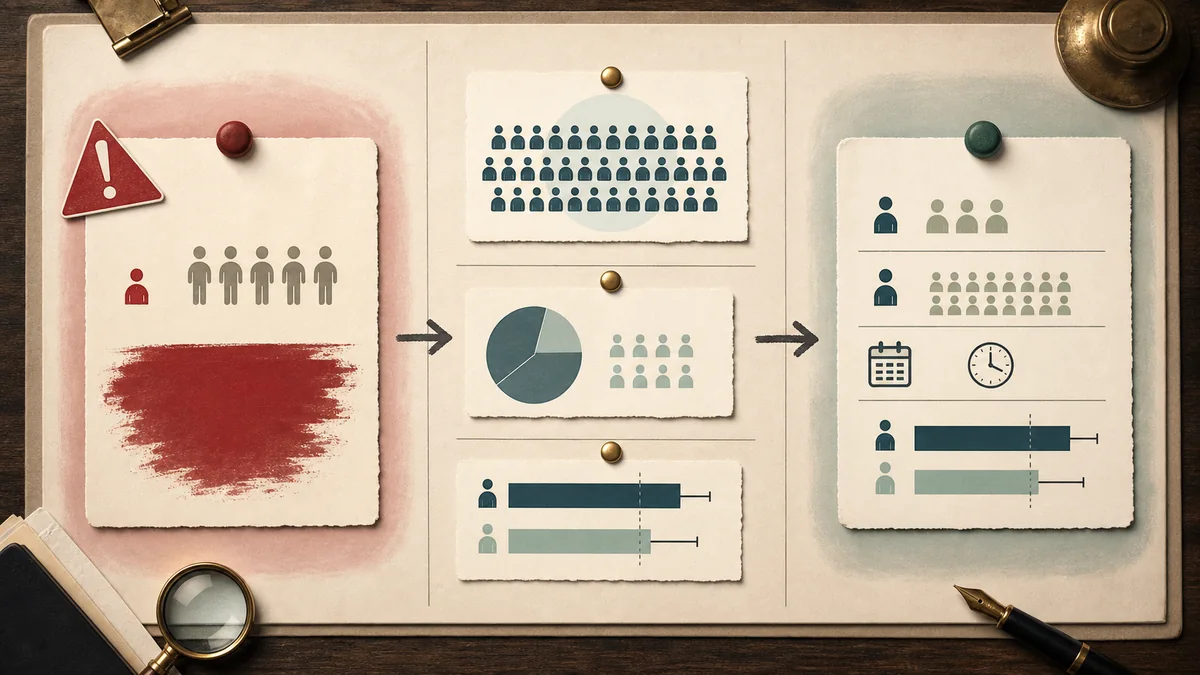
Simulated scenario: assume a story says five incidents were found near a public facility in one month. The count is illustrative, not a report of a real facility or event. The count may be accurate within the simulated record, but the careful sentence depends on the base. If the story wants readers to judge safety, prevalence, system performance, or trend direction, each judgment needs a different denominator.
| If the base is | Careful sentence | What the reader can judge |
|---|---|---|
| All nearby residents | Five reported incidents occurred among the resident population in the stated area and month. | Whether the count is large relative to the number of people potentially affected. |
| Inspected locations | Five incidents were found among the locations inspected under this month's inspection plan. | Whether the inspection result is high or low for the searched universe, not for uninspected places. |
| Prior comparable month | The count changed from the prior comparable month under the same reporting and inspection rules. | Whether there is a directional change after holding the collection process steady. |
| Peer locations | The facility's count can be compared with similar sites only after population, traffic, and reporting rules are aligned. | Whether the facility looks unusual relative to a fair comparison class. |
Reproducible check: 5 incidents ÷ 100 inspected locations = 5.0% inspected-location rate.
Under a different simulated base of 1,000 nearby residents, the same numerator is 5 ÷ 1,000 = 0.5% of residents. Those two values are not interchangeable: the first describes findings among inspected locations, while the second describes incidents relative to residents only if the numerator and resident base truly cover the same event and period. If the five incidents are repeated reports, neither calculation is a person-level prevalence estimate. The comparison is a framing demonstration, not evidence about a real facility or population.
What would change the conclusion: the inspection universe, duplicate-report rule, resident count, event definition, month boundaries, and a comparable prior period. If any of those differ, keep the count descriptive and do not call the result a rate without naming the changed base.
Takeaway
The denominator is not a technical footnote. It is the part of the claim that tells readers what the number is actually about. If a frame hides the denominator, the reader cannot tell whether the number is large, small, changing, representative, or decision-ready.