Media framing
Disconfirming evidence checklist for media claims
Organization byline: Measurement Press editorial desk. This page does not list an individual author or reviewer. Read the editorial method and corrections policy.
About 11 min read
A strong frame should survive contact with the best evidence against it. Before accepting a media claim, name the fact, denominator, comparison, counter-source, or method limit that would weaken the story if it appeared.
A familiar review starts with a headline, a chart, or a campaign readout that feels complete: the number is specific, the quote is confident, and the conclusion is already moving through a meeting or social feed. The weak point is often not that the claim has no evidence. The weak point is that nobody has named the evidence that would make the claim smaller, less causal, or less certain.
This checklist is for readers, editors, analysts, and researchers reviewing public claims from articles, reports, dashboards, records, surveys, and campaign readouts. The goal is not reflexive doubt. The goal is to make confidence depend on what the claim has already survived.

What the claim has to survive
Treat the claim as provisional until it passes four gates: the closest source, the fair base, the fair comparison, and the most likely counter-source. A claim does not need perfect certainty to be publishable or useful, but the final language should show which gates it cleared and which gates remain open.
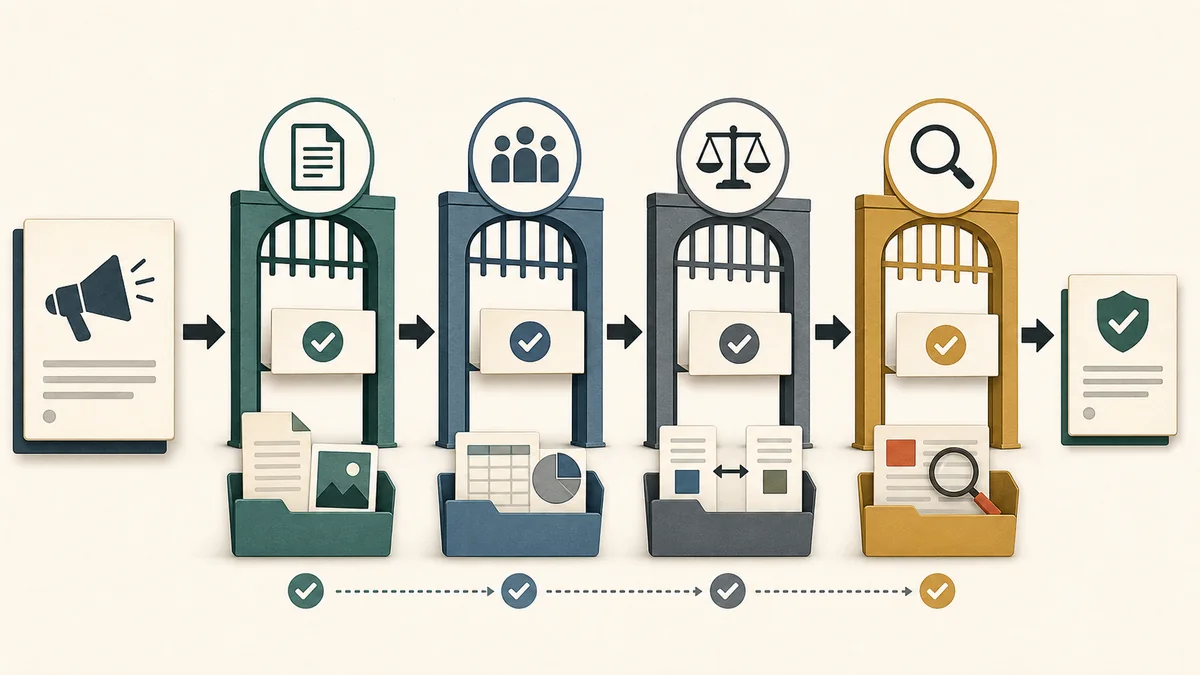
What the source trail should disclose
Descriptive-data check: The CDC guidance on describing epidemiologic data connects what happened with how much, when, where, and among whom; it also calls for source, units, time frame, and explanatory context around tables and charts. This is adapted here as a media-claim review aid, not as a universal standard for every domain.
Disconfirmation is a method, not a mood. The CDC Field Epidemiology Manual recommends specifying the question, data source, population, denominator, variables, missing-value treatment, comparison, and analysis plan before interpreting a result. Its interpretation checklist also names chance, selection bias, information bias, confounding, and investigator error as alternative explanations to examine before calling an association causal.
The U.S. Census Bureau Statistical Quality Standard F1 treats unclear concepts, coverage, response, and other nonsampling problems as reasons to qualify how an estimate is released and used. The federal Reference Guide on Epidemiology separates an observed association from a causal conclusion and asks whether bias, sampling error, and alternative explanations could account for it. For surveys and content analyses, AAPOR's Transparency Initiative calls for disclosure of the sampling frame, coverage, dates, sample sizes, precision, processing, and limitations. These are not a universal score; they are a source trail that lets a reader see what remains unresolved.
Boundary: The CDC and epidemiology references are adapted here as reasoning aids for media and measurement claims, not offered as a legal, medical, or universal causal standard. A disconfirming check can narrow a sentence or expose missing evidence; it cannot prove that every alternative explanation has been eliminated.
The one-page disconfirmation pass
| Check | Ask for | Why it matters | Downgrade when |
|---|---|---|---|
| Central claim | The single sentence the reader is being asked to believe. | Disconfirmation is impossible until the claim is specific enough to test. | The frame depends on vague words such as crisis, surge, backlash, many, or experts. |
| Primary source | The closest record, transcript, table, method note, data release, or report behind the claim. | A summary can be accurate, but it cannot replace the thing being summarized. | The story links commentary, screenshots, or excerpts while the underlying material remains hard to inspect. |
| Alternate denominator | The population, eligible cases, total contacts, prior-period level, or opportunity base that could change the practical meaning. | A true numerator can still create a false sense of scale. | The claim gives a count, percentage, or rate without showing what base would make it fair. |
| Fair comparison | The peer group, prior period, matched geography, expected baseline, or historical range chosen before the conclusion. | Most frames are built by making one comparison easy and another comparison hard. | The article switches comparison classes depending on which one makes the claim sound strongest. |
| Missing source role | The record owner, affected party, method expert, counterparty, data owner, or independent analyst most likely to narrow the claim. | Absence of a role can matter as much as imbalance among visible sources. | One interested source supplies both the fact pattern and the interpretation. |
| Alternative explanation | A plausible non-causal explanation: seasonality, backlog, reporting change, selection, regression to the mean, audience intent, or definition shift. | A claim can be directionally true while its implied cause is weak. | The article treats timing, sequence, or correlation as enough to support cause. |
| Scope limit | The geography, population, sample, platform, data universe, field dates, or measured inventory the evidence actually covers. | Frames often become misleading when a narrow source is written as a broad conclusion. | A local, sampled, platform-visible, or customer-only result becomes a category-wide claim. |
| Decision threshold | The missing fact that would materially change confidence, not just add minor nuance. | Readers need to know what would move the claim from strong to tentative. | Caveats are listed vaguely without saying whether they would change the conclusion. |
Use by claim type
| Claim type | Strongest disconfirming evidence to look for | Useful paired guide |
|---|---|---|
| Public-record count | A different record universe, excluded population, rate base, delayed filing batch, definition change, redaction, or no-responsive-records boundary. | Public records and denominator checklist |
| Before-and-after trend | A longer chart window, seasonal pattern, concurrent change, policy timing mismatch, revised series, peer trend, or expected baseline. | Before-and-after chart and trend checklist |
| Survey or poll headline | Exact wording, field dates, low subgroup base, nonresponse, sponsor effect, weighting choice, coverage gap, or alternate question order. | Survey and poll claim checklist |
| Quote-driven story | A missing direct participant, document, response request, quote role, rebuttal placement, or comparable evidence standard for the other side. | Quote weight and response standard checklist |
| Sponsored or vendor research | Sponsor role, customer-only data, sample selection, omitted benchmark, denominator mismatch, method limit, or unpublished negative slice. | Sponsored research and vendor report checklist |
| Campaign or measurement readout | Holdout leakage, audience selection, attribution window choice, matchback bias, weak outcome quality, noisy interval, or missing comparison rule. | Campaign readout QA checklist |
| Source-quality claim | A closer primary record, more complete method disclosure, independent source, uncertainty statement, or replicable citation path. | Source quality scorecard |
Downgrade rules
No named weakenerIf a critique cannot say what evidence would weaken it, the frame is probably closer to persuasion than evaluation. Lower confidence until the claim has a clear test.
Same-source loopIf the central claim, denominator, comparison, and interpretation all come from the same interested source, treat the result as useful input rather than settled evidence.
Numerator-only pressureIf the article relies on a count, anecdote stack, percent increase, or superlative without a base, ask whether a rate, population, workload, or eligible universe would change the frame.
Post-hoc comparisonIf the comparison appears chosen after the result is known, treat it as exploratory. Strong language needs a comparison rule that was fair before the conclusion was visible.
Proxy outcome upgradeIf a proxy such as attention, clicks, recall, matchbacks, complaints, responses, or filings is written as proof of the broader outcome, keep the claim inside the proxy.
Simulated worked example: count up, rate flat
Simulated Worked Example. The numbers below are invented for method demonstration, not a report about a real policy, place, organization, or event.
Suppose a draft says, “Complaints surged 20% after the policy change.” A reviewer finds 120 reported complaints among 10,000 eligible transactions in the earlier period and 144 among 12,000 in the later period. The count did rise, but the opportunity base rose by the same proportion.
| Measure | Earlier period | Later period | Calculation |
|---|---|---|---|
| Reported complaints | 120 | 144 | (144 − 120) ÷ 120 = 20.0% increase |
| Eligible transactions | 10,000 | 12,000 | (12,000 − 10,000) ÷ 10,000 = 20.0% increase |
| Complaint rate | 120 ÷ 10,000 = 1.20% | 144 ÷ 12,000 = 1.20% | 1.20% − 1.20% = 0.00 percentage-point change |
The supported statement is narrower: reported complaints increased by 20% in this simulated release, while the complaint rate stayed flat under the stated denominator. That does not establish that the policy caused the count change. Before using a stronger sentence, the reviewer would still need to check filing lag, definition changes, missing records, seasonality, and a fair comparison period or peer group. If those checks change the eligible base or show a backlog release, the result and wording must be recalculated.
Simulated disconfirmation packet: what would change the sentence
Simulated Worked Example. This packet extends the complaint example above with invented records so a reader can reproduce the sensitivity test. It is not evidence about a real policy, organization, or event.
Start with the baseline: 120 complaints among 10,000 eligible transactions is 1.20%; 144 among 12,000 is also 1.20%. The count increased, but the rate did not. The useful question is which unresolved record would change that conclusion.
| Disconfirming check | Illustrative input | Recalculation | Wording boundary |
|---|---|---|---|
| Filing lag | 12 of the 144 later-period reports are dated to the earlier period. | (144 - 12) / 12,000 = 1.10%; change from 1.20% = -0.10 percentage points. | Replace “complaints rose” with “the later-period count is unresolved until filing dates are reconciled.” |
| Denominator coverage | 1,500 of the later-period transactions are outside the released eligible universe. | 144 / (12,000 - 1,500) = 1.37%; change from 1.20% = +0.17 percentage points. | Do not call the rate flat unless the excluded transactions are shown to be ineligible for the same reason. |
| Definition change | 24 later-period reports meet a new category rule but would not meet the earlier rule. | (144 - 24) / 12,000 = 1.00%; change from 1.20% = -0.20 percentage points. | Report a classification change, not a policy effect, until both periods use the same rule. |
| Peer comparison | A matched comparison group also moves from 1.20% to 1.20% in the same window. | Observed change - peer change = 0.00 percentage points. | Use “consistent with a broader period effect”; do not attribute the difference to the policy. |
Reproduction: copy the four inputs into a worksheet; calculate each rate as complaints divided by the eligible denominator, then subtract the earlier 1.20% rate. These are sensitivity cases, not confidence intervals or causal estimates. The packet does not resolve measurement error, seasonality, missing records, or a valid comparison by itself. A conclusion can strengthen only after the underlying records and definitions are verified.
Run the disconfirmation workflow
Use the workflow before polishing the final sentence. Start with the exact sentence, then move outward to the closest record, denominator, comparison, missing role, alternate explanation, and final language. If one step is unknown, do not hide it in a caveat paragraph; make it shape the claim verb.
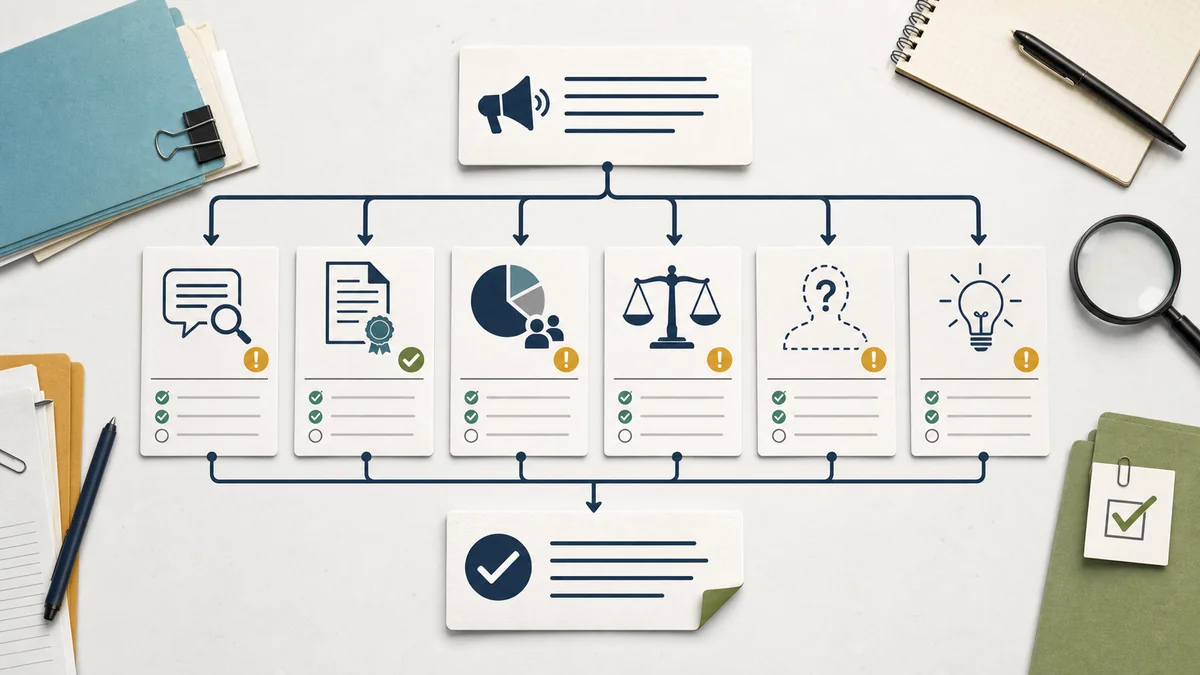
Meeting worksheet prompts
- What exact sentence are we testing?
- What is the closest primary source, and what source is still missing?
- What denominator or comparison would make the claim smaller, larger, or more ordinary?
- Which source role would be most likely to narrow the claim?
- What single fact would move this from strong confidence to modest confidence?
- What wording keeps the conclusion inside what survived the disconfirmation pass?
Worked downgrade example
A downgrade is not a retreat from evidence. It is a cleaner match between the support and the sentence. When the missing fact would materially change the claim, the safer version keeps the observed evidence while removing the unsupported leap.

| Starting frame | Disconfirming check | Careful version |
|---|---|---|
| "Complaints surged after the policy change." | Separate event date from filing date, compare against total transactions, and check whether a backlog release changed the count. | "Reported complaints increased in the release period; the available records do not yet show whether the complaint rate rose after adjusting for filing lag and transaction volume." |
| "The campaign drove a large lift." | Check audience selection, holdout leakage, attribution window, and whether the reported outcome is a proxy for the business result. | "The readout shows higher measured activity among exposed users, but the evidence is not strong enough to separate campaign response from pre-existing intent." |
| "Experts agree the claim is settled." | Name the source roles, look for the strongest counter-source, and ask whether one interested source is carrying both facts and interpretation. | "Several quoted sources support the interpretation; the article has not yet shown the counter-role most likely to narrow the claim." |
| "This chart proves a trend." | Extend the time window, inspect definition changes, compare against peers, and mark whether the comparison was chosen before seeing the result. | "The chart is consistent with a change over this window, but the comparison remains exploratory until the longer series and peer baseline are visible." |
Safer claim language
| When the weakener is missing | Use language like | Avoid language like |
|---|---|---|
| The denominator is unclear. | "The available count shows reported cases, but the relevant rate base is not yet visible." | "The problem is widespread." |
| The comparison was not pre-specified. | "The comparison is suggestive and should be treated as exploratory." | "The comparison proves the claim." |
| The source role is narrow. | "This source can speak to its observed portion of the record." | "This source settles the broader question." |
| The causal path is not tested. | "The timing is consistent with the claim but does not establish cause." | "The event caused the result." |
| The method is proxy-based. | "The metric describes observed activity under this measurement rule." | "The metric proves real-world impact." |
Use with
Pair this checklist with the media claim audit worksheet for a fast first pass, the source role and incentive map when a source may be carrying too much of the frame, the denominator framing examples when the base is unclear, and the evidence-to-claim language matrix when the final wording needs to match the evidence.
Takeaway
The best readers do not only ask whether a claim has evidence. They ask what evidence would make the claim weaker, narrower, or less causal. A frame that can answer that question deserves more confidence than one that cannot.