Campaign measurement
Campaign readout QA checklist
Organization byline: Measurement Press editorial desk. This page does not list an individual author or reviewer. Read the editorial method and corrections policy.
About 10 min read
A campaign readout is not just a report. It is a request to believe that the campaign delivered a certain kind of value and that the next budget decision should follow from it.
Use this checklist when a campaign report arrives, before a renewal meeting, or before an attributed result becomes a board slide. It is written for marketers, publishers, agencies, analysts, and operators who need to separate clean delivery evidence from persuasive but unsupported performance language.
Start with the claim
Read the executive summary as a claim, not as a deck. The first job is to identify what the report wants the reader to believe.
| Readout move | QA question | Careful conclusion |
|---|---|---|
| High delivery volume | Was delivery in the planned context, format, geography, device mix, and window? | The campaign delivered volume only if the eligible inventory definition was met. |
| Strong viewability or attention | Were measurable impressions representative, and were exposure-quality metrics matched to the campaign objective? | The campaign met an exposure-quality threshold, not a business-impact threshold. |
| High click or visit response | Were sessions qualified, deduped, and compared with a relevant baseline? | The campaign produced observed response from measured users. |
| More leads or conversions | Were outcomes defined before launch, filtered for quality, and tied to the correct source? | The campaign produced reported outcomes under the stated attribution rule. |
| Positive brand movement | Were exposed and control respondents balanced, and are question wording and field dates visible? | The survey measured a movement for this sample and window. |
| Incremental lift | Was the comparison protected before results were known, and are leakage and uncertainty shown? | The campaign supports a lift claim only within the design's limits. |
Minimum report packet
A readout is easier to trust when the source materials are visible. Ask for the packet before debating the conclusion.
Campaign briefThe original objective, eligible context, placement IDs, dates, geography, device scope, creative set, destination pages, and primary signal.
Delivery logImpressions, measurable impressions, viewable impressions, clicks, spend, pacing, frequency, and exclusions by placement, date, device, and creative.
Outcome definitionThe exact event counted as a visit, engaged session, lead, qualified lead, conversion, sale, brand movement, or pipeline step.
Comparison ruleThe prior period, matched context, holdout, geo split, exposed-control design, model baseline, or explicit statement that no comparison exists.
Quality controlsInvalid-traffic review, deduplication, bot filtering, conversion-window rules, lead-quality checks, audience leakage checks, and any missing-data notes.
Decision limitThe strongest action the report is allowed to support: delivery acceptance, creative iteration, package renewal, budget shift, or a deeper incrementality test.

Decision QA checklist
| Question | Good evidence | Do not accept |
|---|---|---|
| Did the campaign run as planned? | Delivery by planned placement, context, date, device, geography, size, and creative. | Total impressions without showing where and how they ran. |
| What universe is being measured? | Clear denominator for eligible impressions, users, sessions, leads, respondents, or markets. | Percent changes with no starting level or eligible population. |
| Did the primary metric match the objective? | A preselected signal tied to the campaign's job. | Whichever metric looked strongest after the flight. |
| Was the comparison credible? | A holdout, matched baseline, prior period, or model baseline chosen before the readout. | A before-and-after chart presented as lift. |
| Were outcomes clean enough? | Deduped events, quality filters, conversion windows, and buyer-side status where available. | Raw attributed outcomes treated as incremental outcomes. |
| Are slices stable enough? | Minimum delivery thresholds and uncertainty for placement, creative, device, audience, or time slices. | Ranking small cells as winners and losers. |
| What else changed? | Concurrent campaigns, seasonality, pricing, promotions, sales coverage, inventory shifts, and site changes. | A report that credits the flight for every movement during the window. |
| What action follows? | A recommendation tied to the evidence level and the stated decision. | A broad budget claim from a narrow diagnostic signal. |

Simulated Worked Example: cap the decision at observed response
This is a Simulated Worked Example, not a campaign result. The figures are fictional and show a repeatable readout calculation. Replace them with an export that includes the campaign's actual event definition, comparison rule, status window, and exclusions.
| Readout field | Treatment / campaign path | Matched comparison |
|---|---|---|
| Eligible measured sessions | 1,200 | 1,000 |
| Qualified leads after the stated filter | 72 | 50 |
| Qualified-lead rate | 72 ÷ 1,200 = 6.00% | 50 ÷ 1,000 = 5.00% |
| Observed absolute difference | 6.00% − 5.00% = +1.00 percentage point | |
| Observed relative difference | 1.00% ÷ 5.00% = +20.00% | |
The defensible sentence is: “The campaign path had a 6.00% qualified-lead rate versus 5.00% in the selected matched comparison, a 1.00-point observed difference.” Do not turn the 20.00% relative difference into “the campaign drove 20% lift” until the assignment or matching rule, balance checks, leakage controls, outcome maturity, and uncertainty are documented. This example therefore supports a focused measurement follow-up, not automatic budget expansion.
Simulated Worked Example: reconcile the readout packet before renewal
This is a Simulated Worked Example, not a campaign result. Score the packet only after checking the export and its definitions. The score measures documentation readiness; it is not a performance or lift metric.
| Required packet check | Example finding | Point |
|---|---|---|
| Event and quality definition | Qualified lead is defined, deduped, and tied to a named event or CRM status. | 1 |
| Time basis | Conversion time and reporting window are stated, but the export does not show the lookback setting. | 0 |
| Comparison rule | A matched comparison is named and its eligibility rule is attached. | 1 |
| Source dimensions | Campaign, placement, device, creative, and event parameters are retained for reconciliation. | 1 |
| Decision limit | The memo says “observed response” and requests a stronger test before a causal or renewal claim. | 1 |
Reproduction: add the five point values: 1 + 0 + 1 + 1 + 1 = 4. Divide by the five required checks: 4 ÷ 5 = 80% packet readiness. Because the missing lookback setting affects how conversions are assigned to the report, the decision is revise before renewal, not “80% campaign success.” Recalculate after attaching the setting; do not average this score with qualified-lead rate, CTR, or lift.
Assumptions and limits: the example treats each check as equally important, assumes the stated matched comparison has already been defined, and does not estimate uncertainty or causal impact. A failed event definition, comparison, or leakage control should remain a hold even if the arithmetic score is high.
Source trail for the readout boundary
The source links below anchor the platform terms used in this checklist. Google Ads attribution reports distinguish attribution reports from campaign-page totals and expose conversion actions, lookback windows, conversion windows, and path information; the page also notes that attribution reports and the Campaigns page can differ by time of event, network coverage, and conversion source. That is why a readout must name the counting and timing rules. Google Ads Experiment Center guidance distinguishes campaign-setting experiments from lift studies: the former compare settings or assets, while the latter use treatment and control groups to estimate impact. A matched or before-and-after report cannot borrow randomized-lift language. Google Analytics event-parameter guidance describes parameters as key-value context that feeds dimensions and metrics; that is why the packet should preserve event names, parameter values, and their reporting definitions rather than only a rolled-up total. These links define platform concepts; they do not validate a campaign's own export, matching rule, data quality, or causal conclusion.
Reader check: if the platform report and the campaign export disagree, preserve both views and document the time basis, conversion source, event parameters, and reconciliation result. Do not resolve the disagreement by choosing the more favorable total. The source documentation explains reporting objects; the campaign record must still establish which rows are complete enough for a decision.
Causal language ladder
The same result can support different language depending on the comparison. Use the strongest wording the design deserves, not the strongest wording the chart can imply.
| Evidence available | Stronger wording | Weaker wording |
|---|---|---|
| No baseline or holdout. | The campaign delivered measured activity and observed response. | The campaign drove incremental growth. |
| Prior-period comparison. | Observed outcomes were higher than the selected prior period, with known context changes. | The campaign caused the entire increase. |
| Matched context or matched market. | The result is directionally stronger than a defined comparison, subject to matching limits. | The result is equivalent to a randomized test. |
| Designed holdout or geo test. | The campaign produced measured lift for this design, audience, window, and uncertainty range. | The campaign will produce the same lift in every future context. |
| Calibrated model plus experiments. | Multiple evidence streams support the budget direction, while assumptions still matter. | The model has proven exact channel contribution. |
Slice audit
Breakouts are useful when they explain a decision. They are dangerous when a small, noisy cell becomes the story.
Placement
Compare eligible placements only after minimum delivery, viewability, creative mix, and device mix are visible.
Creative
Check whether one message received better inventory, a different audience, or a stronger landing page before calling it the winner.
Destination
Separate landing-page quality from media quality. A weak destination can depress qualified response even when delivery was clean.
Audience
Ask whether high-performing users were already higher-intent, easier to match, or more reachable before the campaign.
Time
Inspect weekday, seasonality, pacing, promotions, and news-cycle effects before assigning causality to a flight window.
Device
Device splits often mix screen size, context, measurability, landing-page behavior, and conversion friction.
Meeting script
- What decision was this readout supposed to inform before the campaign started?
- Which metric was primary, and was it selected before results were visible?
- What comparison does the report use, and what better comparison was unavailable?
- Which result would survive if attributed conversions were removed from the summary?
- Which slice is useful enough to act on, and which slice is too small or confounded?
- What should be renewed, changed, tested, or stopped based on the actual evidence level?
Pair with
Use this checklist with the campaign reporting worksheet when the readout needs a compact decision note, the campaign reporting sample when the readout needs a shared table structure, the campaign reporting terms glossary when delivery, traffic, lead, matchback, attribution, or lift language needs boundaries, the campaign KPI dictionary to keep metrics in the right lane, the creative and destination troubleshooting matrix when weak response needs a fix, narrow, hold, or retest decision, the campaign issue log and renewal register when weak lanes need owners, due dates, retest rules, and claim boundaries, the campaign renewal memo template when those rows need final renew, revise, retest, or hold language, the campaign renewal evidence archive when final limits need to carry forward, the campaign status-window closeout checklist before delayed lead, matchback, attribution, or survey rows are treated as final, the campaign status-window closeout register when final and preliminary rows need durable export fields, the outcome quality scorecard before reported visits, leads, pipeline, or matched outcomes become claims, the campaign data-layer spec, campaign tagging QA checklist, and creative asset acceptance checklist to preserve the source trail before launch, the private marketplace campaign measurement checklist to plan the readout before launch, the private marketplace readout export sample when the report needs row-level package, placement, device, creative, traffic-quality, and outcome-status fields, the private marketplace renewal scorecard before turning those fields into renewal, creative-change, budget-shift, or lift-test decisions, the incrementality test plan template when the decision needs causal evidence, and the measurement method selector when the report is using the wrong tool for the question.
Pick the next readout action before the report hardens.
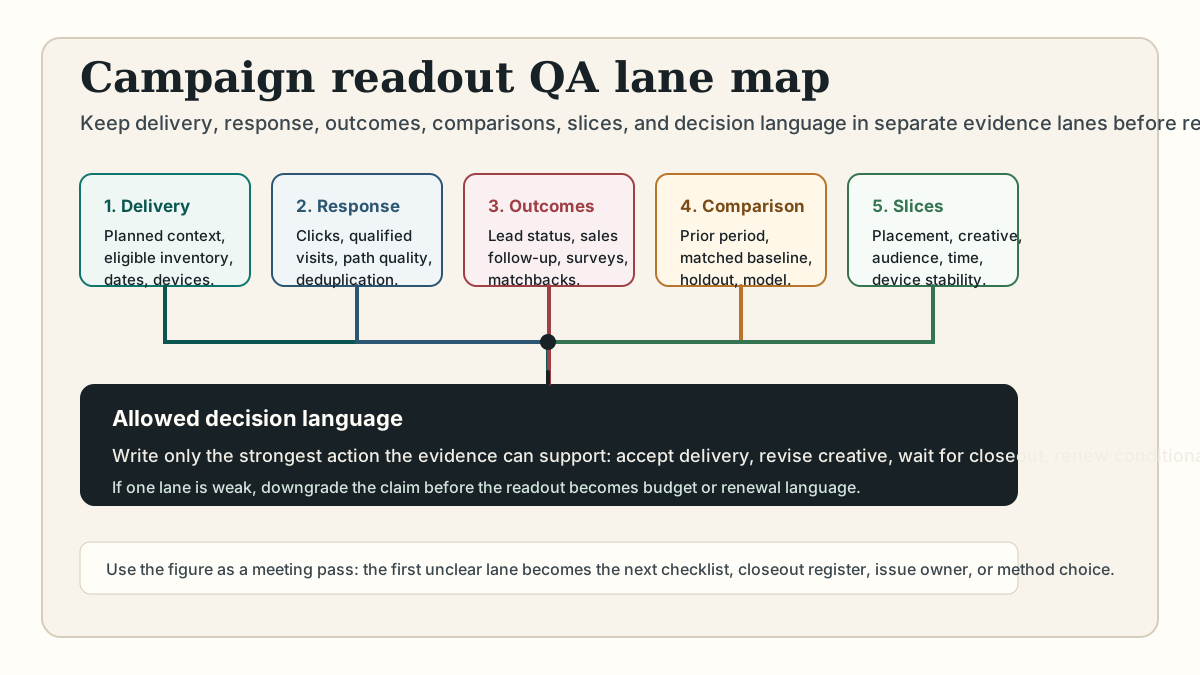
Use the first weak lane in the readout to choose a closeout, baseline, issue, memo, or next-test workflow before renewal language becomes stronger than the evidence.
WorkflowFollow the report workflowMove from delivery, response quality, outcomes, comparison strength, and renewal language into the right next action.
CloseoutWait for mature outcome fieldsUse when lead status, matchbacks, attribution windows, survey returns, or sales follow-up are still aging.
BaselineCheck the comparisonUse when prior periods, matched contexts, holdouts, model baselines, or expected demand are doing the persuasive work.
Issue registerAssign unresolved evidence lanesUse when exclusions, missing fields, owners, retest rules, and claim boundaries need to survive the meeting.
MemoWrite renew, revise, retest, or holdUse when the team needs final decision language that separates what happened from what should happen next.
Next testChoose a stronger evidence designUse when attributed or matched outcomes are not strong enough for budget expansion or causal language.