Buyer readiness
Private marketplace renewal scorecard
Organization byline: Measurement Press editorial desk. This page does not list an individual author or reviewer. Read the editorial method and corrections policy.
About 10 min read
A private marketplace renewal should not be decided by the single strongest chart in the campaign report. The better question is whether the package delivered the intended reader context, produced useful response, preserved enough fields to explain the result, and now deserves renewal, revision, or a stronger test.
Use this scorecard after the readout export is assembled and before a renewal recommendation is written. It is built for contextual display, clearly labeled native placements, and sponsorship packages where clean package evidence matters as much as raw response.
Picture a renewal call where the buyer saw strong engaged sessions, the publisher protected the intended article set, and the sales team still marked half the leads as not ready. A useful scorecard does not ask whether the campaign can be made to look successful. It asks which part of the next decision is earned: renew the same package, revise the creative or destination, retest the context, or design a stronger comparison before budget moves.
Primary sources and scope
This scorecard uses Google Ad Manager documentation for platform terms and delivery boundaries a buyer or publisher can verify. Google defines Private Marketplace deals as non-guaranteed Preferred Deals or Private Auctions, identifies Deal ID as the system-generated identifier for a buyer-publisher deal in reporting, and notes that competing demand or setup issues can affect Private Auction delivery. Those sources establish the vocabulary and mechanics; they do not validate the fictional package rows or prove response, efficiency, or incrementality in the examples below.
- Google Ad Manager: About Private Marketplace deals — defines Preferred Deals and Private Auctions as non-guaranteed PMP deal types.
- Google Ad Manager: Deal ID — documents the report field used to identify a deal between a buyer and publisher.
- Google Ad Manager: Private Auction troubleshooting — explains that competing sources and technical or setup issues can change which deal fills an ad request.
How the sources change the renewal decision
| Source finding | Scorecard consequence | What remains unproven |
|---|---|---|
| Private Marketplace deal types are non-guaranteed, and Deal ID identifies the transaction in reporting. | Require Deal ID, deal type, package scope, and eligible placement rows before scoring context delivery. | A deal identifier does not show that the intended inventory filled or that the buyer received incremental value. |
| Private Auction troubleshooting attributes underdelivery to competing sources or technical/setup issues that can change which source fills a request. | Route a weak delivery score to a delivery exception or rebrief before interpreting outcome metrics. | Observed underdelivery does not by itself show weak audience fit, and delivery alone does not prove efficiency. |
| Report dimensions expose counting-method and measurement-source constraints, while key-value reporting can overlap or require targeted metrics. | Keep report configuration, measurement source, key definitions, and lane grain attached to the scorecard. | A clean scorecard cannot turn configuration-dependent delivery fields into a causal comparison. |
Boundary: the scorecard can support a bounded renew, revise, retest, or pause action. It cannot certify a fictional package, infer lift from descriptive rows, or generalize a decision beyond the observed population and window.

Renewal decision lanes
Start by naming the decision lane. A readout that can support a creative change may not support a budget increase, and a readout that can support a renewal may still need a separate lift test before stronger performance language is used.
| Decision lane | Use when | Required evidence | Decision boundary |
|---|---|---|---|
| Renew package | The context delivered as planned and response quality met the buyer's stated goal. | Package ID, eligible placements, device mix, traffic quality, outcome status, and comparison rule. | Renew the same or narrower package without claiming incremental lift. |
| Revise creative | The context was right, but message, format, destination, or offer quality limited response. | Creative size, message theme, landing page, qualified visit rate, lead status, and uneven-rotation notes. | Change creative or destination before judging the media context. |
| Shift mix | Some contexts, placements, or devices performed differently enough to guide allocation. | Minimum delivery thresholds, device-separated rows, viewability, frequency, and quality flags. | Shift only among cells with enough comparable delivery. |
| Add lift test | The next decision needs causal language rather than descriptive response. | Primary outcome, holdout option, leakage risk, minimum detectable effect, and outcome window. | Do not use the descriptive readout as proof of incremental impact. |
| Pause or rebrief | The campaign missed context, field completeness, destination fit, or measurement readiness. | Delivery exceptions, missing fields, destination mismatch, incomplete status, or no agreed primary signal. | Fix the brief or package definition before another flight. |
Scorecard dimensions
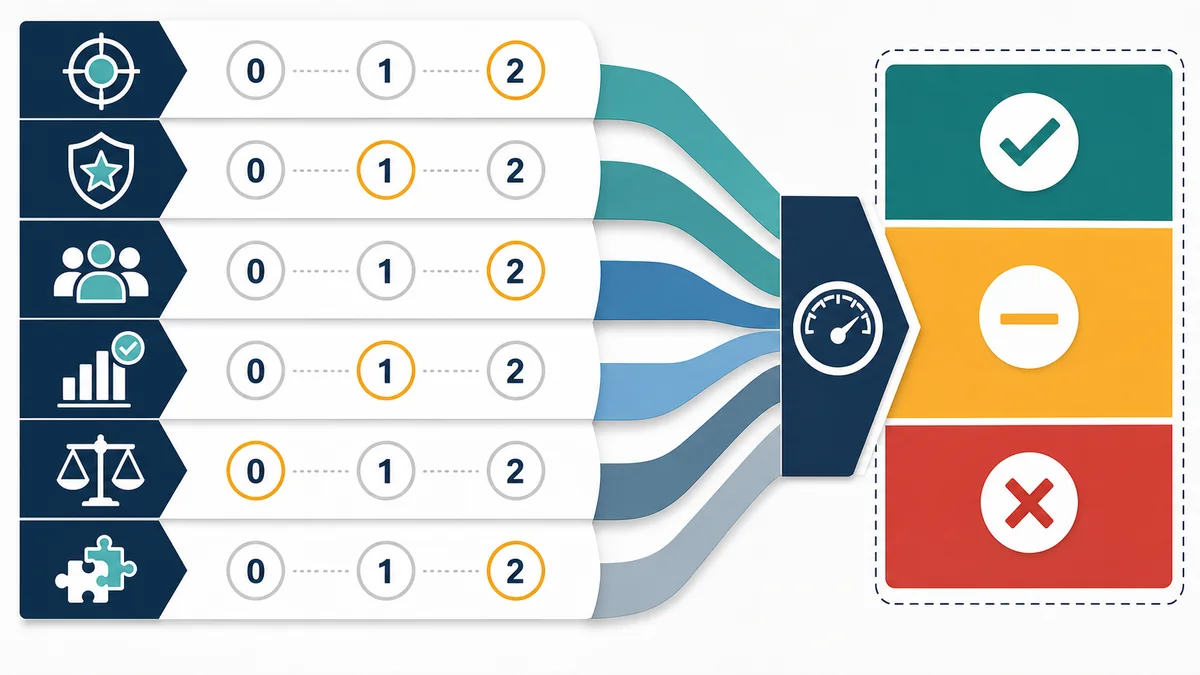
Score each dimension from 0 to 2. The total is less important than the pattern: a package with clean delivery but weak outcome quality needs a different next step than a package with messy delivery and strong-looking attributed outcomes.
| Dimension | 0 points | 1 point | 2 points |
|---|---|---|---|
| Context delivery | Package, page group, or placement delivery was unclear or missed the agreed context. | Most delivery matched the package, with some exceptions or pooling. | Delivery matched the agreed package, placement IDs, device scope, and exclusions. |
| Exposure quality | Measurability, viewability, invalid-traffic review, or frequency was missing. | Exposure quality was reported but not separated by device, placement, or creative. | Exposure quality was visible by placement, device, creative size, and week where relevant. |
| Traffic quality | Clicks or visits were reported without engagement, duplicate, geography, or invalid-traffic checks. | Qualified visits were defined, but destination or device differences remained unresolved. | Qualified visits, destination behavior, return activity, and quality filters were visible. |
| Outcome quality | Raw forms, matches, or conversions were treated as the outcome. | Lead or outcome status was available for part of the campaign. | Qualified, disqualified, missing, and follow-up status were separated before conclusions. |
| Comparison strength | No baseline or comparison was named. | A prior flight, matched context, or directional baseline was used with limits. | A protected holdout, matched-market design, or preplanned comparison was visible. |
| Decision fit | The recommendation was broader than the evidence. | The recommendation matched part of the evidence but left key limits implicit. | The recommendation named the package, creative, mix, or test decision the evidence can support. |
Decision bands
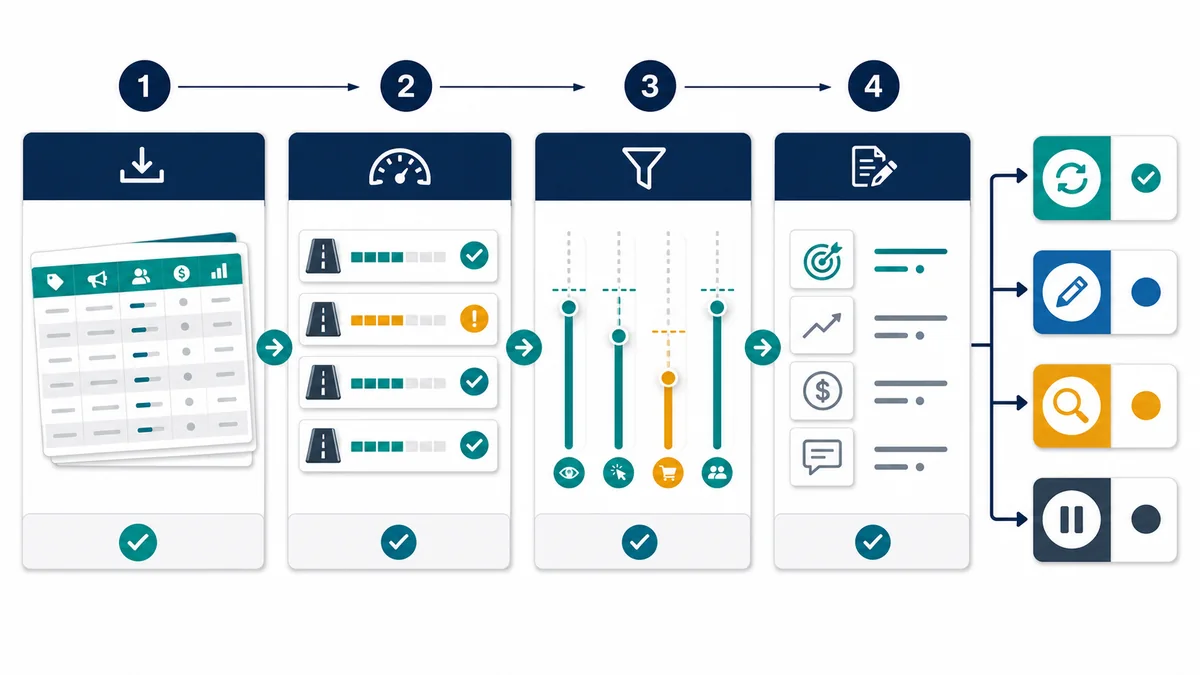
Use the band as a starting point, then read the low-scoring dimensions before recommending action. A high total with a zero in comparison strength still should not become a lift claim.
| Total score | Decision band | Best next action | Readout language |
|---|---|---|---|
| 10-12 | Renew or scale carefully | Renew the package, preserve winning contexts, and add a designed comparison if budget language needs to get stronger. | The package produced strong observed response under the reported context and quality controls. |
| 7-9 | Renew with changes | Renew a narrower package, change creative or destination, and set stricter readout rules for the next flight. | The campaign supports a focused renewal or optimization, with named limits. |
| 4-6 | Retest before renewal | Run a smaller rebriefed flight with clearer context, field completeness, and comparison rules. | The readout is directional and not enough for a confident renewal. |
| 0-3 | Pause or rebuild | Fix package definition, trafficking, destination fit, or measurement handoff before buying again. | The report does not support a renewal decision beyond operational learning. |
Evidence ceiling map
The first weak lane sets the ceiling for the recommendation. This keeps a legitimate renewal from turning into an unsupported performance claim, and it keeps a weak operational record from being judged as a weak audience context.
| Evidence pattern | First weak lane | Decision ceiling | Better next step |
|---|---|---|---|
| Context and exposure were clean, but outcome status is incomplete. | Outcome quality | Renew only with a lead-status handoff condition. | Require qualified, disqualified, pending, and no-follow-up fields before the next readout. |
| Observed outcomes look strong, but there was no holdout or credible baseline. | Comparison strength | Use descriptive renewal language, not lift language. | Renew a bounded package and design a matched baseline or holdout if budget is increasing. |
| Traffic quality looks strong, but viewability, frequency, or device mix is pooled. | Exposure quality | Do not call the context efficient yet. | Separate device, placement, frequency, and viewability rows before shifting mix. |
| Delivery missed the agreed desk, article set, placement, or geography. | Context delivery | Pause performance conclusions. | Close the delivery issue, request corrected rows or makegood terms, and rebrief the package. |
| Every quality lane is strong, but the next decision needs a budget increase. | Decision fit | Renew carefully; do not scale beyond the tested context. | Name the exact package cells that earned renewal and add test design before broader budget language. |
Worked renewal sheet
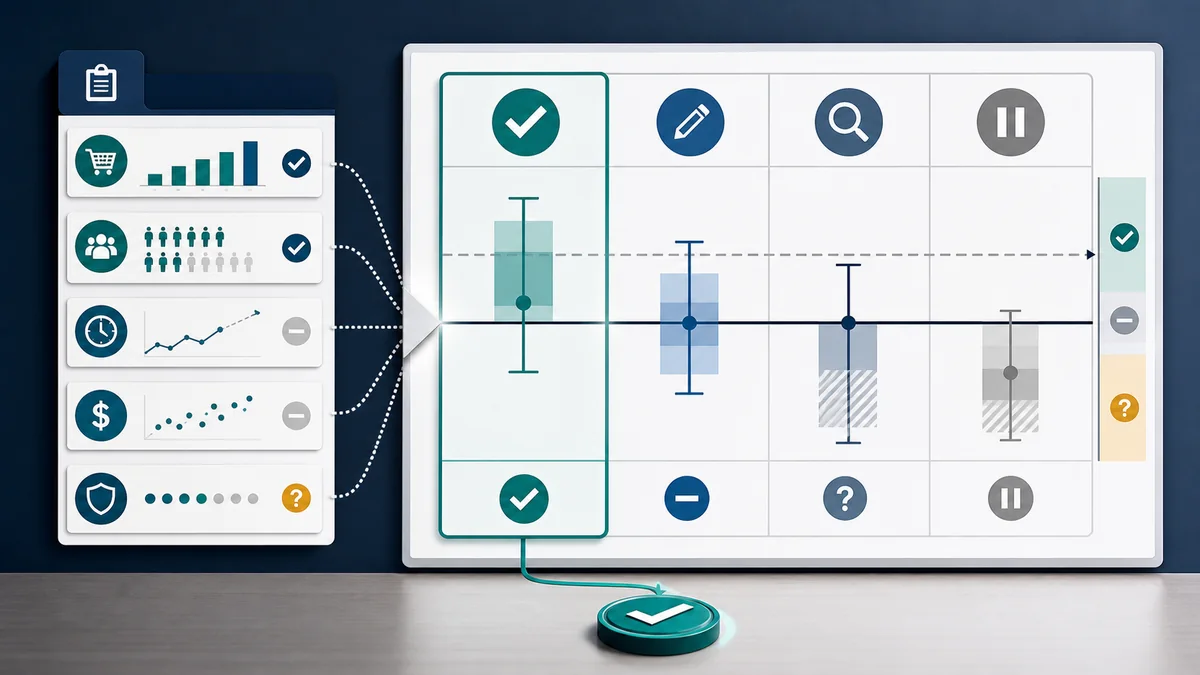
This example shows how a buyer can convert export rows into a decision without overstating the evidence. The numbers are example scoring values, not performance benchmarks.
| Package | Context | Delivery | Exposure | Traffic | Outcomes | Comparison | Decision fit | Action |
|---|---|---|---|---|---|---|---|---|
| measurement-science-desk | Method selector and campaign QA guides. | 2 | 2 | 2 | 1 | 1 | 2 | Renew with better outcome-status handoff and a matched baseline. |
| buyer-readiness | Media kit, audience intent, and inventory readiness pages. | 2 | 1 | 1 | 1 | 0 | 1 | Retest with device-separated goals and one primary destination. |
| guide-library | Checklist pages with clearly labeled native card. | 1 | 1 | 2 | 0 | 0 | 1 | Do not renew as sold; rebrief around lead-quality fields. |
Simulated worked example: reproduce the action band
This is a Simulated Worked Example, not a real buyer, publisher, or campaign record. The values are invented ordinal scores used to show the arithmetic and the claim boundary. Replace them with governed export rows before making a renewal recommendation.
| Package | Six-lane total | Maximum | Share of maximum | Lowest lane | Bounded action |
|---|---|---|---|---|---|
| measurement-science-desk | 10 | 12 | 10 / 12 = 83.3% | Outcome quality and comparison strength: 1 each | Renew with better outcome-status handoff and a matched baseline. |
| buyer-readiness | 6 | 12 | 6 / 12 = 50.0% | Comparison strength: 0 | Retest with device-separated goals and one primary destination. |
| guide-library | 5 | 12 | 5 / 12 = 41.7% | Outcome quality and comparison strength: 0 | Rebrief around lead-quality fields before another flight. |
Reproduction: the row totals are 2+2+2+1+1+2 = 10, 2+1+1+1+0+1 = 6, and 1+1+2+0+0+1 = 5. Across the three rows, 21 of 36 possible points are present (21 / 36 = 58.3%). Comparison strength is zero in 2 of 3 rows (66.7%), so the example can support a bounded descriptive renewal discussion but not a lift claim. The lowest lane, not the average, sets the wording ceiling.
Assumptions and limitations: each fictional row is scored once for the same reporting window, every dimension is an ordinal 0-to-2 review judgment, and the package labels are illustrative. The scores are not probabilities, performance benchmarks, or a forecast; they contain no spend, revenue, delivery volume, uncertainty interval, randomized holdout, or protected counterfactual. A real renewal requires the actual Deal ID, package and placement rows, device and exposure-quality fields, outcome-status definitions, and a comparison design appropriate to the decision.
Renewal meeting questions
- Which package, placement, device, and creative rows explain the recommendation?
- Did the campaign deliver the reader context that justified the buy?
- Which quality flag would most change the conclusion if corrected?
- Are we renewing a context, a creative approach, a destination, or a measurement design?
- What evidence would be needed before the next report can use lift language?
Pair with
Use this scorecard with the private marketplace readiness index for the full sequence from audience fit to renewal, the contextual package proof sheet and private marketplace package brief template for the pre-launch renewal rule, the private marketplace deal review checklist for the activation approval record, the ad yield and deal-readiness checklist for floor, sell-through, refresh, and package-readiness inputs, the private marketplace readout export sample for row structure, the private marketplace campaign walkthrough for a full package-to-renewal example, the private marketplace package performance readout for buyer-ready package language, the campaign issue log and renewal register when low-scoring lanes need owners, due dates, retest rules, and claim boundaries, the campaign renewal memo template when the final action needs bounded renew, revise, retest, or hold wording, the campaign renewal evidence archive when scorecard decisions need to carry forward across flights, the campaign renewal archive follow-up fields when archived conditions need owner actions and next-launch gates, the campaign status-window closeout checklist when delayed outcomes must mature before scoring final action, the campaign status-window closeout register when closeout rows need to travel with the scorecard, the campaign reporting worksheet for the meeting-ready evidence note, the private marketplace reporting field dictionary for stable field names, the private marketplace campaign measurement checklist before launch, the campaign readout QA checklist before budget decisions, the outcome quality scorecard when leads or matched outcomes are part of the recommendation, the incrementality test plan template when the next flight needs causal evidence, and the media kit for package and placement definitions.