Campaign reporting
Campaign renewal evidence archive template
Organization byline: Measurement Press editorial desk. This page does not list an individual author or reviewer. Read the editorial method and corrections policy.
About 13 min read
A renewal decision is easier to overstate after the meeting than during it. An evidence archive keeps the final action, excluded rows, unresolved issues, and next-test requirements attached to the campaign record.
Use this template after the renewal memo is approved. It is built for contextual display, sponsorship, and private marketplace packages where the next flight may inherit assumptions from the prior readout. The goal is a compact decision record that a buyer, seller, analyst, or operations lead can reopen before the next launch.
Reader outcomeBy the end, you should be able to reopen a renewal decision and answer three questions quickly: what evidence supported the action, what was deliberately left out, and what must be true before the next flight earns stronger language.
Page boundaryUse this page when the decision is already approved and the team needs a durable record for the next flight. Draft the recommendation in the renewal memo; preserve its final action here with the included and excluded rows, issue states, comparison rule, and follow-up gate that another team must be able to reopen.

What the archive protects
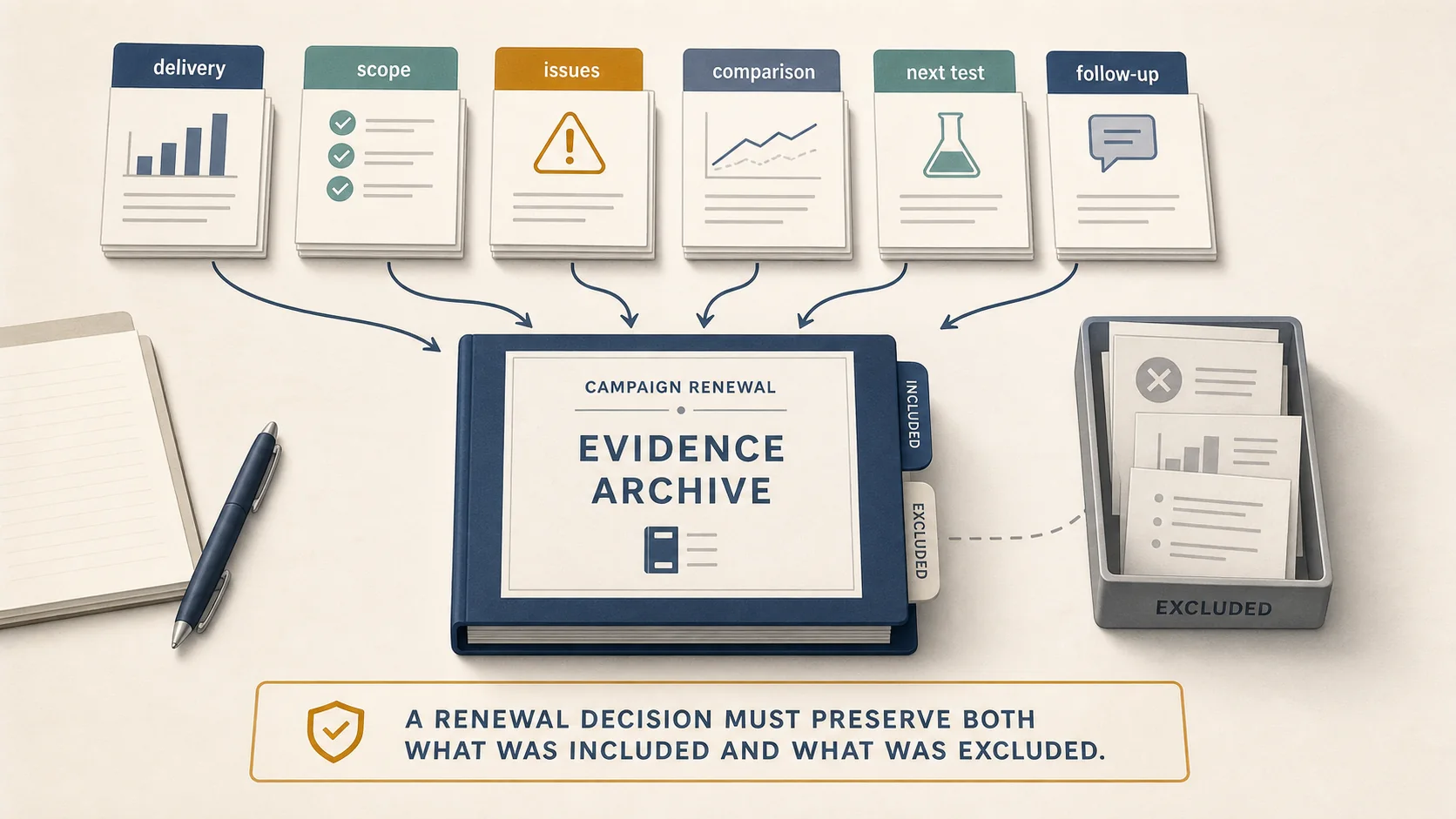
The archive is not a second report. It is the record that prevents a bounded renewal decision from turning into a broader claim after the campaign team moves on.
| Risk after the memo | What gets lost | Archive control |
|---|---|---|
| Decision drift | A renew-with-changes decision becomes a scale recommendation. | Store the exact final action and the condition that must hold before the next flight. |
| Scope creep | The verified package gets mixed with pooled placements, devices, or dates. | Separate included rows, excluded rows, and rows carried forward only for diagnosis. |
| Issue recurrence | The same destination, routing, status, or field gap returns in the next campaign. | Carry issue IDs, owner names, closeout states, and due dates into the next launch checklist. |
| Comparison inflation | A prior-period or attributed result is repeated later as lift. | Record the comparison rule and the strongest claim language allowed by that rule. |
| Retest delay | A needed holdout, matched baseline, or minimum-cell rule is remembered only after launch. | Archive the next-test requirement before the next brief is approved. |
| Follow-up ambiguity | No one knows when missing outcome status, repaired pages, or next-flight results should be reviewed. | Assign a follow-up date, owner, required evidence, and decision meeting. |
Archive record fields
A useful archive should fit on one page while preserving enough detail to challenge a future claim. These fields are the minimum record.
Archive ID
A stable ID that connects the campaign, package, decision date, and renewal memo.
Flight scope
Campaign ID, package ID, deal key when relevant, placement IDs, creative IDs, device classes, dates, and destination IDs.
Final decision
Renew same scope, renew narrower scope, revise, retest, add causal test, hold, or rebrief.
Evidence included
The delivery, exposure, traffic, outcome, and comparison rows used for the final action.
Evidence excluded
Rows removed because they were pooled, incomplete, off-scope, low volume, unresolved, or not comparable.
Issue IDs
The weak-lane IDs, closeout states, owners, due dates, and retest rules from the issue register.
Claim boundary
The final allowed sentence and the stronger sentence that remains unavailable until better evidence exists.
Next-test requirement
The holdout, matched baseline, minimum-cell rule, outcome-status threshold, or page repair required before stronger action.
Follow-up record
The date, owner, required fields, and meeting where the archived condition will be reviewed.
Export column set
If the archive is exported from a reporting workbook or campaign system, keep decision fields beside evidence fields. That makes later reuse harder to detach from the original limits.
| Column | Sample value | Why it matters | Do not use it to claim |
|---|---|---|---|
| archive_id | renewal-2026-q3-methods-01 | Connects the memo, readout, issue register, and next brief. | That the record is complete without the supporting fields. |
| final_decision | renew narrower package | Keeps the action visible before anyone reads the supporting charts. | That the full campaign should scale. |
| included_scope | verified guide placements, desktop and tablet rows, approved creative set | Names the evidence that actually supports the decision. | That excluded mobile or pooled rows performed the same way. |
| excluded_rows | pooled low-volume placements; mobile destination repair row | Prevents later decks from reusing rows that were removed from the conclusion. | That excluded rows are failures or wins. |
| issue_ids | delivery-01; mobile-page-02; comparison-04 | Connects unresolved conditions to owners and due dates. | That issues are fixed because they were logged. |
| issue_closeout_state | fixed; condition for renewal; causal test required | Shows whether each weak lane is resolved, excluded, conditional, or carried forward. | That all decision risks have the same severity. |
| comparison_rule | prior contextual flight; no protected holdout | Sets the ceiling for final claim language. | Incremental impact. |
| next_test_required | matched baseline and complete qualified-lead status | Turns caveats into the next launch requirement. | That the current result already answered the next test. |
| follow_up_date | 2026-07-15 | Gives the archived condition a review moment. | That the issue can wait indefinitely. |
| final_allowed_claim | The verified scope produced useful observed response under the reported controls. | Provides copy-safe language for the next brief or memo. | Lift, causality, winner status, or all-inventory quality. |
Sample archive rows
These rows show structure only. They do not describe a real advertiser, publisher, platform, or campaign.
| Archive ID | Package scope | Final decision | Excluded rows | Open issue IDs | Next requirement | Follow-up | Allowed claim |
|---|---|---|---|---|---|---|---|
| renewal-methods-01 | Measurement guide placements, approved creative, desktop and tablet rows. | Renew narrower package. | Mobile destination rows and two pooled placements. | mobile-page-02; comparison-04 | Repair mobile page and reserve matched baseline. | Review before next launch. | The verified guide scope produced useful observed response. |
| renewal-readiness-02 | Buyer-readiness package, native card and leaderboard rows, one destination. | Revise before scale. | Creative version with uneven rotation. | creative-03; lead-status-05 | Relaunch with balanced creative rotation and complete lead status. | Review after status window closes. | The package supports a repair-and-retest decision. |
| renewal-reporting-03 | Campaign reporting articles, inline units, approved source-trail fields. | Add causal test. | No rows excluded; all evidence remains descriptive. | comparison-01 | Define holdout or matched-market design before lift wording. | Review during next measurement brief. | The flight produced observed response, not proven incremental impact. |
| renewal-context-04 | Contextual package with complete delivery and outcome-status fields. | Renew same scope with monitoring. | Low-delivery diagnostic slice. | slice-02 | Preserve minimum-cell thresholds and report slice separately. | Review at mid-flight and readout. | The scoped package supports renewal under the current controls. |
Archive handoff gate
A complete-looking archive can still be unsafe to reuse if one missing field changes the meaning of the renewal decision. Before the record is attached to a new brief, score the handoff fields and apply a hard hold to missing scope or comparison rules.
This is a Simulated Worked Example, not a campaign result. The packet below is fictional. It tests whether the record is reusable; it does not score delivery, response, lift, or campaign quality.
| Handoff check | Packet state | Score | Why it matters |
|---|---|---|---|
| Stable archive and campaign IDs | Present | 1 | Connects the memo, export, issue register, and next brief. |
| Included scope and denominator | Present | 1 | Defines the rows that can support the archived action. |
| Excluded rows with reasons | Present | 1 | Stops later readers from silently adding pooled or unresolved rows. |
| Issue owners, states, and due dates | Present | 1 | Turns open risks into trackable follow-up work. |
| Comparison rule and claim ceiling | Present | 1 | Prevents a descriptive comparison from becoming an unsupported lift claim. |
| Next-test or launch requirement | Present | 1 | States what must be true before stronger language or broader scope. |
| Outcome-status close date and reviewer | Missing | 0 | Leaves delayed outcomes open and makes the final decision difficult to reproduce. |
Reproduction: add the seven binary scores: 1 + 1 + 1 + 1 + 1 + 1 + 0 = 6. Divide by seven checks: 6 / 7 x 100 = 85.7%. The packet is Revise before renewal, not ready for automatic reuse, because the missing outcome close date is a critical handoff field. If included scope, denominator, or comparison rule is missing, use Hold regardless of the percentage.
Claim ceiling: the archive is documentation-ready for a bounded renewal discussion after the outcome window and reviewer are recorded. It does not show that the campaign performed well, caused an outcome, or should scale. Re-score after the missing field is closed and preserve the prior score so the change is auditable.
Simulated Worked Example: preserve the comparison boundary
This is a Simulated Worked Example, not a campaign result. The figures are fictional and show how an archive can preserve a descriptive comparison without upgrading it to lift. Replace them with the campaign export, documented scope, and closed outcome window before using the method.
Assume the archive contains two equally sized, comparable scopes after exclusions. The current flight has 63 qualified leads from 10,000 eligible impressions; the prior comparable flight has 54 qualified leads from 10,000 eligible impressions.
| Archive calculation | Formula | Result | Decision reading |
|---|---|---|---|
| Current qualified-lead rate | 63 / 10,000 | 0.63% | Observed response in the verified current scope. |
| Prior qualified-lead rate | 54 / 10,000 | 0.54% | Descriptive comparator for the same stated denominator. |
| Absolute difference | 0.63% - 0.54% | +0.09 percentage points | The current scope is higher on this comparison. |
| Relative difference | (0.63% - 0.54%) / 0.54% | +16.67% | Useful context, not proof of incremental impact. |
Archive decisionRenew the verified scope with monitoring, archive the excluded rows separately, and keep the allowed claim at “the verified scope showed a 0.09 percentage-point higher qualified-lead rate than the stated prior comparison.” Do not write “the campaign drove 16.67% lift” because this comparison has no randomized holdout or other causal design.
Assumptions and limits: the two denominators use the same qualified-lead definition, scope, attribution window, and outcome-status rule; the 10,000-impression denominator excludes the same kinds of rows; and the example does not calculate uncertainty or statistical significance. A holdout, matched-market design, or other controlled experiment could change the decision ceiling, while a scope mismatch, incomplete status window, or definition change would invalidate this comparison.
Primary source trail for the archive boundary
These first-party references support the archive's field and claim rules. Google explains that conversion tracking connects ad interactions to defined actions, and that advertisers should choose the conversion type they want to track; Analytics documents event parameters as the context needed to analyze an interaction. For stronger causal language, Google describes experiments as comparisons between original and experiment traffic and Conversion Lift as a controlled treatment-and-control design.
Source check for this edition: The linked Google documentation was re-read for this source trail. It supports preserving conversion definitions, event context, experiment scope, and treatment/control requirements; it does not verify this page's fictional archive rows, prove that an attributed conversion was caused by a campaign, or make a prior-period comparison an experiment.
- Google Ads: Conversion tracking definition - defines a conversion as a tracked action following an ad interaction.
- Google Ads: Different ways to track conversions - separates conversion types and recommends choosing what to track before setup.
- Google Analytics: Event parameters - explains how additional event context supports analysis and reporting.
- Google Ads: About the Experiments page - describes comparing original and experiment traffic over a defined period.
- Google Ads: About Conversion Lift - describes controlled treatment-and-control measurement for incremental conversions.
Source boundary: what belongs in the archive
| Source establishes | Archive action | It does not establish |
|---|---|---|
| Google Ads defines conversions as tracked actions and separates conversion types. | Record the conversion action, type, status definition, and scope used in the archived decision. | That a tracked or attributed conversion was caused by the campaign or is incremental. |
| Google Analytics event parameters add context to an interaction. | Preserve the event parameters, row grain, and export version needed to reopen the evidence. | That missing, changed, or poorly validated parameters make the underlying result reliable. |
| Google Ads experiments compare an original campaign with an experiment over a defined period. | Archive the hypothesis, changed variable, comparison scope, dates, and preselected metrics when a test exists. | That a prior-period comparison in this archive was an experiment. |
| Conversion Lift uses controlled treatment and control groups to estimate incremental conversions. | Keep lift language unavailable unless the archived record contains the completed controlled study and its limits. | That every account or campaign is eligible, or that this archive contains a lift result. |
Carry-forward rules
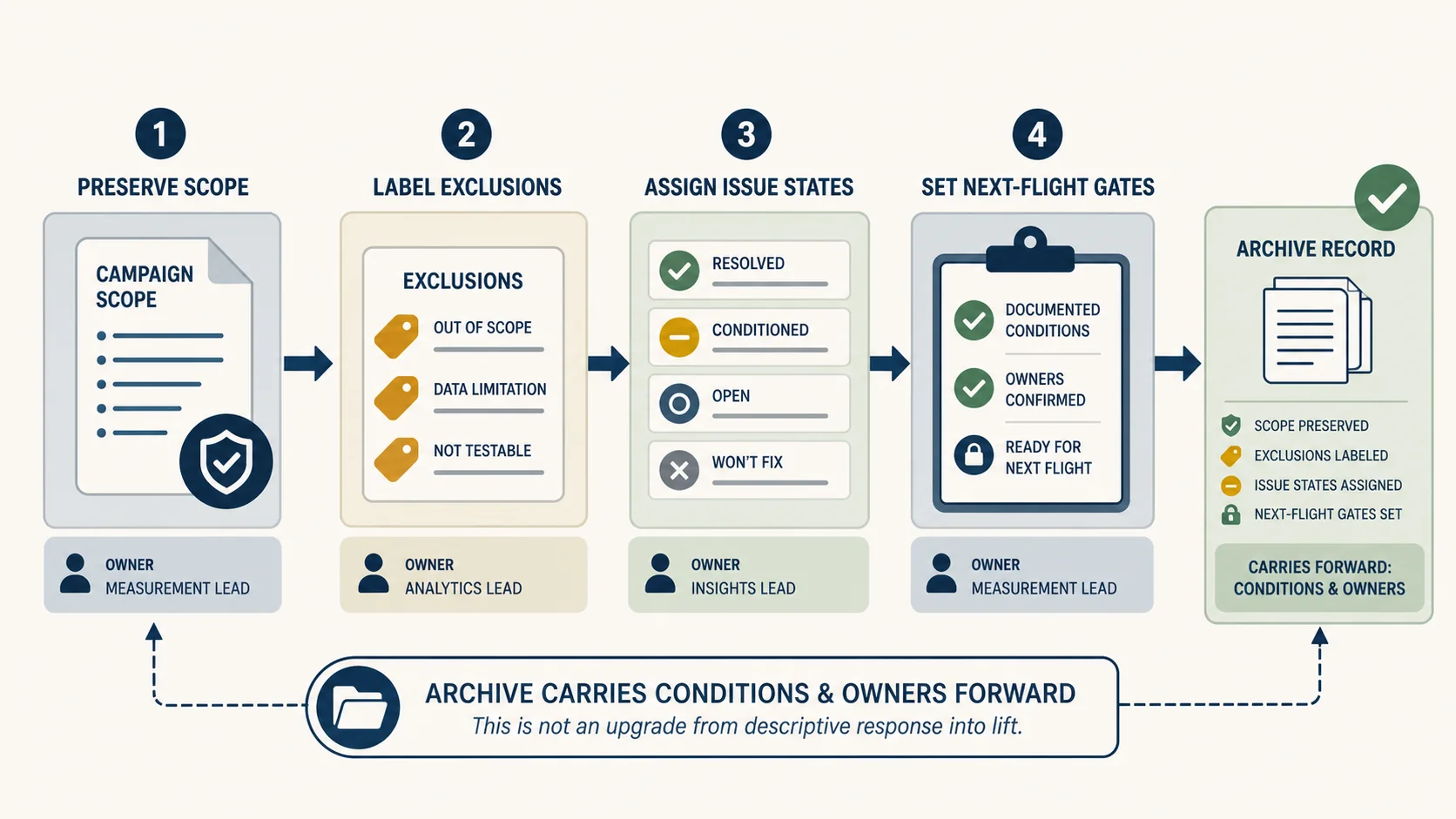
The archive should tell the next team what must move forward and what must stay in the past. Different closeout states need different treatment.
| Archive state | Carry forward to next brief | Keep out of the next claim |
|---|---|---|
| Fixed before decision | The repaired field, page, routing step, or trafficking note as a launch requirement. | The pre-fix result as proof that the issue never mattered. |
| Excluded from decision | The excluded row labels and why they were removed. | The excluded response total, unless the next readout reports it separately. |
| Condition for renewal | The owner, due date, field threshold, and launch gate. | A renewal claim that assumes the condition was already met. |
| Retest required | Minimum delivery, cell balance, creative rotation, and outcome-status rules. | A budget shift based only on the fragile cell. |
| Causal test required | The holdout, matched baseline, suppression, leakage, and outcome-window requirements. | Lift language from the descriptive readout. |
| Watch item | The threshold that will turn the issue into a decision limit. | A weak warning that dismisses otherwise useful evidence. |
Archive closeout note
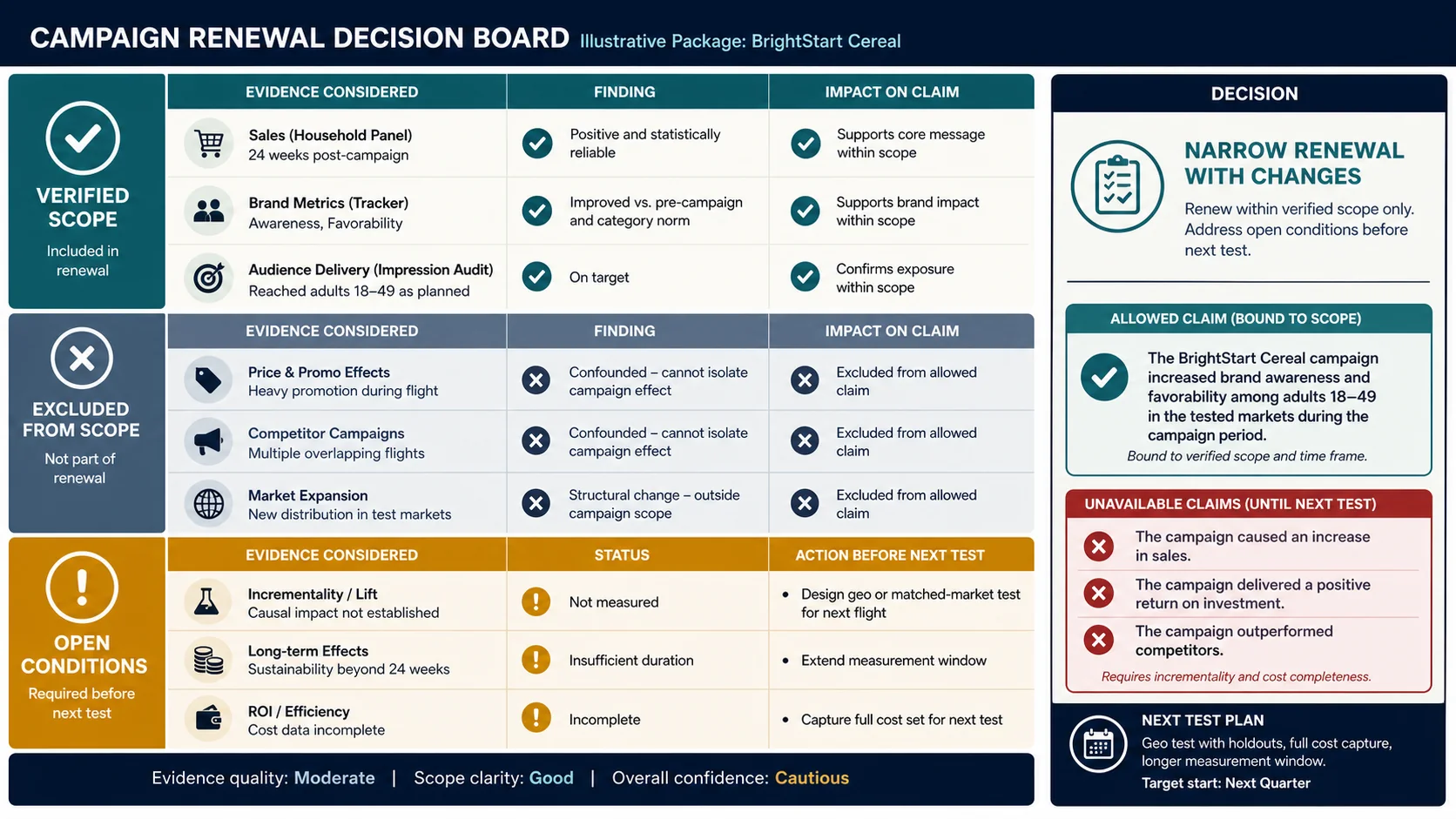
Close every renewal with a note that can be reused in the next brief without upgrading the claim.
Recommended structureArchive the renewal decision as [final action] for [included scope]. Exclude [row labels] from the renewal claim because [reason]. Carry forward [issue IDs] as [fixed, condition, retest, or causal-test state] with [owner] due by [date]. The allowed claim is [bounded sentence]. The unavailable claim is [stronger sentence] until [next evidence requirement] is complete.
Turn archive conditions into launch gates
Every unresolved archive condition needs a status, a review moment, and a decision effect. Keep these controls beside the evidence so a later brief cannot silently upgrade an open row into a general renewal claim.
| Status | Decision effect |
|---|---|
| Open or evidence due | Assign an owner, proof source, and due date before the next brief is approved. |
| Fixed pending QA | Launch only with an explicit exception and reviewer checkpoint. |
| Ready for launch | Use only the verified scope for the next-flight decision. |
| Readout due | Keep outcome, matchback, or survey claims open until the status window closes. |
| Blocking | Hold, narrow, or rebrief when the missing evidence would make the next decision uninterpretable. |
Checkpoint sequence: before the next brief, activation, mid-flight, status-window close, and readout meeting. At each point update the affected scope, proof, reviewer, issue state, allowed claim, unavailable claim, and next requirement.
Choose the action: launch as planned when blocking rows are closed; launch narrower scope when only some contexts are verified; launch with monitoring when live or delayed evidence is still needed; or hold and rebrief when the missing condition changes interpretation.
Pre-launch reuse checks
- Does the next campaign brief cite the archive ID before reusing a prior campaign result?
- Are excluded rows still excluded, or have they been repaired and requalified for the new flight?
- Do issue IDs have owners, due dates, and closeout states before launch approval?
- Is the next claim still bounded by the archived comparison rule?
- Has any required holdout, matched baseline, outcome-status threshold, or minimum-cell rule been written into the next measurement plan?
Pair with
Use this archive after the campaign renewal memo template, the campaign issue log and renewal register, and the private marketplace renewal scorecard. Use the follow-up launch-gate sequence on this page to turn archived issue IDs, due dates, next-test requirements, and claim boundaries into next-flight controls. Use the private marketplace readout export sample for row fields, the private marketplace reporting field dictionary for stable column names, the private marketplace package performance readout for buyer-facing package language, the campaign baseline comparison checklist when comparison limits carry forward, the campaign status-window closeout checklist when delayed lead, matchback, attribution, or survey rows need final status, the campaign status-window closeout register when maturity decisions need exportable rows, the outcome quality scorecard when lead or matchback status remains incomplete, and the incrementality test plan template when the archive says causal evidence is still needed.