Campaign measurement
Campaign baseline comparison checklist
Organization byline: Measurement Press editorial desk. This page does not list an individual author or reviewer. Read the editorial method and corrections policy.
About 6 min read
A campaign result is only as useful as the comparison underneath it. Before a report says a campaign drove, lifted, improved, or outperformed, the reader needs to know what baseline it is being compared against.
Use this checklist when a campaign readout, vendor deck, dashboard, or renewal memo turns observed performance into a stronger claim. The goal is to separate clean descriptive reporting from directional evidence and from causal lift language.
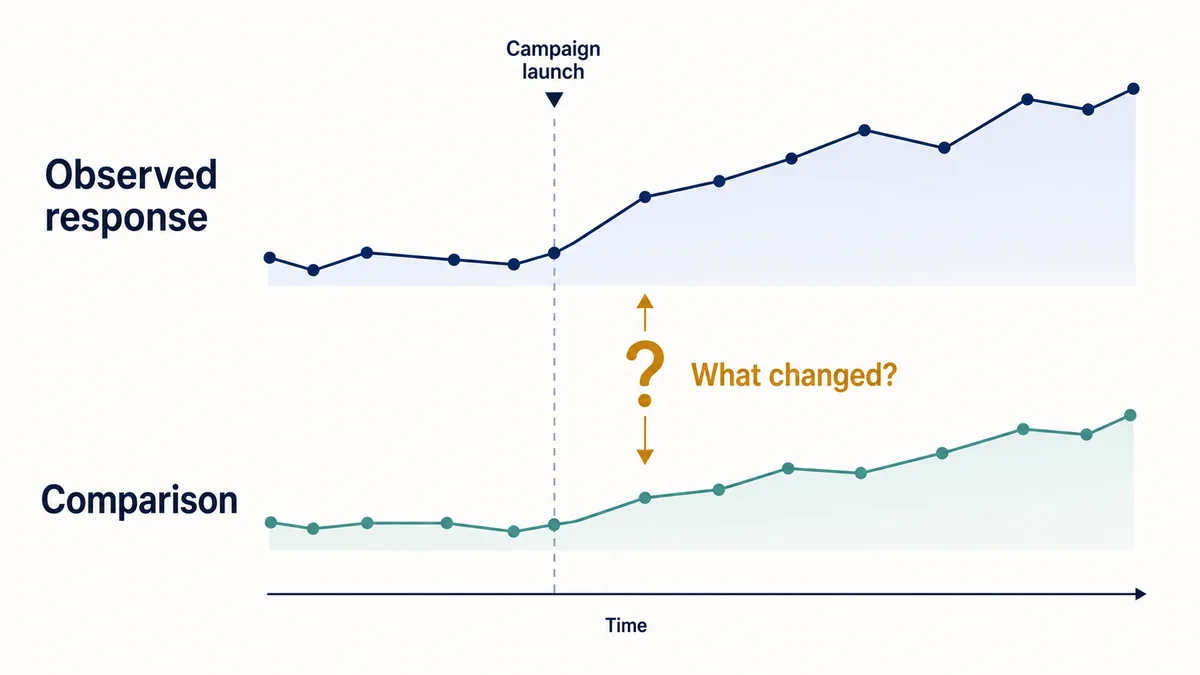 A higher post-launch line is an observation, not a counterfactual. The comparison lane helps the reader ask what would likely have happened without the campaign.
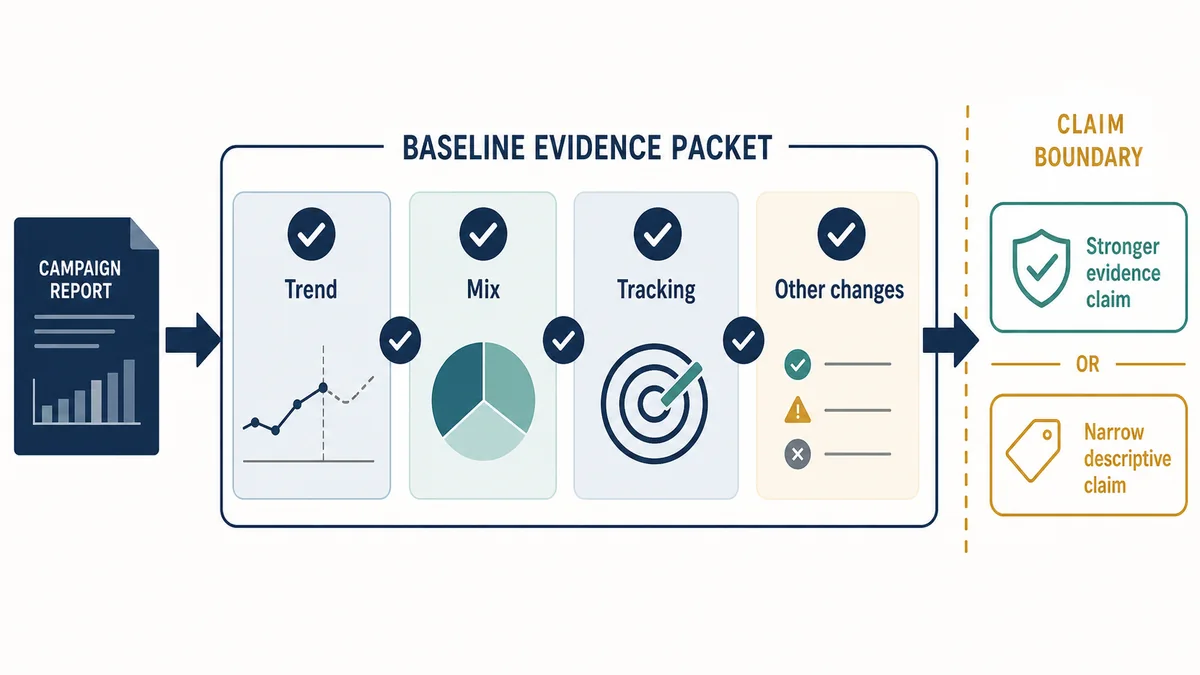
Build the comparison packet
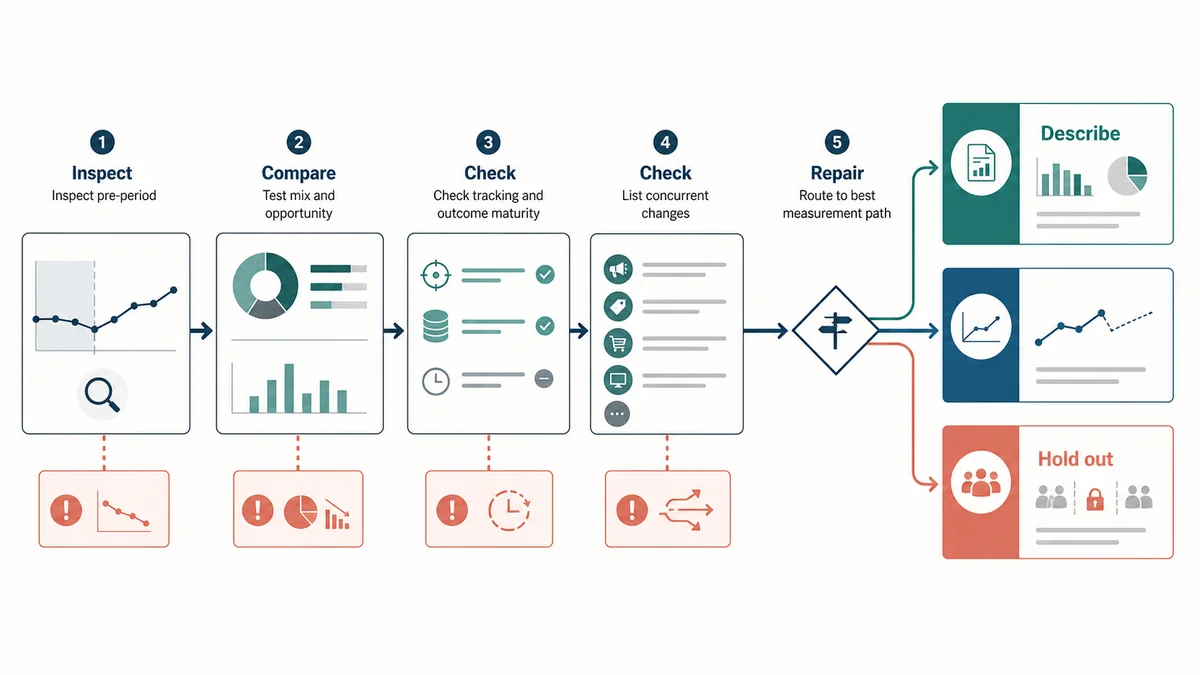
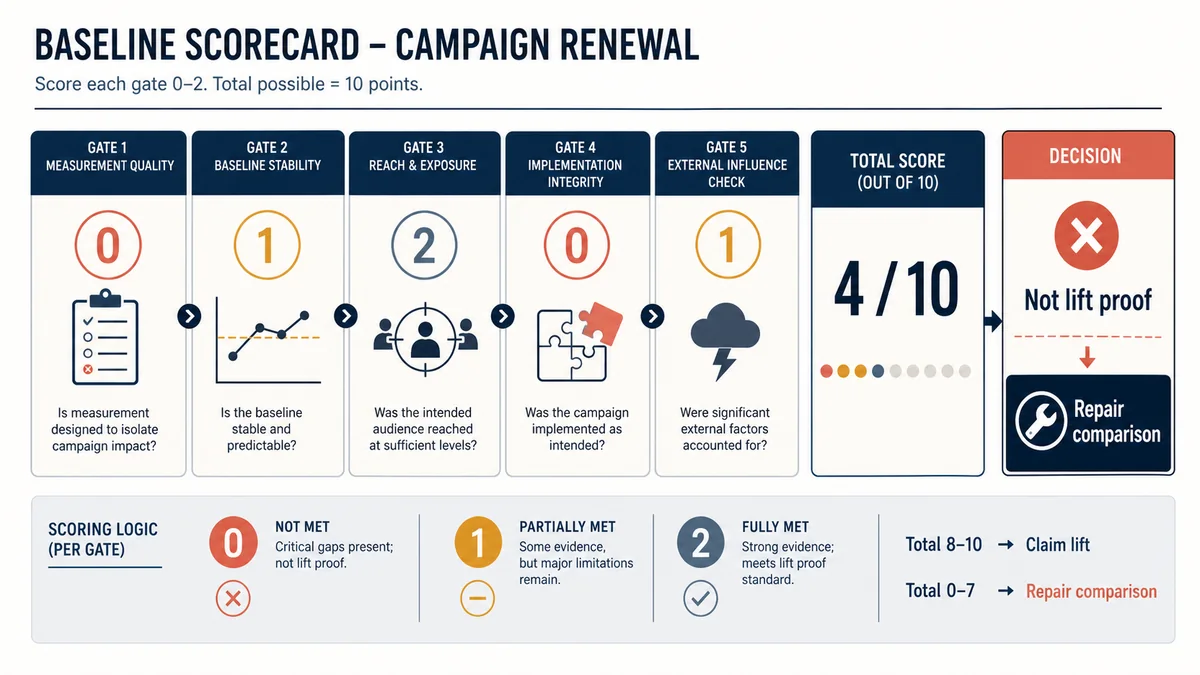
Language by evidence level
The same table can support very different wording depending on the baseline. Keep the conclusion inside the comparison.
| Evidence in hand | Use this language | Avoid this language |
|---|---|---|
| Tracked response only | The campaign produced observed visits, leads, or matched outcomes under the stated tracking rule. | The campaign created new demand. |
| Prior-period comparison | Observed outcomes were higher than the selected prior period, with these known context changes. | The campaign caused the full before-and-after increase. |
| Matched baseline | The campaign outperformed the matched comparison on this outcome, with remaining mix and selection limits. | The matched result proves incremental lift. |
| Protected holdout with leakage checks | The campaign produced measured lift within the design, window, sample, and uncertainty range. | The result will generalize to every future campaign. |
| Model plus calibration evidence | The model and calibration evidence support this planning direction, with stated assumptions and sensitivity. | The model has proven exact channel contribution. |
A simulated baseline comparison
This worked example is simulated, not a report from a real campaign. It shows how a reader can expose the comparison arithmetic before deciding whether "lift" is warranted.
Simulated worked example: stable denominators
Assume two groups each contain 1,000 eligible records. In the pre-period, treatment has 100 conversions (10%) and comparison has 100 (10%). In the post-period, treatment has 120 (12%) and comparison has 110 (11%).
- Treatment change: 12% - 10% = +2 percentage points.
- Comparison change: 11% - 10% = +1 percentage point.
- Difference-in-differences: +2pp - +1pp = +1 percentage point.
- Illustrative adjusted conversions: 1% x 1,000 treatment records = 10 conversions.
Under the narrow assumption that the comparison group is a credible counterfactual and both groups would have followed parallel trends, the adjusted result is 10 conversions. That arithmetic is not, by itself, proof of causal lift: one pre-period does not establish parallel trends, and selection, mix, tracking, concurrent changes, and conversion lag can still move the estimate.
Reproduce the comparison arithmetic
Enter eligible records and conversions for each period. The worksheet calculates treatment change minus comparison change; it does not establish a causal result.
+1.00 percentage pointsTreatment and comparison changes will appear here.
Use matching outcome definitions, eligibility rules, and time windows. The calculation is an arithmetic sensitivity aid; selection, concurrent changes, tracking, conversion lag, and weak pre-period evidence can still invalidate a causal interpretation.
Stress-test the comparison before naming lift
A useful baseline review does not stop at one selected comparison. Hold the treatment numbers constant and vary only the comparison group's post-period result. This sensitivity check shows how much of the conclusion comes from the comparison assumption.
| Simulated comparison post-period | Comparison change | Difference-in-differences | Illustrative adjusted conversions | Decision language |
|---|---|---|---|---|
| 100 / 1,000 (10%) | 0 percentage points | +2 percentage points | 20 | Stronger directional result, still dependent on counterfactual assumptions. |
| 110 / 1,000 (11%) | +1 percentage point | +1 percentage point | 10 | Report the adjusted estimate with the comparison and limitations visible. |
| 120 / 1,000 (12%) | +2 percentage points | 0 percentage points | 0 | Do not call the treatment increase lift; repair the design or use descriptive language. |
Each row uses the same treatment change of +2 percentage points and the same formula: treatment change minus comparison change, multiplied by 1,000 eligible treatment records. The example is not a forecast or a real campaign result. It is a decision aid: if plausible comparison trends move the conclusion from 20 to 0 adjusted conversions, the claim is sensitive and should be held below causal language until the comparison is better supported.
For a controlled study, Google Ads describes Conversion Lift as comparing exposed treatment users with an unexposed control group, while its campaign experiment definition describes comparing an experiment with the original campaign over a specified period. Those designs answer different questions from a simple before-and-after comparison.
Source and timing checks
Do not treat a baseline score as a substitute for study feasibility. Google's Conversion Lift setup guidance says study power depends on historical data, estimated lift, budget, duration, and traffic split; it also notes that smaller holdouts may require longer studies. Separately, Google's conversion-window guidance defines the period in which an interaction can receive conversion credit and warns that a window that is too short can miss later conversions. Record those choices beside the baseline rather than burying them in a footnote. These official definitions were re-read for this source trail; they constrain how this page interprets a comparison, but they do not validate its simulated counts or turn a before-and-after change into causal evidence.
Common baseline traps
- Choosing the weakest prior week, month, or quarter after the campaign result is known.
- Comparing a high-intent campaign audience with all site visitors, all customers, or all reachable households.
- Pooling placements, devices, or creative units when one side had better visibility, lower friction, or stronger destination quality.
- Using attribution-window credit as if it were a comparison group.
- Calling a matched market valid because it is similar in size while pre-period trends point in different directions.
- Ignoring late-arriving conversions, lead disqualification, sales follow-up gaps, or data-lag cutoffs.
- Treating a model baseline as objective without showing controls, calibration evidence, uncertainty, and sensitivity.
Meeting script
- What is the exact baseline used in this readout?
- Was the comparison chosen before results were visible?
- Do treatment and comparison groups align on pre-period level, trend, mix, and tracking quality?
- What changed during the campaign window that could explain the same outcome?
- Which claim survives if attributed outcomes are described as observed response instead of lift?
- Does the next decision need descriptive optimization, a matched baseline, a protected holdout, or a calibrated model?
Pair with
Use this checklist with the campaign readout QA checklist when a finished report needs evidence-level language, the measurement method selector when the question may need a different method, the incrementality test plan template before a causal test is launched, the comparison market and holdout planning guide before selecting markets or controls, the randomized lift test readout checklist when assignment is controlled, the holdout leakage and suppression QA checklist when the control group may have been exposed, the uncertainty interval readout checklist when a point estimate needs a decision range, the outcome quality scorecard before volume becomes a value claim, and the evidence-to-claim language matrix when the final sentence needs safer wording.