Campaign measurement
Outcome quality scorecard for campaign readouts
Organization byline: Measurement Press editorial desk. This page does not list an individual author or reviewer. Read the editorial method and corrections policy.
About 12 min read
Outcome volume is easy to count and easy to overread. A serious campaign readout asks whether the reported outcomes were eligible, deduped, qualified, timely, and tied to a comparison that can support the conclusion.
Use this scorecard before a campaign launches, when a report arrives, or when a buyer and publisher need shared language for what a visit, lead, sale, matchback, or lift result can actually prove.
Source trail for the scorecard boundaries
These first-party references anchor the checks below. Google Analytics defines events as measured interactions, describes event parameters as context for those interactions, and documents attribution as a credit-assignment choice. Google Ads documents conversion windows as a reporting boundary and Conversion Lift as a treatment/control comparison for incremental conversions; its setup guidance also ties study feasibility to conversion actions, budget, duration, traffic split, and conversion lag. Those distinctions are why this scorecard separates counted outcomes, source context, timing, attribution, and causal evidence.
- Google Analytics events for defining the interaction or occurrence being measured.
- Google Analytics event parameters for carrying context such as the interaction location, object, or outcome detail.
- Google Analytics attribution for the difference between assigning credit across a path and proving that an ad caused the outcome.
- Google Ads conversion windows for the time boundary that determines which conversions enter a report.
- Google Ads Conversion Lift for the controlled treatment/control design needed for an incremental-conversion claim.
Source-to-decision handoff
| Source boundary | Retain in the outcome packet | Decision it supports | Claim it does not support alone |
|---|---|---|---|
| GA4 events | The named interaction or occurrence, its counted state, and exclusions. | Describe exactly what was counted and reproduce the denominator. | That the interaction was qualified demand or caused by media. |
| GA4 event parameters | Context fields such as campaign, destination, object, device, and outcome detail. | Inspect eligibility, source completeness, and useful slices without guessing from totals. | That a populated field proves identity, quality, or incrementality. |
| GA4 attribution | The selected attribution model, lookback setting, and path or touchpoint scope. | State how credit was assigned and keep credited outcomes descriptive. | That attributed credit is the same as causal lift. |
| Google Ads conversion windows | Interaction date, conversion window, reporting cutoff, and lag or maturity note. | Decide whether cohorts are complete enough for the requested readout. | That an early or short-window count is final pipeline or revenue. |
| Google Ads Conversion Lift and setup guidance | Treatment/control definition, holdout, study duration, conversion action, lag, and uncertainty. | Bound an incremental claim to the tested population, window, and outcome. | That ordinary attributed outcomes or a post hoc baseline establish lift. |
Verification boundary: these sources document platform concepts and study requirements. They do not validate the simulated rows below, certify a real export, or choose a universal quality threshold for every business.
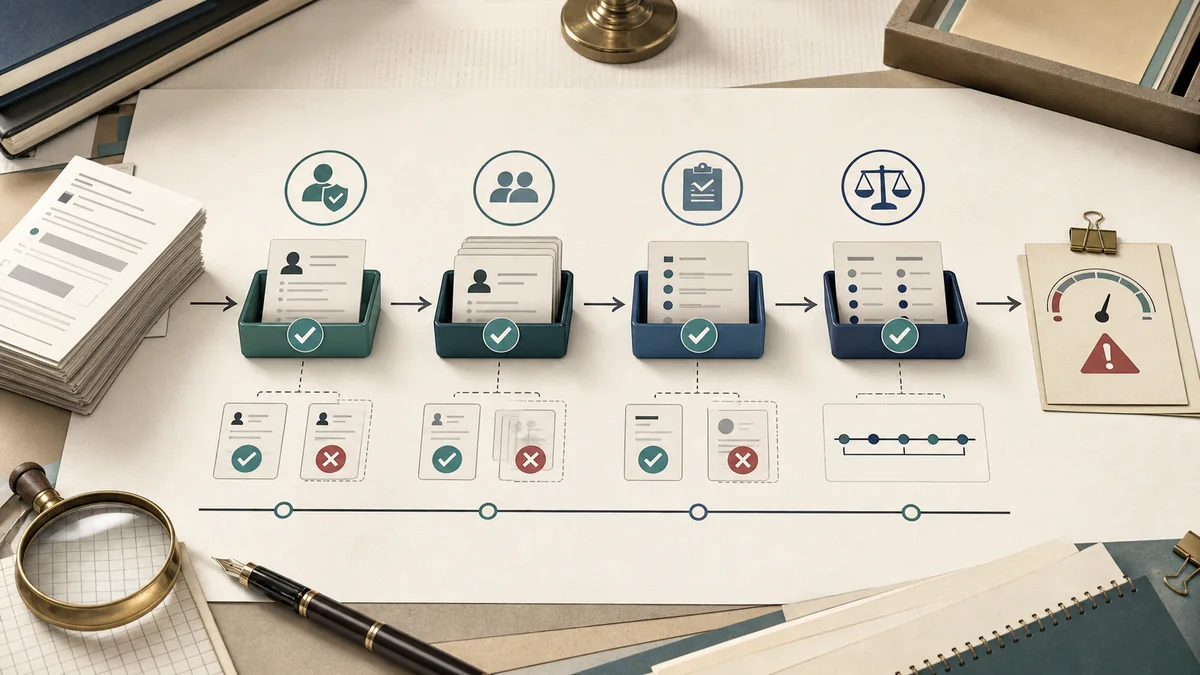
Outcome ladder
Read the strongest outcome by the weakest link in its source trail. A late-stage business metric can still be weak evidence if identity, qualification, or comparison rules are unclear.
| Outcome level | Useful when it shows | Quality checks | Do not claim alone |
|---|---|---|---|
| Qualified visit | A real session from the intended context reached a relevant destination. | Invalid traffic review, bounce rule, content depth, duplicate visits, source fields, and device mix. | Incremental demand or lead quality. |
| Engaged account or household | Multiple signals connect to the same qualified organization or buying group. | Identity unit, match rate, account fit, repeat exposure, excluded internal traffic, and minimum activity threshold. | Sales intent without buyer-side status. |
| Raw lead | A form, call, signup, download, or demo request was captured. | Required fields, duplicate suppression, spam filter, consent status, time to follow-up, and campaign source. | Pipeline, revenue, or incremental impact. |
| Qualified lead | The lead matches a prewritten fit, need, role, geography, or readiness definition. | Disqualification reasons, missing fields, sales acceptance, follow-up coverage, and lead-source overwrite rules. | That media caused the lead. |
| Opportunity or pipeline | A sales process accepted the outcome and assigned a value or stage. | Stage definition, owner assignment, duplicate account rules, source influence rule, and time lag from lead to stage. | Closed revenue or lift without maturity checks. |
| Matched sale or conversion | A buyer-side outcome was joined back to campaign exposure or traffic. | Match method, unmatched universe, lookback window, deduplication, prior intent, and comparison rule. | Incrementality without a protected baseline. |
| Incremental outcome | A designed comparison estimates what changed because of the campaign. | Holdout integrity, leakage, outcome window, uncertainty, pre-period balance, and sensitivity checks. | That the same effect holds in every future context. |
Score the readout
Give each line a low, medium, or high quality read before judging the headline result. A report with high volume and low outcome quality should lead to cleanup, not a stronger claim.
| Scorecard dimension | High quality | Medium quality | Low quality |
|---|---|---|---|
| Outcome definition | The event, stage, or sale is defined before launch and visible in the report. | The definition exists, but it changed or needs interpretation. | The report counts a vague conversion, action, or success event. |
| Eligibility | The outcome belongs to the planned audience, geography, context, date range, and destination. | Most outcomes appear eligible, with some exclusions or missing fields. | The report pools unlike audiences, placements, windows, or destinations. |
| Deduplication | User, account, household, lead, and order duplicates are handled with named rules. | Duplicate rules exist for some but not all outcome types. | The same person, account, or order can be counted multiple ways. |
| Qualification | Quality filters and disqualification reasons are prewritten and reported. | Quality is reviewed manually after results arrive. | Raw volume is treated as useful demand. |
| Source trail | Campaign, placement, creative, destination, audience, and outcome fields survive into the readout. | Some fields survive, but source or creative detail is incomplete. | Outcomes are detached from the delivery and creative context that produced them. |
| Timing | Outcome lag, data maturity, and reporting cutoff are stated before comparison. | The report mentions lag but does not show mature cohorts. | Early outcomes are ranked as final performance. |
| Comparison | The readout uses a holdout, matched baseline, prior flight, or explicit no-comparison label. | The comparison is directionally useful but imperfect. | Attributed outcomes are written as lift. |
| Decision fit | The recommended action matches the evidence level. | The action is plausible but needs a follow-up test or cleanup. | The report asks for a budget decision the evidence cannot support. |
Worked scoring pass
Use the scorecard as a decision filter, not a points game. One low-quality lane can cap the recommendation even when total volume is high. The reviewer should name the weakest material lane and choose the next action that fixes that lane first.
| Readout row | Quality read | Decision consequence |
|---|---|---|
| 1,240 form fills, but the report does not show duplicate suppression or fit status. | Volume is visible, but deduplication and qualification are low quality. | Do not use the count as qualified demand. Ask for duplicate rules, spam filters, fit criteria, and disqualification reasons before renewal language. |
| 84 sales opportunities tied to campaign leads, with owner assignment and stage definitions, but no protected comparison. | Outcome definition and qualification are stronger, while comparison remains descriptive. | Use observed pipeline language. A budget increase needs a baseline, holdout, or planned matched comparison. |
| Matched sales are reported after a 30-day lookback, but the usual sales cycle is 60 to 90 days. | Source trail may be useful, but timing and maturity are weak. | Hold final performance language until mature cohorts close, or report the result as an early status read. |
| A holdout readout shows lift, and exclusions, leakage checks, uncertainty, and outcome definitions are archived. | Comparison, timing, and outcome definition are high quality for the tested population. | Support a bounded lift claim for the named population, window, and outcome, while naming transfer limits for future buys. |
A useful rule of thumb: if eligibility, deduplication, qualification, timing, and comparison do not all clear at least medium quality, the safest action is cleanup or follow-up testing. If they clear medium but comparison is still descriptive, the safest language is observed response. If the comparison is preplanned and the outcome packet is complete, the readout can support a bounded causal sentence.
Simulated Worked Example: score a readout before renewal
Simulated Worked Example - not a real campaign report. Assume a report contains 1,000 submitted outcome rows. The reviewer applies the scorecard before deciding whether the campaign supports renewal language.
| Check | Simulated evidence | Score | Calculation or consequence |
|---|---|---|---|
| Outcome definition | The event dictionary distinguishes submitted, accepted, and disqualified rows. | High (2) | Counted states are reproducible before interpretation. |
| Eligibility and deduplication | 80 rows fail spam, geography, or duplicate checks, leaving 920 eligible rows. | High (2) | 80 / 1,000 = 8.00% excluded; the denominator is stated. |
| Qualification | 690 of the 920 eligible rows meet the written fit rule. | Medium (1) | 690 / 920 = 75.00%; disqualification reasons still need review. |
| Source trail | Campaign and destination survive, but placement and creative fields are missing for 120 qualified rows. | Medium (1) | 570 / 690 = 82.61% have a complete source trail. |
| Timing | The report closes at 30 days while the stated sales cycle is 60 to 90 days. | Low (0) | Do not treat early rows as mature pipeline or final performance. |
| Comparison | No holdout, matched baseline, or pre-specified comparison is supplied. | Low (0) | Observed outcomes cannot be written as incremental lift. |
| Decision fit | The only defensible action is to repair the packet and wait for mature cohorts. | Medium (1) | 8 / 14 possible points = 57.14%; renewal claim is downgraded. |
Bounded decision: use the report to describe 690 simulated qualified rows and prioritize cleanup, but do not claim that the campaign caused them or that it produced mature pipeline. The next packet should retain the missing source fields, close the 60-to-90-day outcome window, and add a protected comparison if the renewal decision requires incremental language.
Assumptions and limits: the row counts, percentages, and scores above are illustrative. The scoring weights are a teaching device, not a universal benchmark; a real reviewer may cap the decision more severely when qualification rules, consent, identity matching, or sales-stage definitions are unclear.
Simulated outcome-claim gate
Apply this second pass when a readout asks for renewal, budget, or causal language. A Pass means the fictional packet exposes the field needed for that claim; a Hold means the missing evidence keeps the claim below the requested level.
| Claim gate | Simulated packet evidence | Result | Claim boundary |
|---|---|---|---|
| Outcome states | The event dictionary separates 1,000 submitted rows from accepted and disqualified states. | Pass | The counted outcome can be named instead of calling every submission a success. |
| Denominator chain | 80 rows are excluded, 920 remain eligible, and 690 meet the written fit rule. | Pass | The reviewer can reproduce 80 / 1,000 = 8.00% excluded and 690 / 920 = 75.00% qualified. |
| Source completeness | Placement and creative fields are missing for 120 of 690 qualified rows; 570 / 690 = 82.61% are complete. | Hold | Do not compare source slices or attribute the qualified count evenly across placements. |
| Outcome maturity | The report closes at 30 days while the stated sales cycle is 60 to 90 days. | Hold | Do not call the early rows mature pipeline or final performance. |
| Protected comparison | No holdout, matched baseline, or pre-specified comparison is supplied. | Hold | Observed qualified rows cannot become incremental lift language. |
| Pre-set claim ceiling | The packet explicitly limits the decision to descriptive qualified-row reporting and cleanup. | Pass | The action is reproducible: repair fields, wait for maturity, and add comparison evidence before renewal claims. |
Reproduction: 3 / 6 gates pass = 50.00% packet readiness for a renewal or causal claim. That percentage is a review aid, not a probability of success. The defensible statement remains that the simulated packet contains 690 qualified rows under the stated filters; it does not establish mature pipeline, renewal value, or incremental impact.
What would change the result: complete placement and creative fields for the qualified rows, a closed 60-to-90-day outcome window, and a comparison chosen before results are interpreted would move the packet toward stronger language. None would eliminate the need to state the population, filters, outcome definition, and limitations.
Minimum outcome packet
A useful outcome packet lets a reviewer reproduce how the result became a conclusion. Ask for these pieces before debating whether the campaign worked.
Event dictionaryDefines every counted action, including page events, form submits, calls, downloads, demo requests, account actions, sales stages, purchases, refunds, and exclusions.
Qualification rubricStates what makes a visit, lead, account, opportunity, or sale useful enough to count for the campaign's decision.
Deduplication ruleNames the unit being counted once: person, browser, device, household, account, lead, opportunity, order, or transaction.
Source fieldsPreserves campaign ID, package ID, placement ID, creative ID, destination, audience rule, device, date, and content context.
Lag and maturity noteShows how long outcomes usually take to appear and which cohorts are mature enough for comparison.
Comparison ruleStates whether the readout uses a holdout, matched context, prior flight, model baseline, or descriptive attribution only.
Lead and pipeline review
Lead generation reports need a quality view before they need a victory sentence. Volume is only useful when the follow-up process can separate real fit from easy form completion.
| Review field | Ask for | Why it matters |
|---|---|---|
| Form completion | Required fields, hidden fields, validation rules, duplicate handling, and spam filters. | Prevents form ease or weak validation from masquerading as demand. |
| Fit status | Role, company size, geography, use case, category need, or other prewritten fit criteria. | Separates relevant demand from broad curiosity or low-fit submissions. |
| Follow-up coverage | Share contacted, time to first contact, owner assignment, and unreachable rate. | A campaign cannot be fairly judged if many leads were never worked. |
| Disqualification | Reasons such as duplicate, student, vendor, competitor, wrong region, no need, no budget, or bad contact data. | Shows whether the campaign is producing the wrong audience or the wrong page behavior. |
| Stage movement | Sales accepted, meeting held, opportunity opened, closed, lost, pending, and aged-out status. | Prevents early lead counts from being treated as mature pipeline evidence. |
| Source overwrite | Whether later channels, CRM imports, or sales updates can overwrite the original campaign source. | Keeps credit rules from reshaping the readout after results are visible. |

Careful outcome language
| Evidence available | Use this wording | Avoid this wording |
|---|---|---|
| Qualified visits only. | The campaign produced observed qualified traffic from the planned contexts. | The campaign generated qualified leads. |
| Raw leads with limited qualification. | The campaign produced form activity that needs duplicate, fit, and follow-up review. | The campaign produced pipeline. |
| Qualified leads with no comparison. | The campaign produced qualified leads under the stated filters and source rules. | The campaign created incremental demand. |
| Matched conversions with no holdout. | Matched records show observed outcomes inside the selected window. | The campaign caused these conversions. |
| Holdout or matched baseline with clear outcome quality. | The campaign supports a measured lift read for this population, window, and outcome definition. | The result proves the same lift in all future buys. |
Meeting script
- Which outcome is the report asking us to believe in: visit, lead, opportunity, sale, or lift?
- Was that outcome definition written before launch?
- What share of outcomes survived duplicate, eligibility, and quality checks?
- Which outcomes are still immature because the lag window has not closed?
- What comparison makes this result meaningful, and was it chosen before results were visible?
- What would we change if we judged by qualified outcomes rather than total outcomes?
Pair with
Use this scorecard with the campaign readout QA checklist when a finished report needs review, the campaign KPI dictionary when metric language needs boundaries, the campaign data-layer spec before launch, the landing page and lead quality checklist for form and follow-up checks, the identity matchback checklist for joined outcomes, the attribution window and conversion lag checklist for credited outcomes, the campaign status-window closeout checklist when lead, matchback, sales follow-up, attribution, or survey rows need maturity review, and the incrementality test plan template when the decision needs causal evidence.