Campaign measurement
Attribution window and conversion lag checklist
Organization byline: Measurement Press editorial desk. This page does not list an individual author or reviewer. Read the editorial method and corrections policy.
About 11 min read
Attribution windows look like reporting settings, but they decide which outcomes receive credit and which outcomes disappear from the story.
Use this checklist when a campaign report credits leads, sales, store visits, signups, pipeline, renewals, or revenue to media exposure. The goal is to separate timing rules, reporting coverage, and observed credited outcomes from stronger claims about incremental impact.
A common mistake happens on the first renewal call after a campaign ends. The dashboard credits a large pile of conversions, the most recent cohorts are still waiting for late CRM updates, and the team treats the credited total as if it already answers the budget question. A timing rule has become a business claim.

Start with the credited outcome
Before debating whether a window is too short or too long, identify the action that received credit and the touchpoint allowed to claim it.
| Credited result | What it can show | What it cannot prove alone |
|---|---|---|
| Click-through conversion | A tracked conversion happened after a click inside the selected window. | That the click caused the conversion or that unclicked impressions had no effect. |
| View-through conversion | A tracked conversion happened after a recorded exposure without a required click. | That the exposure changed behavior rather than reaching a user already likely to convert. |
| Engaged visit or lead | A session or form action met the report's engagement and source rules. | That the person was new demand, qualified, reachable by sales, or incremental. |
| Offline or CRM outcome | A tracked identity, account, or household later matched to an offline event. | That the match captured the whole eligible universe or removed prior intent. |
| Assisted conversion | A touchpoint appeared somewhere in a tracked path before the reported outcome. | That the assist deserves causal credit or budget weight equal to the last touch. |
| Modeled conversion | The reporting system estimated unobserved outcomes under its model and coverage assumptions. | That the estimate is equivalent to directly observed incremental lift. |
Name every clock
Most attribution disputes are really clock disputes. A usable report should show each window separately instead of compressing them into one "campaign period."
Exposure windowThe dates and times when the campaign could serve impressions, clicks, sponsorship placements, video views, emails, or other eligible touches.
Lookback windowThe period before the conversion during which a touchpoint is allowed to claim credit. Show separate windows for impressions, clicks, visits, and matched identifiers when they differ.
Conversion windowThe period after a touchpoint during which an outcome is eligible for credit. The window should match the buying cycle, not only the easiest reporting setting.
Data-lag allowanceThe delay between the real-world outcome and the moment it appears in the reporting system. Late CRM updates, returns, approvals, and offline files can change the result after the first readout.
Pre-periodThe period used to detect prior intent, existing customers, earlier visits, open opportunities, sales outreach, loyalty behavior, or category purchase history before media exposure.
Reporting cutoffThe date when the report was pulled, which cohorts were mature enough to judge, and which recent cohorts are still incomplete because their conversion lag has not run out.
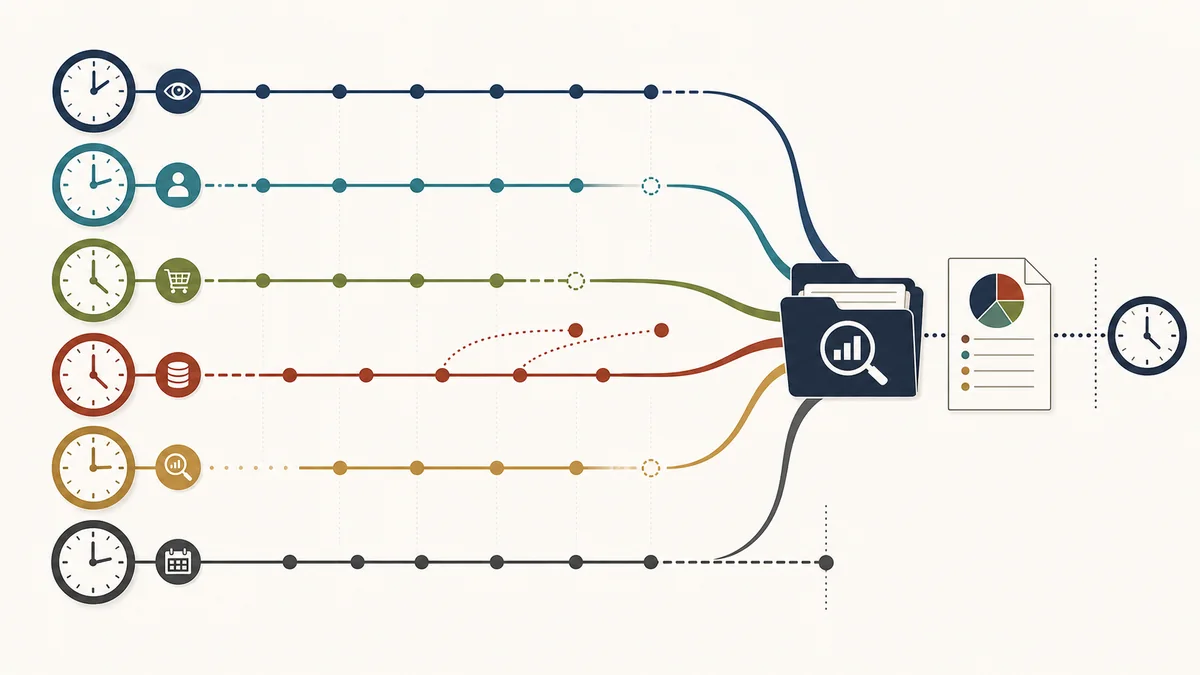
Conversion lag audit
A short window can undercount slower decisions. A long window can absorb demand that would have happened anyway. The right question is not whether the window is generous, but whether the window matches the decision and the evidence level.
| Risk | QA question | Why it matters |
|---|---|---|
| Immature cohorts | Are recent exposures separated from older exposures whose conversion window has fully matured? | Fresh cohorts often look weak simply because their lag has not elapsed. |
| Window shopping | Were 1-day, 7-day, 14-day, 30-day, and longer windows inspected after results were visible? | Flexible windows can turn ordinary timing into a stronger story. |
| Sale-cycle mismatch | Does the window match the normal time from first touch to qualified lead, purchase, renewal, or pipeline stage? | Complex decisions need different lag treatment than impulse actions. |
| Prior intent | Were users with recent visits, searches, cart activity, open opportunities, or sales contact identified before credit was assigned? | Attribution can reward the touchpoint closest to demand already in motion. |
| Channel blind spots | Which touches, devices, offline interactions, privacy-constrained paths, or untagged placements are missing from the path? | The visible path can over-credit the channels that are easiest to observe. |
| Outcome revisions | Are cancellations, returns, duplicate leads, rejected applications, unqualified leads, and late-stage CRM changes applied after the initial conversion? | A fast count can be directionally useful while still overstating durable value. |
| Concurrent activity | Did promotions, sales outreach, pricing changes, email, search, affiliates, or other media run during the same lag window? | Attribution windows can collect outcomes created by other work. |
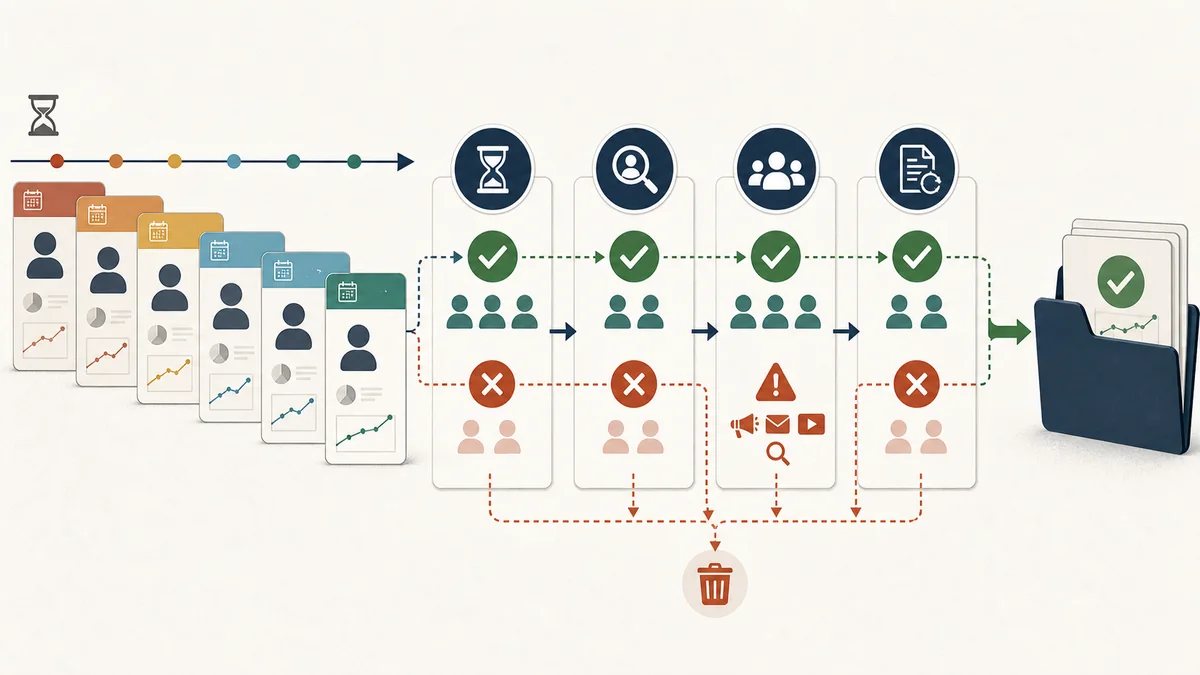
Window QA checklist
| Question | Good evidence | Do not accept |
|---|---|---|
| What was the primary window before launch? | A preselected click, view, matchback, and outcome window tied to the campaign objective. | A summary that changes windows after the strongest result is known. |
| How does performance change by lag day? | A lag curve or cohort table showing conversions by day since exposure or click. | Only the final credited total with no timing distribution. |
| Which cohorts are complete? | Separate mature and immature cohorts, with the reporting cutoff visible. | Ranking recent placements or creatives before their lag window has matured. |
| What happens under a shorter window? | A sensitivity table that shows how credited outcomes change under tighter windows. | One long window presented as the natural truth. |
| What happens under a longer window? | A sensitivity table that shows whether late conversions concentrate among high-prior-intent users. | Late outcomes credited without checking prior demand or concurrent touches. |
| What denominator is used? | Eligible exposed users, clicked users, matched users, sessions, leads, accounts, or households shown separately. | Rates calculated from whichever denominator makes the result look strongest. |
| What comparison protects causal language? | A holdout, matched control, geo baseline, model baseline, or explicit statement that no causal comparison exists. | Credited conversions described as incremental conversions. |
Lag-window fit score
Use this quick score when a report looks persuasive but the conversion window may be doing too much work. The score does not prove impact. It tells the team how cautious the next sentence should be.
| Check | 0 points | 1 point | 2 points |
|---|---|---|---|
| Window set before launch | The window changed after results were visible. | The window was inherited from a platform default. | The window was preselected and tied to the buying cycle. |
| Cohort maturity | Recent and mature cohorts are mixed together. | Recent cohorts are flagged but still ranked against mature cohorts. | Only mature cohorts drive the main decision readout. |
| Lag curve visibility | No day-by-day or cohort timing view is shown. | A lag curve exists but is not used in the conclusion. | The conclusion changes when the lag curve shows incomplete or late outcomes. |
| Prior-intent separation | Recent visitors, cart users, open opportunities, or existing customers are not separated. | Prior intent is reported as a side note. | Prior-intent groups are separated before credit becomes a claim. |
| Comparison strength | Credited outcomes are treated as lift. | A weak baseline exists but has clear limitations. | A holdout, matched comparison, geo baseline, or explicit non-causal label protects the language. |
Decision rule: 0-4 points supports only descriptive credit language, 5-7 points supports directional timing language, and 8-10 points can support stronger readout language only if the comparison itself is credible.
Simulated worked example: long-window credit needs a downgrade
Simulated example - not a live campaign: a report credits 1,240 purchases inside a long window and labels them "campaign-driven." An audit flags 390 purchases from recent site visitors, 220 from open CRM opportunities, and 180 from immature cohorts. These flags are not assumed to be mutually exclusive, so the arithmetic must show its assumption instead of silently subtracting the categories.
| Illustrative calculation | Result | Interpretation |
|---|---|---|
| Reported credited purchases | 1,240 | Observed credit inside the selected window. |
| Flagged records, if categories are mutually exclusive | 390 + 220 + 180 = 790 | Records needing separate treatment before a stronger claim. |
| Unflagged remainder under that assumption | 1,240 - 790 = 450 (36.3%) | A lower-bound illustration, not an incremental-conversion estimate. |
Because the three flags may overlap, the actual unflagged remainder could be higher than 450; the report needs record-level overlap logic before publishing a final count. A careful readout would say: "The campaign received credit for 1,240 tracked purchases inside the selected window. Prior intent and cohort maturity require further separation; until a protected comparison estimates incremental impact, the result is window-sensitive credited activity." The calculation makes the uncertainty visible without turning a hypothetical into a case study.

Primary source trail and method notes
The distinction between credit, timing, and impact follows the documentation below. These sources describe platform reporting rules; they do not validate any particular campaign's causal claim.
- Google Analytics: Get started with attribution - defines attribution as assigning credit to touchpoints and explains that models distribute credit along a path to a key event.
- Google Ads: About conversion windows - defines the post-interaction period in which a conversion is recorded, explains that longer windows can record more conversions, and points to time-lag reporting for window choice.
- Google Ads: About conversion lag reporting - explains that conversion delay can make recent CPA look inflated or ROAS look deflated while later conversions are still arriving.
- Google Ads: Find out how long it takes for your customers to convert - recommends checking a sufficiently mature date range and using days-to-conversion segmentation to understand reporting delay.
Verified source boundary: Attribution assigns credit to touchpoints, while a conversion window decides how long after an ad interaction a conversion can be recorded. Google’s lag guidance warns that recent, immature periods can make CPA look high or ROAS look low because later conversions have not arrived; changing the window also changes the reporting population going forward. Compare mature cohorts under a stable rule, and keep credited outcomes separate from incremental impact.
Method boundary: the simulated remainder is calculated only under an explicit mutually-exclusive assumption. It is not a lift estimate, and the page does not claim that removing prior-intent or immature records removes all selection bias. A real audit should retain record IDs or cohort keys, document overlap, state the reporting cutoff, and compare the eligible population with a credible baseline or holdout.
Simulated lag-readout acceptance gate
Simulated Worked Example - not a live campaign or benchmark. Apply this six-gate check to the fictional 1,240 credited purchases before the result changes renewal, budget, or channel language. The gate tests whether the packet is ready for a bounded timing readout; it does not estimate incremental conversions.
| Gate | Evidence in the example | Result |
|---|---|---|
| Window was fixed before results | The example names a long window but does not document a pre-results choice tied to the buying cycle. | Hold |
| Mature and immature cohorts are separated | 180 purchases are flagged as immature, so the 1,240 total is not a fully mature decision count. | Hold |
| Lag distribution is visible | No day-to-conversion or cohort-lag table is supplied to show whether the long window adds meaningful late outcomes. | Hold |
| Prior-intent overlap is resolved | 390 recent visitors and 220 open CRM opportunities are flagged, but their overlap is unknown. | Hold |
| Comparison protects causal language | No holdout, matched baseline, geo comparison, or other counterfactual is included. | Hold |
| Claim and action stay bounded | The proposed language says observed credited activity is window-sensitive and does not call it incremental. | Pass |
The reproducible packet result is 1 / 6 = 16.7%. This is not a universal quality score: the five hold gates control the decision. Keep the example at descriptive, window-sensitive reporting; do not use it to rank channels, claim lift, or approve a renewal. Re-run the gate after adding a predeclared window record, mature-cohort cutoff, lag distribution, overlap keys, and a credible comparison. The conclusion can change when those fields change.
Readout language ladder
Attribution-window work can make reporting cleaner, but clean credit rules are not the same as a counterfactual.
| Evidence available | Careful wording | Overclaim to avoid |
|---|---|---|
| Credited outcomes only | The campaign received credit for observed outcomes inside the stated window. | The campaign created those outcomes. |
| Lag curve with no baseline | Observed credited outcomes matured over this timing pattern. | The lag curve proves the channel's incremental contribution. |
| Window sensitivity | The result is sensitive, or not sensitive, to the selected credit window. | The best-looking window is the correct window. |
| Prior-intent controls | The report reduces some selection risk by separating users already close to action. | Prior-intent controls remove all selection bias. |
| Designed holdout or geo test | The campaign supports measured lift for the eligible population, window, outcome, and uncertainty range. | The same attribution window should be treated as causal proof in every future campaign. |
Questions for the vendor call
- Which attribution window was selected before launch, and who approved it?
- How do credited outcomes change at 1, 7, 14, 30, and 60 days?
- Which cohorts are fully mature, and which are still incomplete because of conversion lag?
- What share of credited outcomes came from users, accounts, or households with visible prior intent?
- Which channels or touchpoints were invisible to this attribution system?
- How are duplicate leads, returns, cancellations, rejected applications, and late CRM updates handled?
- What comparison shows whether credited outcomes were incremental rather than only timed after exposure?
Pair with
Use this checklist with the campaign readout QA checklist for finished reports, the campaign reporting terms glossary for shared language, the campaign data-layer spec before launch, the identity matchback checklist when outcomes rely on joined records, the campaign status-window closeout checklist when conversion lag or credited outcome windows are not yet mature, the audience selection bias checklist when high-intent users may be easier to credit, and the incrementality test plan template when the decision needs causal evidence.