Campaign reporting
Campaign status-window closeout checklist
Organization byline: Measurement Press editorial desk. This page does not list an individual author or reviewer. Read the editorial method and corrections policy.
About 14 min read
A campaign readout can look finished while important outcome fields are still immature. Status-window closeout decides when delayed lead status, matchback, sales follow-up, attribution, and survey fields are ready for final language.
Use this checklist when a report has delivery, traffic, and initial outcome rows, but the decision depends on records that arrive later. It is built for contextual display, sponsorship, private marketplace, lead generation, matched-outcome, and survey-supported campaigns where early response can be useful without being final.
Picture a renewal meeting scheduled two business days after the media flight ends. Delivery is complete, the report packet has first response numbers, and the buyer wants to decide whether to renew. But lead qualification is only half reviewed, the offline matchback file is still processing, sales follow-up has not reached every row, and the survey comparison cell needs more respondents. The right closeout decision is not "the campaign is done." It is "which evidence lanes are mature enough to control final wording today?"
Page boundaryUse this page to decide whether each delayed evidence lane is ready for final language. Once the rules are accepted, transfer the row-level states and exclusions to the closeout register; this checklist should not be the only record of who closed which window and when.
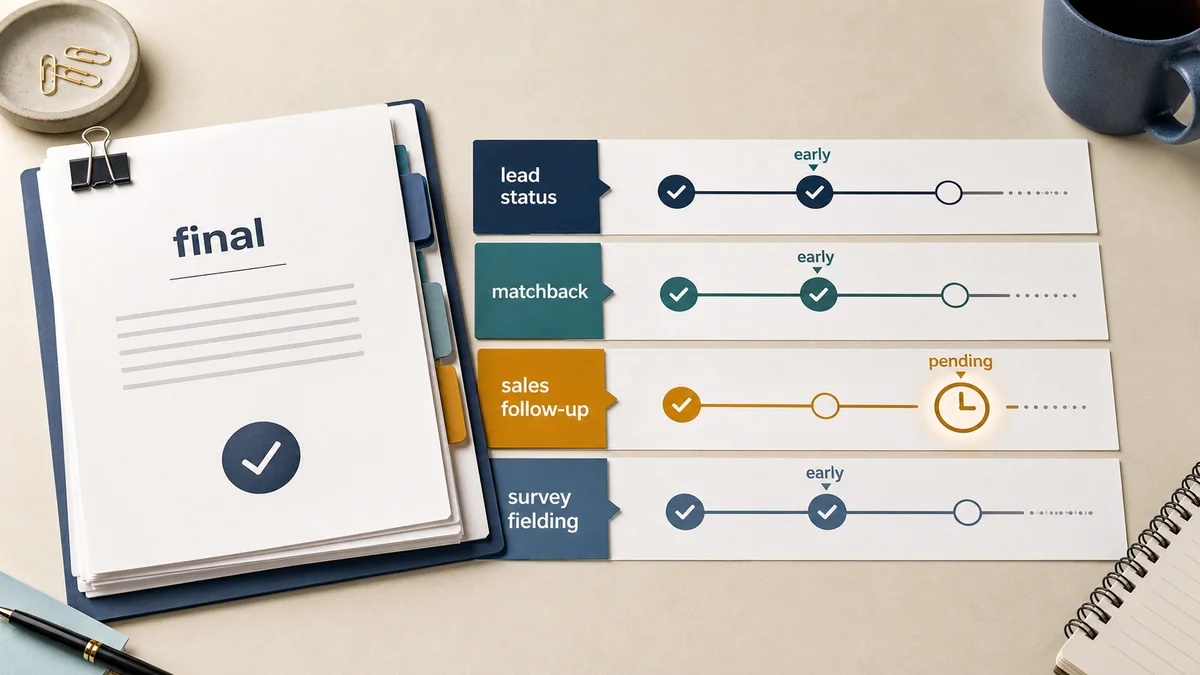
What early closeout breaks
The closeout step prevents a preliminary read from becoming the last read simply because the meeting happened before delayed evidence matured.
| Closeout risk | How it appears | Control before final language |
|---|---|---|
| Immature lead status | Most leads are still new, contacted, pending, or unqualified by default. | Set a coverage threshold before lead-quality or pipeline language is final. |
| Incomplete matchback | Offline, CRM, clean-room, or household matches are still processing. | Keep matched outcomes preliminary until match runs, duplicate rules, and unmatched counts are visible. |
| Sales follow-up delay | Meetings, opportunities, or qualified pipeline require human follow-up after the media flight ends. | Separate traffic response from sales-status evidence until the follow-up window closes. |
| Attribution-window drift | Short-lookback rows are final while longer conversion windows continue to fill. | Name the window used and keep later-window rows out of final claims until the cutoff is reached. |
| Survey sample lag | Brand, awareness, or recall results are reported before sample, balance, or field dates are complete. | Close only after fielding, weighting, and respondent-balance checks are accepted. |
| Duplicate or reversal cleanup | Duplicate leads, returned orders, canceled bookings, or invalid events are not yet removed. | Require a final hygiene pass before outcome counts become renewal evidence. |
| Open issue rows | A mobile page, routing field, placement slice, or comparison condition remains unresolved. | Carry the issue ID into final wording or exclude the affected row. |
| Baseline mismatch | The report closes after campaign rows finish but before the comparison period or holdout read is complete. | Do not use lift language until the comparison evidence is closed as well. |
Closeout record fields
Each delayed evidence lane needs a small closeout record. Without it, readers cannot tell whether a field is final, preliminary, missing, or excluded.
Status window
The field or process being allowed to mature: lead status, matchback, attribution, sales follow-up, survey, reversal, or comparison.
Start trigger
The event that starts the clock, such as click, form submit, booked meeting, purchase date, exposure date, fielding date, or campaign end.
End rule
The calendar date, elapsed-days rule, system run, fielding close, or status threshold that makes the row ready for final review.
Eligible rows
The exact campaign, placement, creative, device, destination, package, or audience rows covered by the closeout rule.
Owner
The team responsible for producing the final status record and the reviewer allowed to accept it.
Maturity threshold
The minimum coverage, match completion, response count, duplicate review, or comparison readiness needed before language can close.
Missing and excluded rows
The rows not yet mature, not eligible, low volume, duplicated, reversed, or removed from the final claim.
Allowed claim
The strongest sentence supported after the window closes and the weaker sentence required before it closes.
Carry-forward action
Renew, revise, retest, monitor, exclude, add causal test, or hold until a later closeout record exists.
Status-window types
Different evidence matures on different clocks. A single final readout date should not erase those differences.
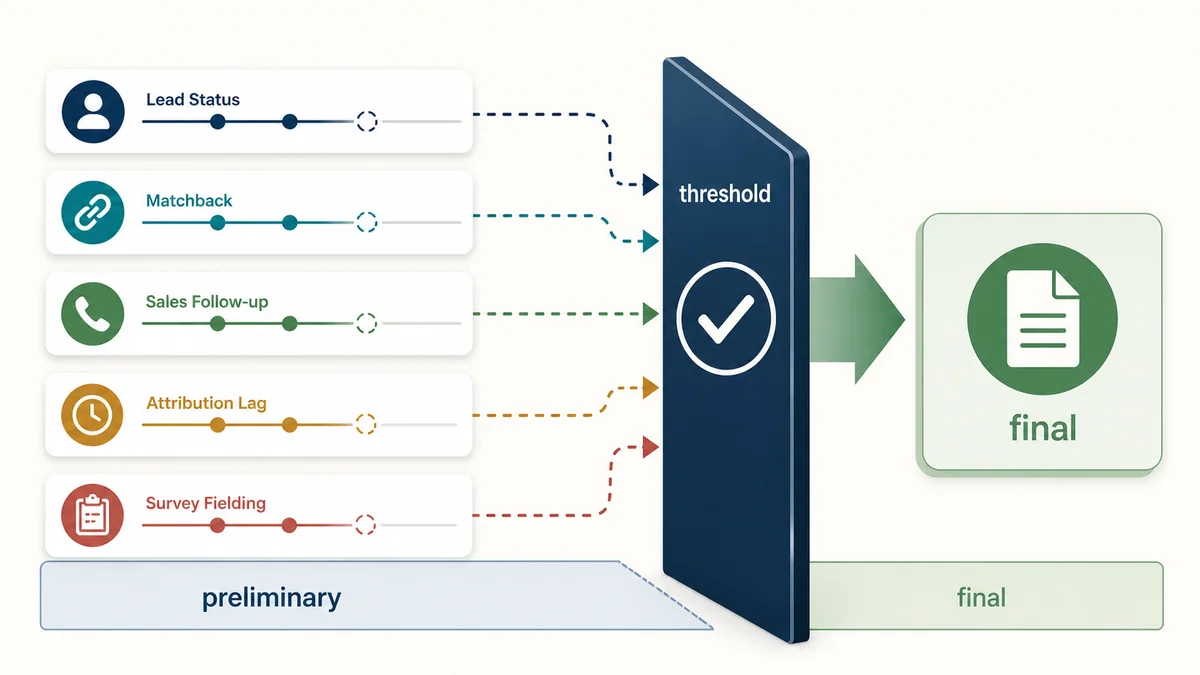
| Window | Close when | Still preliminary when | Final language can say |
|---|---|---|---|
| Lead status | The agreed share of leads has moved beyond default or pending status. | Most records are new, untouched, pending, or missing qualification fields. | Qualified lead status reached the named coverage threshold. |
| Sales follow-up | Follow-up attempts, meeting status, opportunity state, or pipeline fields meet the review rule. | Sales activity is still in progress or uneven across source rows. | Follow-up-complete rows support the scoped outcome statement. |
| Identity matchback | The final match run, duplicate rule, unmatched count, and privacy threshold are recorded. | New offline records, clean-room joins, or CRM imports are still arriving. | Matched outcomes were observed under the stated match and eligibility limits. |
| Attribution or conversion lag | The lookback and conversion windows are both complete for the eligible cohort. | Later conversions can still enter the credited outcome set. | Credited outcomes are final for the named window, not proof of lift. |
| Survey fielding | Field dates, final sample, weighting, exposed-control balance, and exclusions are accepted. | Sample, balance, or response-quality checks are still open. | Survey movement is final for the fielded sample and stated uncertainty. |
| Reversal or quality cleanup | Duplicate, invalid, canceled, returned, or low-quality rows are removed or named. | Outcome counts still include rows likely to be cleaned later. | Final counts reflect the accepted hygiene and exclusion rules. |
| Comparison readiness | Baseline, matched market, holdout, or model comparison data is complete enough for the intended claim. | The campaign result is closed but the counterfactual evidence is not. | The comparison supports only the claim level it was designed to answer. |
Maturity decisions
Use a decision label that changes the readout. The label should tell a buyer whether the evidence can close, stay preliminary, or be excluded.
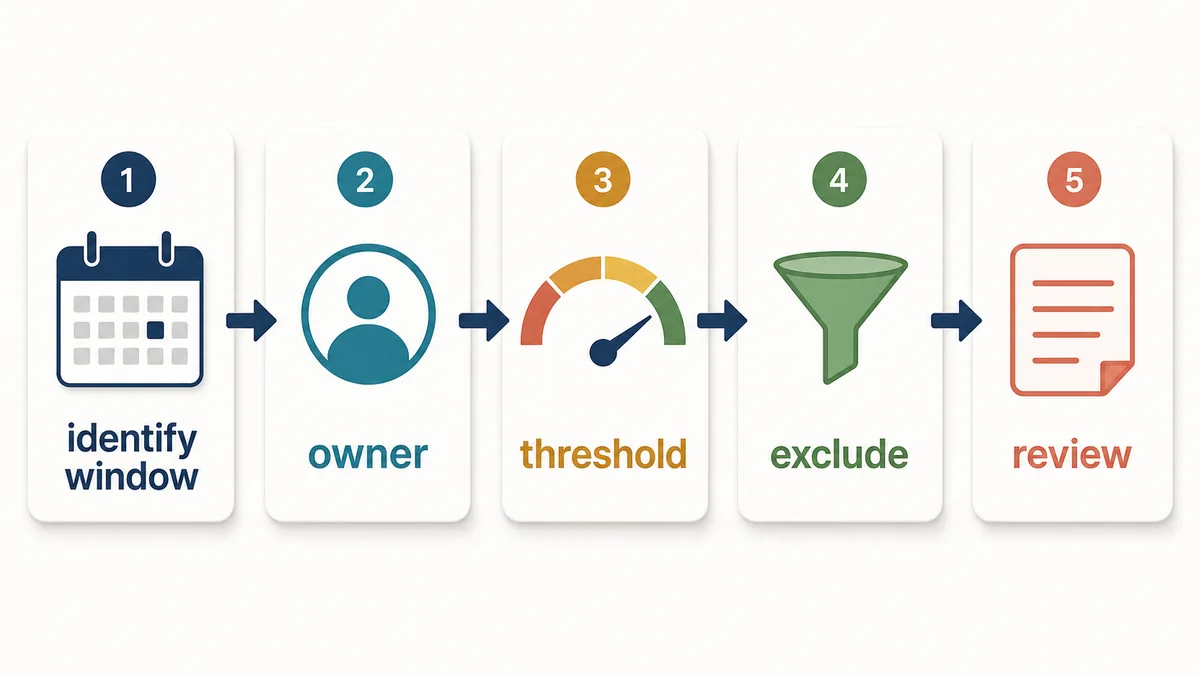
| Decision | Use when | Readout effect |
|---|---|---|
| Final | The window closed, the threshold was met, and exclusions are documented. | Use final language for the covered rows only. |
| Final with exclusions | The main window closed, but named rows remain ineligible, low volume, invalid, or unresolved. | Use final language for included rows and keep exclusions visible. |
| Preliminary | Useful evidence exists, but the window, coverage threshold, or hygiene pass is incomplete. | Use early-read language and set the next review date. |
| Not comparable | The delayed field matured unevenly across placement, audience, creative, or source rows. | Split the readout or avoid pooled outcome claims. |
| Retest required | The window closed but the evidence is too sparse, imbalanced, or affected by a known issue. | Do not renew on the result without a new test or narrower scope. |
| Causal test required | The status window is mature, but the comparison design still cannot answer incrementality. | Keep descriptive language and plan the next test before lift wording. |
| Hold | The missing status would make the next budget, renewal, or package decision misleading. | Delay final language or narrow the decision to mature rows. |
Sample closeout rows
These rows show structure only. They do not describe a real advertiser, publisher, platform, or campaign.
| Window | Eligible rows | End rule | Maturity threshold | Status | Allowed final language |
|---|---|---|---|---|---|
| Lead status | Guide-package form submissions from verified desktop and tablet placements. | 14 days after form submit. | 80% of records have accepted status values. | Preliminary | Early lead volume is visible; lead-quality language waits for status coverage. |
| Matchback | CRM outcomes for contextual package visitors with eligible source fields. | Final weekly match run after campaign close. | Match rate, unmatched count, and duplicate rule are recorded. | Final with exclusions | Matched outcomes were observed for eligible rows under the stated match limits. |
| Sales follow-up | Qualified visit rows handed to the buyer's follow-up team. | 21 days after assignment. | Attempt count and disposition complete for each included row. | Hold | Traffic response can be reported; sales-readiness language is not final. |
| Attribution lag | Seven-day and 30-day credited conversion rows. | 30 days after last eligible click or view. | Both windows closed for the same cohort. | Final | Credited outcomes are final for the named windows and remain descriptive. |
| Survey fielding | Exposed and comparison respondents from the same campaign period. | Fielding close and weighting acceptance. | Final sample, balance, and uncertainty fields accepted. | Retest required | Survey results are directional and do not support a renewal claim by themselves. |
Simulated Worked Example: close a status window without overstating quality
This is a Simulated Worked Example, not a campaign result. The counts are fictional and show how to calculate a closeout state from a defined denominator. Replace them with an export that preserves the status definitions, hygiene rules, observation window, and unresolved rows.
| Closeout field | Simulated value | Calculation or decision use |
|---|---|---|
| Submitted records | 1,000 | Starting population for the closeout note. |
| Duplicate or invalid records removed | 100 | 1,000 - 100 = 900 eligible rows after the hygiene pass. |
| Rows with accepted status | 720 | 720 / 900 = 80.00% status coverage. |
| Rows still pending or unresolved | 180 | 900 - 720 = 180 rows excluded from final status-quality language. |
| Qualified rows among accepted status | 360 | 360 / 720 = 50.00% of resolved rows; this is not 50.00% of all submissions. |
| Closeout decision | Final with exclusions | The 80.00% threshold is met for eligible rows, but pending rows and the hygiene exclusions stay visible. |
The bounded sentence is: "Among 900 eligible rows after the stated hygiene pass, 720 had accepted status and 360 were qualified, so 50.00% of resolved rows were qualified; 180 eligible rows remained pending and were excluded from final status-quality language." That sentence does not claim that 36.00% of all submissions were qualified, because the unresolved rows have not earned that label. It also does not claim incremental impact: a mature status window describes outcome quality, while causality requires a comparison design.
Assumptions and limits: the simulated 80.00% threshold is a local operating rule, not a universal benchmark; "accepted status" must be defined before the export; duplicate and invalid filters must be reproducible; pending rows may change the final rate; and the example says nothing about selection, seasonality, match quality, or incrementality.
How to reproduce the example
- Export one row per submitted record with a stable ID, submission timestamp, status value, eligibility flag, duplicate/invalid flag, and qualification flag. Keep the observation-window start and end dates with the export.
- Count submitted rows, then remove only rows that meet the predeclared duplicate or invalid rules. Confirm that
eligible rows = submitted rows - removed rows. - Count accepted statuses and unresolved statuses from the same eligible denominator. Confirm that
accepted + unresolved = eligible, then calculatestatus coverage = accepted / eligible. - Calculate the qualified share only among accepted rows:
qualified / accepted. Keep this separate from any share of all submissions, and attach the export, filter rules, and unresolved-row list to the closeout record.
For an attributed-conversion lane, inspect the platform conversion-lag or days-to-conversion report before choosing the end rule; a calendar deadline that ignores observed lag can make a recent cohort look artificially incomplete or complete. This operating method is adapted from the linked Google Ads guidance, not a claim that every campaign or platform has the same lag profile.
Worked closeout gate
The closeout gate is where the draft sentence gets weaker, narrower, or delayed. Start with the sentence a stakeholder wants to use, then ask which status windows actually support it.
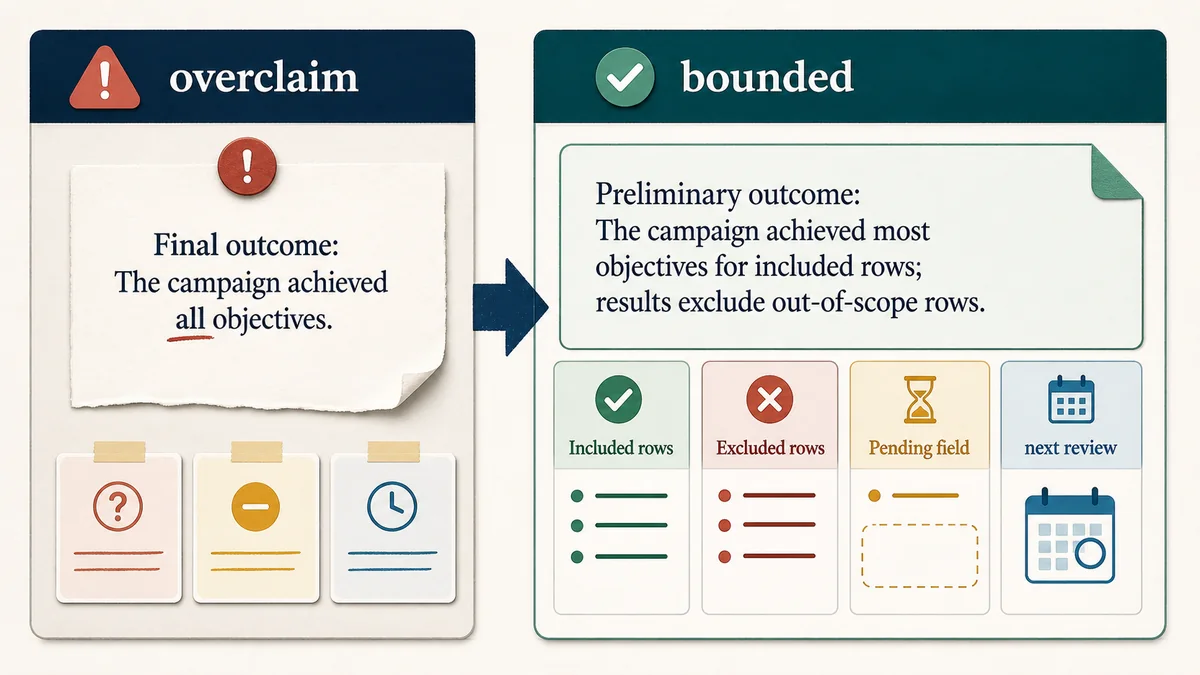
| Requested sentence | Current closeout evidence | Gate decision | Safer readout language | Next action |
|---|---|---|---|---|
| The campaign produced qualified leads across the package. | Desktop and tablet rows reached status coverage; mobile repair rows remain incomplete. | Final with exclusions. | Included desktop and tablet rows reached the accepted lead-status threshold; mobile repair rows are excluded from final lead-quality language. | Carry excluded mobile rows into the next-flight issue register. |
| The campaign drove matched pipeline. | The final match run finished, but sales disposition is still pending for several matched rows. | Preliminary for pipeline. | Matched outcomes are visible under the stated match rule; pipeline language waits for sales follow-up closeout. | Schedule a follow-up review after the sales-status window closes. |
| The campaign caused incremental conversions. | Attribution windows are closed, but no holdout, matched market, or baseline design can answer lift. | Causal test required. | Credited outcomes are final for the named attribution window; incremental impact is not established. | Write a holdout or matched-baseline requirement into the next test plan. |
| The survey proves brand impact. | Exposed sample is complete, but the comparison cell is under threshold and weighting is not accepted. | Retest required. | Survey movement is directional and cannot carry renewal by itself. | Set the minimum sample and balance rule before the next fielding period. |
| The readout is ready for renewal approval. | One issue ID remains open and affects the same rows used in the renewal claim. | Hold. | Delivery and early response can be discussed; renewal language should wait or narrow to unaffected rows. | Name the blocker, owner, and decision date in the renewal memo. |
Primary source trail for the timing and claim boundary
The timing rules here are anchored to first-party platform guidance, then adapted into a reader-facing closeout record. Google Ads conversion-lag guidance explains that conversions can be reported after the ad interaction and that recent metrics may change as delayed conversions arrive; that is why this checklist names a start trigger, end rule, and observation window. Google Ads' Days to conversion reporting guidance describes where to inspect how long conversions take to count; that is why a team should use observed lag rather than an arbitrary meeting date. Google Ads' conversion-cycle definition distinguishes the time from click to conversion from the time needed to report imported conversions; that is why offline or CRM status needs its own closeout clock. Finally, Google Ads Conversion Lift guidance reserves incremental-conversion language for a controlled treatment/control design, so a mature status window does not become causal evidence by itself.
Source boundary: Google Ads’ lag reports describe how that platform’s recent conversion metrics can change and where to inspect the delay. They do not supply a universal closeout period for sales, CRM, survey, or offline-status workflows, and they do not validate the fictional threshold in this page’s worked example. Set the local end rule from the actual outcome process, then preserve the report date, definitions, pending rows, and limitations.
Source boundary: closeout timing versus causal evidence
| Source establishes | Closeout implication | It does not establish |
|---|---|---|
| Google Ads conversion-lag reporting says recent metrics can change as delayed conversions arrive. | Keep recent cohorts open or label them preliminary until the observed lag and status rule are satisfied. | A universal 30-day rule for every conversion, sales, survey, or CRM workflow. |
| Google Ads Days to conversion reporting shows how long conversions take to count. | Use observed timing to set or review the end rule, and record the report date and conversion window. | That a completed timing window proves outcome quality or makes rows comparable across scopes. |
| Google defines a conversion cycle as both time to conversion and, for imports, time to reporting. | Give offline or CRM imports their own reporting-status clock rather than closing them on the ad-interaction date. | That an imported row is final merely because the platform has accepted the upload. |
| Conversion Lift uses controlled treatment and control groups for incremental measurement. | Keep the final sentence descriptive unless a completed controlled design supports incremental wording. | That closing an attribution or status window creates lift evidence. |
Claim-language ladder
The closeout state should change the verb and scope of the final sentence. Do not use a stronger sentence because the deadline arrived.
| Evidence state | Supportable wording | Avoid saying |
|---|---|---|
| Window still open | Early response is visible, but final outcome status is pending. | The campaign produced qualified leads or final conversions. |
| Window closed with missing rows | The included rows reached final status; unresolved rows are excluded from the conclusion. | All campaign traffic reached the same outcome quality. |
| Status mature, weak comparison | Final descriptive outcomes are available for the named rows. | The media caused the outcomes. |
| Status mature, comparison designed | The readout can use the comparison rule named in the test plan. | The result generalizes beyond the tested rows or period. |
| Status mature, issue unresolved | Final rows are reported with the issue ID and decision limit attached. | The issue was irrelevant because final numbers exist. |
Closeout note
End the status-window review with a short note that can move into the readout, renewal memo, or evidence archive.
Recommended structureStatus window [window name] for [eligible rows] opened on [trigger] and closed on [end rule]. The maturity threshold was [met, missed, or partially met] because [coverage, match, fielding, duplicate, or comparison evidence]. Exclude [rows] from final language. The allowed claim is [bounded sentence]. The unavailable claim remains [stronger sentence] until [missing status, comparison, or test requirement] is complete.
Pre-readout checklist
- Does every delayed evidence field have a start trigger, end rule, owner, reviewer, and maturity threshold?
- Are lead status, sales follow-up, matchback, attribution, survey, and comparison windows separated instead of pooled into one final date?
- Are missing, duplicate, invalid, reversed, and low-volume rows named before final outcomes are summarized?
- Does the final readout distinguish mature descriptive evidence from causal evidence?
- Are unresolved rows carried into the issue register, renewal memo, evidence archive, or next-flight tracker?
Pair with
Use this checklist after the campaign readout QA checklist and before the campaign renewal memo template. Pair it with the campaign status-window closeout register when closeout IDs, thresholds, exclusions, allowed claims, and next review dates need to be exported, the outcome quality scorecard when lead or pipeline status is part of the decision, the attribution window and conversion lag checklist when credited outcomes are still filling in, the identity matchback checklist when offline or CRM outcomes are joined later, the campaign issue log and renewal register when unresolved rows need owners and claim boundaries, the campaign renewal evidence archive when final closeout decisions, owners, and next-flight gates need to carry forward, the private marketplace readout export sample when row fields need structure, the private marketplace renewal scorecard when final action needs scoring, and the incrementality test plan template when mature outcomes still need causal evidence.