Campaign diagnosis
Campaign evidence triage tree
Organization byline: Measurement Press editorial desk. This page does not list an individual author or reviewer. Read the editorial method and corrections policy.
About 12 min read
A campaign readout usually creates pressure to pick an action quickly: renew, revise, shift budget, request more data, or claim lift. The safer sequence is to triage the evidence lane before choosing the action.
Use this page after the first readout pass and before the renewal note is written. It turns the main evidence questions into a decision tree so teams can distinguish operational fixes, creative or destination changes, descriptive renewals, and true incrementality-test needs.

What the tree changes in the meeting
In plain language, the tree asks one question at a time: what is the first part of this report that cannot yet carry the decision? That changes the closeout from “the campaign worked” to a useful next sentence such as “delivery was clean, observed response is promising, and the renewal can be descriptive while comparison evidence is repaired.”
Reader outcome: leave the meeting with one allowed action, one claim ceiling, and one named evidence request. If the first weak lane is comparison, do not spend the meeting debating creative winners; write the comparison repair into the next flight.
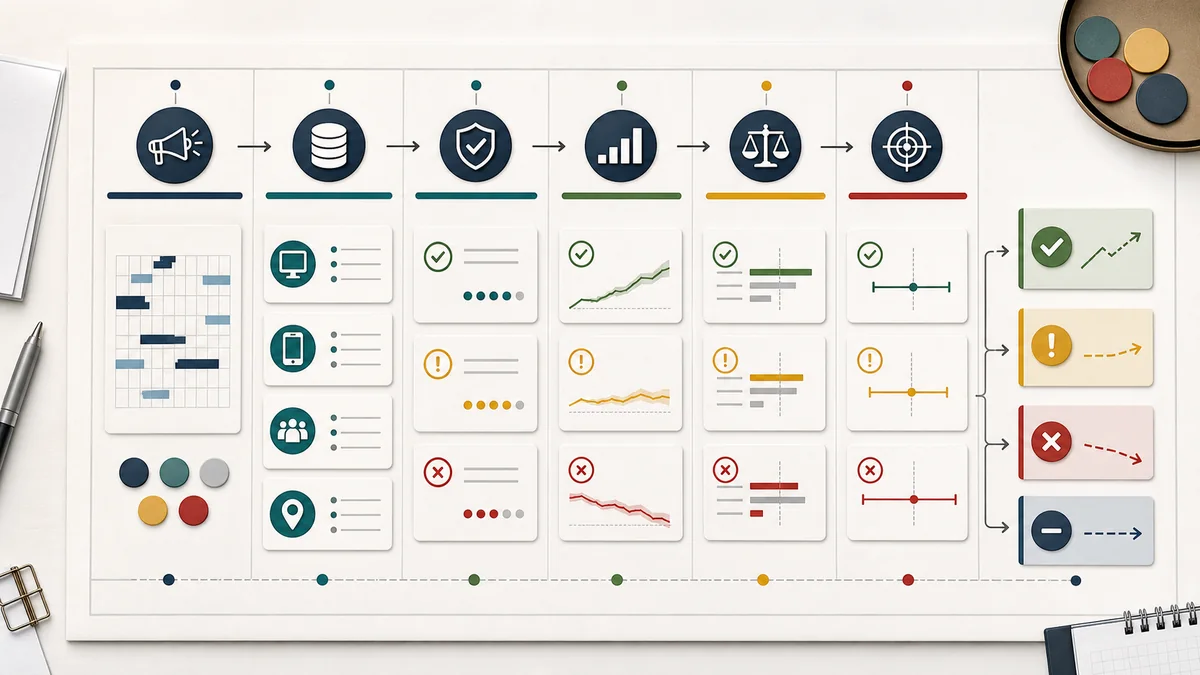
Five-minute triage
Start at the top. Do not move to stronger decision language until the previous branch is clean enough for the decision at hand.
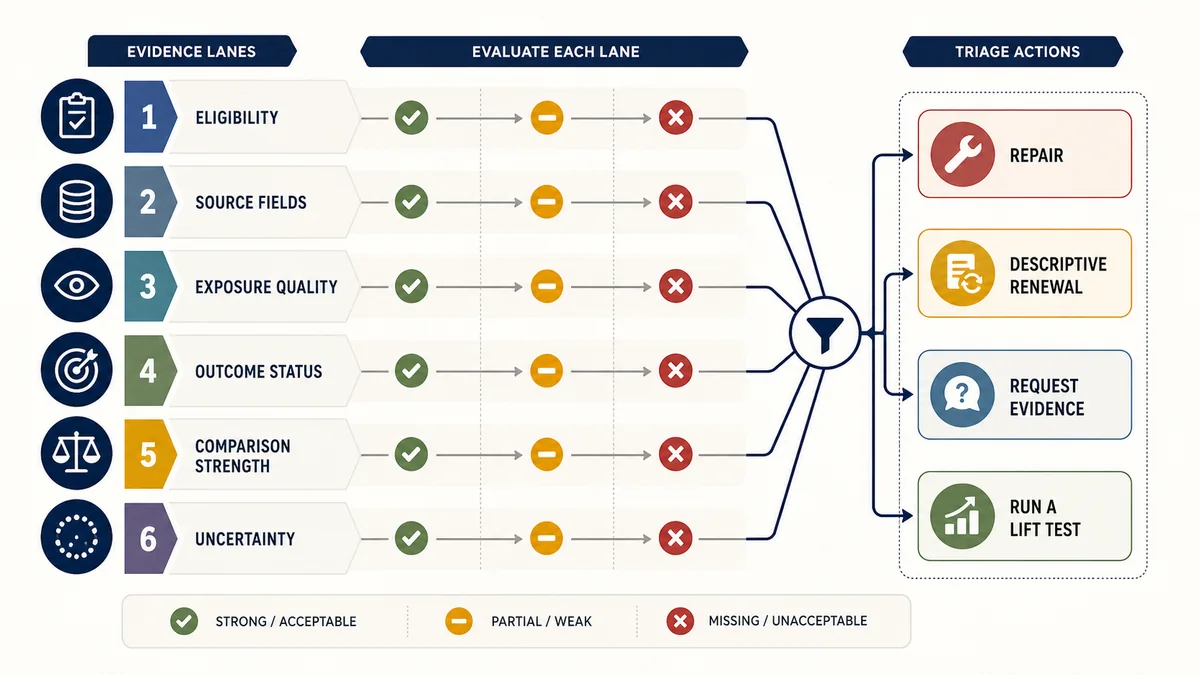
| Branch | Gate question | If the answer is yes | If the answer is no |
|---|---|---|---|
| 1. Eligibility | Did the campaign run in the agreed package, placement, device, geography, date, and creative scope? | Move to source-field completeness. | Treat the readout as an operational exception. Fix trafficking, package definition, or delivery evidence before judging response. |
| 2. Source fields | Are placement IDs, creative IDs, destination IDs, dates, device class, audience rule, and primary outcome visible at the row level? | Move to exposure and traffic quality. | Request the missing fields and log an issue. Do not let a pooled summary become the decision record. |
| 3. Exposure and traffic | Are measurability, viewability, invalid-traffic review, frequency, qualified visits, and destination behavior good enough to interpret the response? | Move to outcome status. | Diagnose exposure quality, creative, destination, or routing before treating weak response as a media-context failure. |
| 4. Outcome status | Are reported leads, conversions, matches, sales steps, survey responses, or pipeline rows defined and separated by quality status? | Move to comparison strength. | Hold final action language until outcome maturity, lead quality, matchback, or survey status is clear enough. |
| 5. Comparison strength | Is there a prior-period, matched, holdout, geo, model, or survey-control comparison that was defined before the conclusion? | Read the uncertainty and decide the action boundary. | Keep the conclusion descriptive. Renew, revise, or retest only within the observed-response evidence. |
| 6. Uncertainty | Does the result show a range, threshold, minimum cell size, or sensitivity check that could change the recommendation? | Use the evidence-to-action matrix below. | Reduce the strength of the claim and request a cleaner readout before scaling the decision. |
Triage scoring rule
The tree works best when each branch receives a decision status before the meeting discusses renewal language. The score is not a grade for the campaign. It is a guardrail for the next sentence the team is allowed to write.
| Status | Use when | Decision ceiling | Closeout action |
|---|---|---|---|
| Clean lane | The field is visible, the definition is stable, and the evidence can be checked by another reviewer. | The lane can support the next branch, but it does not strengthen unrelated lanes. | Record the source, threshold, and owner so the proof can travel into the renewal memo. |
| Watch lane | The evidence is useful but depends on a caveat, delayed status, small base, modeled field, or known operating event. | Use descriptive or directional language and name the caveat beside the recommendation. | Assign a maturity date, sensitivity check, issue row, or follow-up field before stronger wording is reused. |
| Blocking lane | The field is missing, pooled too broadly, changed after launch, or unable to answer the decision being asked of it. | Do not renew, scale, or claim lift from this lane alone. Move the action to repair, retest, or request evidence. | Write the exact missing artifact: row-level export, outcome status, holdout rule, leakage check, interval, or comparison note. |
The first blocking lane sets the ceiling for the readout. Later branches can still be informative, but they cannot turn an incomplete source trail, unqualified outcome, or weak comparison into decision-grade evidence.
Evidence-to-action matrix
The right next action depends on which lane is weak. A campaign can be worth renewing without supporting lift language, and a strong-looking response can still be too messy to renew.
| Evidence pattern | Best next action | Allowed language | Pair with |
|---|---|---|---|
| Clean delivery, complete fields, weak qualified response. | Diagnose creative, destination, offer, lead routing, and context fit before changing the media plan. | The campaign delivered cleanly, but response quality needs diagnosis before renewal. | Creative and destination troubleshooting matrix |
| Clean delivery, strong observed response, no credible comparison. | Renew carefully or repeat with a planned baseline, but do not claim incremental impact. | The campaign produced strong observed response under the reported context and quality controls. | Campaign baseline comparison checklist |
| High exposure quality, weak outcome status. | Check landing-page quality, form quality, sales follow-up, matchback rules, or delayed status windows. | The campaign met exposure-quality thresholds, but downstream outcome evidence is not final. | Outcome quality scorecard |
| Strong total result, noisy or contradictory slices. | Use issue rows and minimum cell thresholds before naming placement, creative, device, or audience winners. | The total result is useful, but slice-level conclusions are not stable enough for winner language. | Campaign issue log and renewal register |
| Incomplete lead, matchback, attribution, or survey status window. | Publish a provisional decision only if the incomplete fields cannot change the action. | The readout is preliminary until delayed status rows mature. | Campaign status-window closeout checklist |
| Credible comparison with visible uncertainty and stable quality controls. | Act within the design limit, then preserve the assumptions for the next flight or model calibration. | The campaign supports a bounded lift or budget-direction claim for this design, audience, and window. | Evidence-to-claim language matrix |
Worked triage example
A contextual package report arrives with on-time delivery, strong click-through movement, several qualified visits, and a recommendation to renew at a higher budget. The report is useful, but the triage tree keeps the action from skipping over missing outcome maturity and comparison evidence.
| Lane | Finding | Triage status | Allowed decision language |
|---|---|---|---|
| Eligibility | The package ran in the agreed context, geography, device mix, dates, and creative scope. | Clean lane | The campaign delivered in the agreed environment. |
| Source fields | Placement, creative, date, device, and destination fields are visible, but audience-rule changes are summarized rather than row-level. | Watch lane | The report is directionally inspectable, with one source-field caveat. |
| Exposure and traffic | Viewability and qualified visits are above the planned threshold, and invalid-traffic review shows no material exception. | Clean lane | Traffic quality is strong enough to continue the readout. |
| Outcome status | Lead quality is not final because sales disposition and duplicate checks close two weeks later. | Watch lane | The result supports provisional learning, not final renewal proof. |
| Comparison strength | The report compares against the prior month even though a seasonal promotion changed demand. | Blocking lane | Observed response improved, but lift and budget-scale language must wait for a cleaner baseline. |
| Uncertainty | No interval, sensitivity check, or minimum-cell rule is shown for the main outcome. | Blocking lane | The renewal memo should request a comparison note and uncertainty pass before stronger action. |
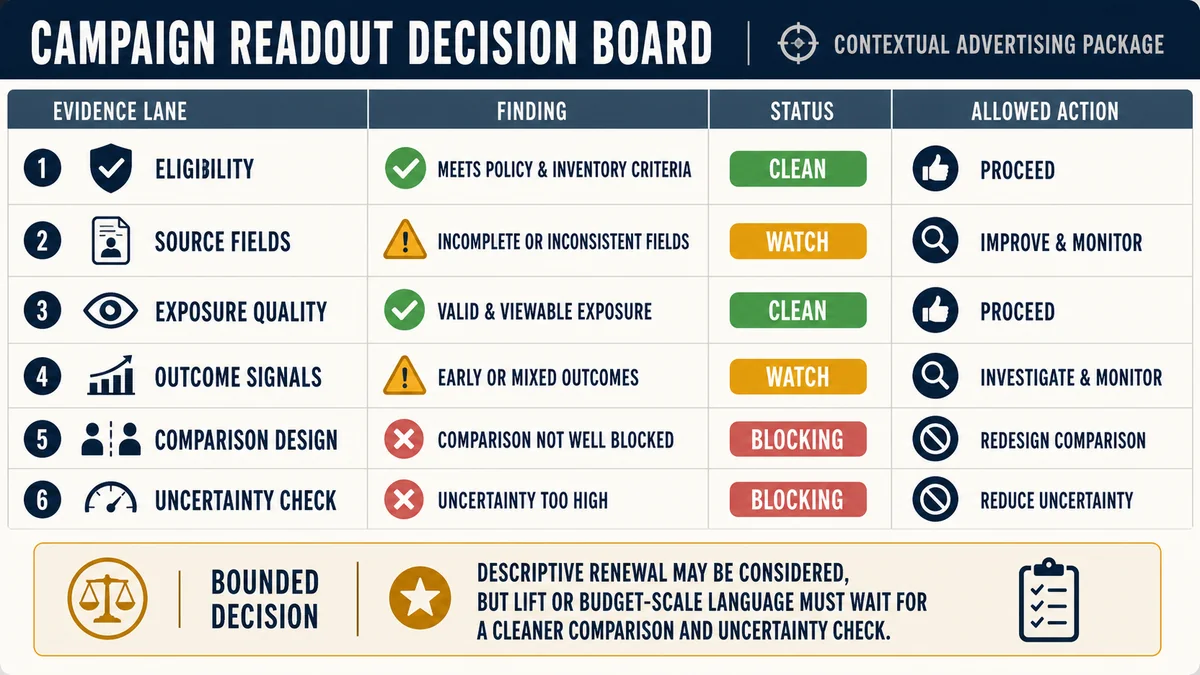
The practical action is not to discard the campaign. The safe action is to renew only if the business case can stand on observed response and delivery quality, while separately requesting the comparison and uncertainty checks needed for lift or scale claims.
Decision tree by next action
Renew the package
Use when delivery matched the agreed context, response quality met the stated goal, and the recommendation stays descriptive or uses a clearly bounded comparison.
Revise creative or destination
Use when the media context was eligible but response quality points to message mismatch, format friction, page speed, form quality, or lead-routing issues.
Shift mix carefully
Use only when placement, creative, device, or audience slices have enough comparable delivery and quality controls to support a mix change.
Request missing evidence
Use when row-level fields, outcome status, exclusions, denominator, or comparison rules are missing from the packet.
Run a lift test
Use when the next budget decision requires causal language and the current readout is descriptive, confounded, or based on attribution.
Pause or rebrief
Use when package definition, delivery eligibility, creative acceptance, destination readiness, or measurement handoff broke before the report arrived.
Triage worksheet fields
Use these fields as the compact record that travels into the renewal memo, issue register, or next-test plan.
| Field | What to record | Why it matters |
|---|---|---|
| Primary decision | Renew, revise, shift mix, request evidence, pause, or test. | Prevents a general readout from pretending to answer every possible decision. |
| Weakest evidence lane | Eligibility, source fields, exposure quality, traffic quality, outcome status, comparison, or uncertainty. | Shows where the conclusion should be bounded. |
| Cleanest evidence lane | The strongest supported finding after exclusions and quality checks. | Keeps useful learning from being discarded when one lane is weak. |
| Claim ceiling | Delivery, observed response, directional comparison, bounded lift, or unsupported. | Sets the strongest sentence the readout can support. |
| Owner and due date | The person or team responsible for missing fields, issue closeout, creative revision, or test planning. | Turns critique into an operational next step. |
| Carry-forward rule | What must change before the next flight can use stronger language. | Protects the next campaign from recycling the same evidence weakness. |
Meeting script
- Which branch of the tree is the first weak branch?
- What action can the cleanest evidence support today?
- What action would require a stronger comparison or more mature status window?
- Which result would change if attributed outcomes, small slices, or incomplete statuses were removed?
- What must be fixed before this evidence can be reused in a renewal or next-flight brief?
Primary source trail and a reproducible triage check
The tree separates descriptive reporting from causal evidence because the underlying tools answer different questions. Google Ads describes Conversion Lift as a controlled treatment-and-control design for measuring incremental conversions, while its standard experiment guidance recommends a clear hypothesis, a limited test change, preselected success metrics, and a retained experiment record. Google also warns that holdout size, study duration, conversion lag, traffic, and confidence intervals affect how much certainty a test can provide. Those controls strengthen a triage decision; they do not make an ordinary attributed report a lift study.
- Google Ads: About Conversion Lift - defines treatment and control groups and distinguishes incremental conversions from ordinary campaign reporting.
- Google Ads: Test with confidence with the Experiments page - recommends a clear hypothesis, testing one variable at a time, choosing success metrics before the test, and keeping records.
- Google Ads: Set up Conversion Lift based on users - explains the holdout-size tradeoff, study duration, conversion lag, study power, and confidence intervals.
- Google Ads: Monitor your experiments - documents comparison periods, confidence intervals, and the possibility of no clear winner when data is insufficient.
Simulated worked example - not a live campaign: assume a packet reports 1,000 qualified visits and 30 mature conversions for the campaign period, versus 1,000 visits and 25 conversions in a prior period. The observed rates are 30 / 1,000 = 3.0% and 25 / 1,000 = 2.5%; the observed difference is 3.0% - 2.5% = +0.5 percentage points, or 0.5 / 2.5 = 20% relative to the prior rate. Score the six triage lanes as Eligibility 2, Source fields 1, Exposure and traffic 2, Outcome status 1, Comparison strength 0, and Uncertainty 0, for 6 / 12 points where Clean = 2, Watch = 1, and Blocking = 0. The arithmetic supports "observed response was higher in this packet"; it does not support "the campaign caused lift," because the prior-period comparison was not preplanned, seasonality is not controlled, and no interval or holdout is shown. The result changes if the visit definition, maturity rule, comparison period, traffic mix, conversion lag, or test design changes.
References checked for this source trail. Google Ads distinguishes Conversion Lift from ordinary reporting, recommends a predeclared experiment question and success metric, and exposes uncertainty or no-clear-winner states. Those platform rules support the triage boundary; they do not validate this simulated packet or make a prior-period comparison causal.
Reproduce the action boundary
For a consistent handoff, score each of the six lanes once and add the values: total = eligibility + source fields + exposure/traffic + outcome status + comparison + uncertainty, with Clean = 2, Watch = 1, and Blocking = 0. These are editorial guardrails, not Google thresholds. A score of 0-4 routes the packet to repair or evidence request; 5-8 can support a descriptive renewal or revision if the blocking lane is named; and 9-12 can support planning a bounded next action, but it still does not authorize causal language unless the comparison and uncertainty evidence are fit for that claim. A single blocking eligibility or outcome-status lane can therefore hold a decision even when the total score looks respectable.
| Verified packet fact | What it permits | What it still cannot prove |
|---|---|---|
| Treatment and control groups were defined for a lift study. | Compare incremental outcomes within that study design. | That an ordinary attributed campaign report is incremental. |
| Hypothesis, test variable, success metric, and experiment record were set before analysis. | Interpret the planned experiment against its stated question. | That a different outcome, slice, or unplanned change has the same conclusion. |
| Holdout, study power, duration, and conversion lag are visible. | Judge whether the study has a credible uncertainty and feasibility boundary. | That a result is conclusive regardless of traffic, budget, or data strength. |
| Comparison dates and an interval or “no clear winner” result are visible. | Choose an action within the comparison and uncertainty shown. | That the result generalizes beyond the tested audience, window, or design. |
Pair with
Use this triage tree after the campaign readout QA checklist, before the campaign renewal memo template, and alongside the private marketplace renewal scorecard when a contextual package needs a final action. Use the campaign status-window closeout register when delayed rows need durable closeout fields, the campaign renewal evidence archive when final limits and next-flight owners need to carry forward, and the incrementality test plan template when the next decision requires a stronger causal design.