Buyer readiness
Private marketplace readiness index
Organization byline: Measurement Press editorial desk. This page does not list an individual author or reviewer. Read the editorial method and corrections policy.
About 12 min read
A private marketplace package should leave a clear evidence trail from audience fit to renewal. This index gives buyers, sellers, operations teams, and analysts one compact sequence for checking package proof, activation readiness, reporting fields, and decision language.
Use this page when a contextual package is moving from proposal review into activation, or when a campaign readout needs to be traced back to the package that was actually approved. It is not a rate card or a lift claim. It is a buyer-facing handoff map for deciding what must be ready, what can be revised, and what should hold before money or conclusions move.
Picture the last review before a private marketplace package launches. Sales can explain the package, ad operations can traffic the placements, analytics can name the fields, and the buyer wants to know what the campaign will prove. The readiness index turns that meeting into a sequence of records instead of a loose yes.

Source anchors and method
The sequence treats a private marketplace deal as an operational record, not a promise that every eligible impression will transact. Google Ad Manager describes Private Auctions as publisher-initiated, non-guaranteed deals with invited buyers, configurable targeting, and minimum floors. Its troubleshooting guidance also separates buyer non-response, bids under other deal IDs, filtered responses, winning bids, and competing demand. Read the Private Auctions overview and Private Auction troubleshooting guide before treating an activation or delivery result as evidence.
For the handoff itself, keep the deal identifier with the package and report grain. Google defines a Deal ID as the system-generated identifier used for Preferred Deals, Private Auctions, and Programmatic Guaranteed transactions. If custom targeting is part of the package, confirm the match rule before activation: Google's key-value targeting documentation describes exact-match key values for Private Auction deals when custom targeting is used. Before calling a key a reporting field, also check Google's targeting-key reporting guidance for defined values, reportability, overlap, and targeted-impression metrics.
How to use these sources
Copy the relevant source into the package review record, then verify the live deal settings, deal ID, targeting rule, and competing-demand conditions in the account. Documentation supports the workflow boundary; it does not prove that a specific package is configured correctly or that it will deliver.
Source-to-decision handoff
| Question | Capture before activation | Decision boundary |
|---|---|---|
| Is the transaction lane understood? | Private Auction type, invited buyer, floor, priority, start/end dates, and whether Open Auction optimization is enabled. | Revise if the brief calls a non-guaranteed deal guaranteed or omits the condition that can let competing demand win. |
| Can the deal be reconciled? | Deal ID, package revision, buyer identity, targeted inventory, report dimensions, and export timestamp. | Hold the readout if the deal ID or report grain cannot distinguish this package from another deal or Open Auction demand. |
| Is targeting testable? | Inventory dimensions, custom-targeting key and value, match rule, exclusions, creative sizes, and the account record showing the saved configuration. | Revise if a targeting label is only a proposal description; documentation cannot substitute for the saved account setting. |
| Can targeting be reported? | Key definition, value list, reportable setting, reporting dimension, targeted-impression metric, overlap treatment, and reporting date range. | Hold the delivery readout if values are undefined or the report pools overlapping keys; do not treat a key label as delivered inventory without a configured report. |
| Can a delivery problem be explained? | Ad requests, buyer did not bid, bids for this deal, winning bids, filtered/competing-demand counts, and the relevant troubleshooting export. | Use a diagnostic conclusion only when the categories reconcile; do not call low delivery a buyer or inventory failure without checking competing sources and filters. |
Reproducibility rule: retain the source URLs and access date, proposal or package revision, saved deal settings, Deal ID, targeting export, creative and destination versions, report definition, raw count fields, exception notes, and decision owner. A reviewer should be able to rebuild each readiness row from those records without relying on a screenshot or memory.
Simulated readiness check
This is a Simulated Worked Example, not a report from a live buyer, publisher, or Google Ad Manager account. It shows one reproducible way to turn the index into an activation decision. Replace the labels and values with the approved package record before use.
| Check | Pass rule | Example result | Calculation |
|---|---|---|---|
| Reader job and destination | Named buyer problem and matching destination are both recorded. | Pass | 1 pass / 1 check = 100% |
| Package identity | Package label, deal ID field, and reporting key are present and consistent. | Pass | 1 / 1 = 100% |
| Inventory scope | Included contexts, exclusions, placements, sizes, and device rules are recorded. | Revise | 4 of 5 fields present = 80% |
| Targeting rule | Targeting dimension and match rule are stated, including exact-match treatment where relevant. | Pass | 1 / 1 = 100% |
| Reporting grain | Package, context, placement, device, creative, destination, quality, and outcome fields are available. | Revise | 5 of 6 required field groups = 83.3% |
| Renewal boundary | Next action and strongest permitted conclusion are written before results arrive. | Pass | 1 / 1 = 100% |
Reproduction: count a check as passing only when every field in its pass rule is present; divide passing fields by required fields for the field-completeness rows; do not average the six percentages into a performance claim. This record has 4 passes, 2 revise states, and no hold state, so the example decision is Revise before activation until the missing inventory exclusion and reporting field are assigned an owner.
Assumptions and limits: The example uses invented statuses and no delivery, revenue, audience, or outcome data. A complete handoff can support an operational readiness decision, but it cannot establish fill, price, response, incrementality, or renewal value. Recheck the account after launch because eligible requests may be filled by competing demand and configuration can change.
The complete readiness sequence
Each stage should produce a named record. If the record is weak, the package may still be useful, but the strongest buyer-facing conclusion should be narrowed.
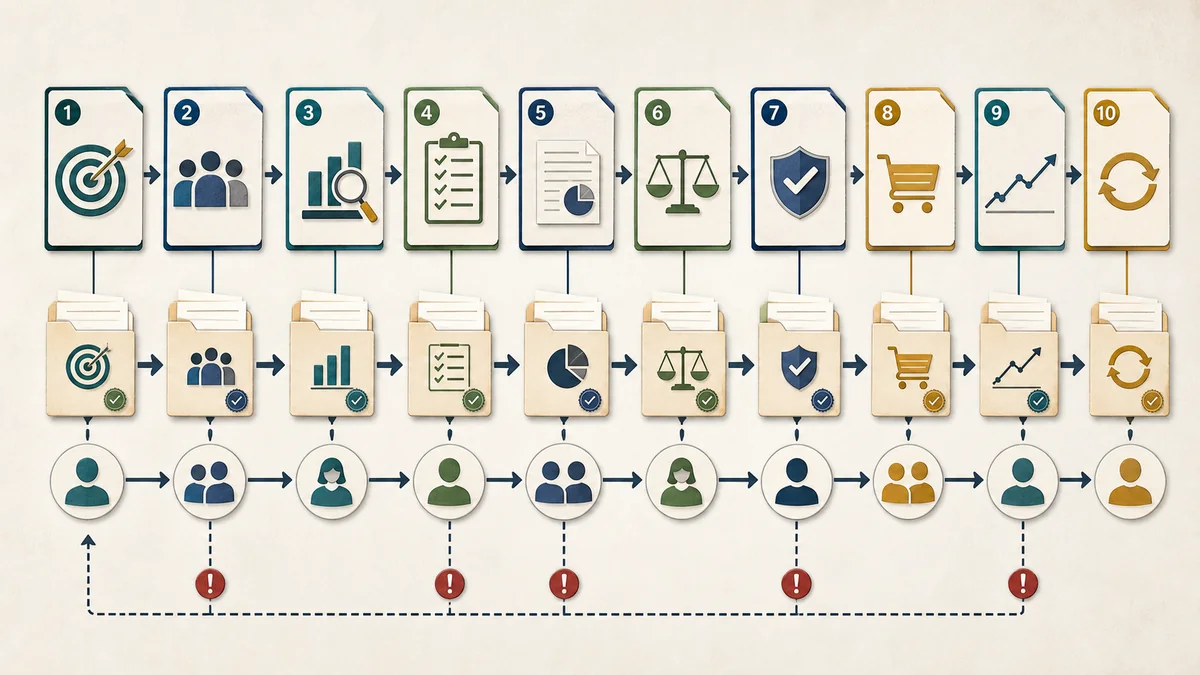
| Stage | Primary decision | Required record | Best starting page |
|---|---|---|---|
| 1. Audience fit | Does the buyer's offer match a real reader job? | Reader job, clean-fit category, unsupported uses, and destination depth. | Audience intent map and advertiser source-quality standards. |
| 2. Proposal readiness | Is the proposal narrow enough to price and review? | Objective, package lane, offer evidence, creative concept, destination, floor inputs, and readout boundary. | Proposal review packet and advertiser intake worksheet. |
| 3. Package proof | Can the package be explained without broad audience language? | Package ID, included contexts, excluded contexts, reader job, and primary signal. | Contextual package proof sheet and package proof export template. |
| 4. Inventory contract | Can operations traffic the buy without guessing? | Placement IDs, deal key, ad-unit path, accepted sizes, device rules, refresh status, and reporting key. | Media kit and inventory readiness matrix. |
| 5. Buyer brief | Does the buyer see the scope, fields, and renewal evidence before activation? | Package scope, reader context, creative fit, reporting grain, comparison rule, and renewal threshold. | Private marketplace package brief template. |
| 6. Activation gate | Are proof, identifiers, placement scope, fields, exceptions, and thresholds approved? | Ready, revise, or hold decision with exception owner and launch boundary. | Private marketplace deal review checklist. |
| 7. Launch readiness | Can the campaign launch without losing the evidence trail? | Creative approval, destination QA, URL parameters, change log, trafficking owner, and launch status. | Campaign readiness dashboard, creative acceptance checklist, and landing page QA worksheet. |
| 8. Reporting fields | Will the final report preserve enough detail to interpret results? | Package, placement, context, device, creative, destination, exposure quality, traffic quality, outcome status, and comparison fields. | Reporting field dictionary and campaign data-layer spec. |
| 9. Readout language | Does the report separate delivery, response, quality, and comparison strength? | Row-level export, package performance note, quality flags, and conclusion boundary. | Campaign walkthrough, readout export sample, and package performance readout. |
| 10. Renewal decision | Should the next action be renew, revise, shift, test, pause, or rebrief? | Renewal score, evidence dimension notes, status-window closeout, next-test need, archive record, owner/gate fields, and wording limit. | Private marketplace renewal scorecard, campaign renewal memo template, campaign renewal evidence archive, campaign status-window closeout checklist, and incrementality test plan template. |
Ready, revise, or hold
This compact decision grid keeps each handoff from becoming a vague approval. A package can be commercially promising and still need a hold if the missing field affects interpretation.
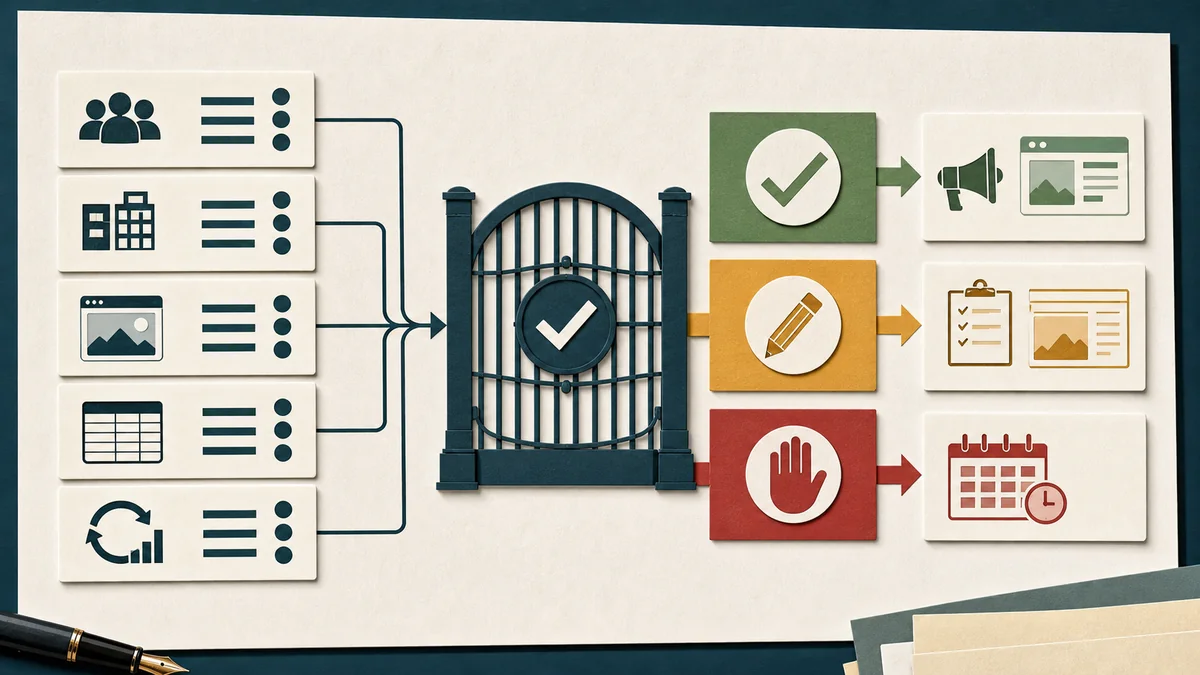
| Area | Ready | Revise | Hold |
|---|---|---|---|
| Audience and offer fit | The offer helps the reader with a relevant professional task and the destination has enough substance to inspect. | The fit is plausible, but the offer or destination should be narrowed to one use case. | The package depends on broad reach, thin evidence, or a destination that does not match the reader job. |
| Package and inventory | Package IDs, eligible contexts, placements, sizes, exclusions, and reporting keys match the public inventory record. | One placement, device rule, or excluded context needs a clearer contract. | The package cannot be trafficked or audited against the sold scope. |
| Creative and destination | Display or native assets, labels, URLs, UTM values, destination state, and change-log owner are complete. | Creative can launch after a named file, copy, or destination fix. | The creative or destination gap would make response data uninterpretable. |
| Reporting and comparison | Fields preserve package, context, placement, device, creative, destination, quality, outcome, and comparison status. | Some fields are directional and must be labeled before the readout. | The buyer's expected decision depends on fields or comparisons that will not exist. |
| Renewal threshold | The renew, revise, shift, test, pause, or rebrief rule is written before results arrive. | The threshold exists but needs a minimum delivery or quality caveat. | The next decision would be chosen after seeing the most favorable metric. |
Minimum buyer handoff
If a team needs one portable record, capture the fields below before activation. The values should match the proposal, media kit, ad operations sheet, reporting export, and renewal note.
| Handoff field | What to record | Decision it protects |
|---|---|---|
| buyer_problem | The planning, evaluation, education, or decision task the campaign supports. | Whether the package is a contextual fit rather than a broad audience buy. |
| package_id | Stable package ID, label, pmp_deal_key, package_reporting_key, and buying path. | Whether proposal, trafficking, invoice, and report can name the same buy. |
| eligible_context | Included desks, guide groups, case-study groups, buyer-reference pages, and excluded contexts. | Whether delivery can be judged against the sold reader job. |
| placement_scope | Placement IDs, sizes, device rules, format, refresh status, and excluded placements. | Whether operations can traffic the package without changing scope. |
| creative_destination | Creative IDs, message theme, native fields if used, destination ID, URL parameters, and launch state. | Whether response reflects the package, the creative, the destination, or a launch issue. |
| reporting_grain | Package by context group, placement, device class, creative size, destination, quality flag, and outcome status. | Whether the readout can avoid pooling unlike signals into one claim. |
| comparison_rule | No comparison, prior flight, matched context, matched market, protected holdout, or randomized split. | Whether the final language can be descriptive, directional, or causal. |
| renewal_threshold | Minimum delivery, quality condition, outcome state, and next action rule. | Whether the campaign result becomes a clear decision instead of a favorable metric search. |
| exception_owner | The owner for placement, creative, destination, reporting, comparison, and renewal exceptions. | Whether weak fields are resolved or labeled before the report is written. |
Evidence path by buyer question
Different buyer questions require different proof. Start with the question before choosing the metric or report page.

| Buyer question | Evidence path | Strongest ordinary conclusion | Upgrade needed for stronger language |
|---|---|---|---|
| Is this the right context for the offer? | Audience intent map, source-quality standards, package proof sheet, and package brief. | The package fits a named reader task and offer type. | Post-launch response by context, creative, and destination. |
| Can the buy be trafficked cleanly? | Media kit, inventory readiness matrix, programmatic inventory QA, and deal review. | The package has stable IDs, placements, sizes, and reporting keys. | Launch-readiness confirmation and exception log. |
| Did the package deliver as sold? | Reporting field dictionary, export sample, and package performance readout. | The campaign delivered within or outside the approved package scope. | Device, placement, creative, and context-separated rows. |
| Did the campaign produce useful response? | Traffic-quality fields, outcome status fields, campaign readout QA, and renewal scorecard. | The campaign produced observed response under the stated quality rules. | A credible comparison if the next question is incremental impact. |
| Should the package renew? | Package performance readout, renewal scorecard, outcome quality scorecard, and comparison rule. | The evidence supports renewal, revision, mix shift, retest, pause, or rebrief. | A designed holdout, geo test, or randomized split for lift language. |
When the path branches
The standard sequence can be shortened or extended depending on the buying path, the format, and the decision the buyer wants to make.
Direct sponsorship
Start with proposal review, source-quality fit, native-card examples, creative acceptance, and the contextual campaign brief before using the same reporting and renewal steps.
Programmatic package
Prioritize inventory QA, supply-path transparency, package IDs, deal keys, size maps, seller-path evidence, reporting keys, and the activation gate.
Native card
Keep display and native results separate. Preserve headline, sponsor label, destination, image, message theme, and placement context before comparing response.
Migration or template change
Use migration readiness before route, ad path, template, feed, or reporting-baseline changes affect package availability or historical comparisons.
Yield decision
Use deal-readiness and yield inputs when the question is floor, scarcity, sell-through, refresh, renewal signal, or package priority rather than campaign response.
Lift decision
Move to incrementality planning when the buyer needs causal language. A clean package readout can justify a better test, but it does not replace the test.
Readiness record example
The sample values below show structure, not performance targets. Replace them with the actual package, creative, destination, and reporting decisions for the campaign being reviewed.
| Record item | Example value | Decision note |
|---|---|---|
| Readiness decision | Revise before activation. | Package proof and identifiers are ready; destination status and outcome fields need completion. |
| Package | measurement-science-desk, mp-msd-pmp, package.measurement_science_desk. | Reader job is method selection and campaign measurement review. |
| Placements | article-inline-1, article-inline-2, article-rail-1, post-content. | Archive leaderboard excluded from this flight because the brief is deep-guide oriented. |
| Creative and destination | Planning-guide display creative, approved desktop and mobile sizes, destination_id measurement-report-demo. | Click URL and UTM values are ready; form source field still needs QA. |
| Reporting grain | Package by guide group, placement ID, device, creative size, destination, qualified visit, and lead status. | Small cells will be marked directional before package performance language is written. |
| Comparison rule | Matched prior contextual flight, no protected holdout. | Supports directional renewal language, not causal lift language. |
| Next action | Complete landing-page QA, then rerun the deal review before activation. | Activation should wait because destination fields affect the buyer's outcome decision. |
Signoff questions
- Can the buyer, seller, operations team, and analyst name the same package ID, deal key, placements, and reporting key?
- Does the package proof describe a reader job and eligible context rather than a broad audience promise?
- Are creative files, native fields, destination state, URL parameters, and change-log ownership ready before traffic starts?
- Will the report preserve package, context, placement, device, creative, destination, quality, outcome, and comparison fields?
- Is the renewal threshold written before results are visible, and does it match the comparison rule?
Open the broader buyer-readiness route.
Use these routes when a package review needs audience intent, inventory boundaries, or a live search lane.
Buyer deskStart the readiness pathConnect package proof, buying teams, creative handoff, launch QA, reporting fields, and renewal evidence.
Buyer laneSearch buyer-readiness guidesFind private marketplace, contextual package, proposal, launch, and renewal pages.
Inventory routeCheck placement readinessMove from package promise into slot contracts, reading flow, seller paths, and reporting keys.