Advertiser fit
Native card and landing page example gallery
Organization byline: Measurement Press editorial desk. This page does not list an individual author or reviewer. Read the editorial method and corrections policy.
About 12 min read
A buyer can bring a useful professional resource and still hand over a native card that is too vague, a landing page that changes the promise, or a reporting plan that would turn clicks into a stronger claim than the setup supports.
Use this gallery when the offer seems relevant but the paid card, landing page, or expected readout needs clearer evidence language before launch. The examples are patterns, not templates for named brands. A strong card helps the reader understand the resource, keeps the sponsor visible, sends the reader to a destination with substance, and preserves the fields needed for a bounded campaign readout.
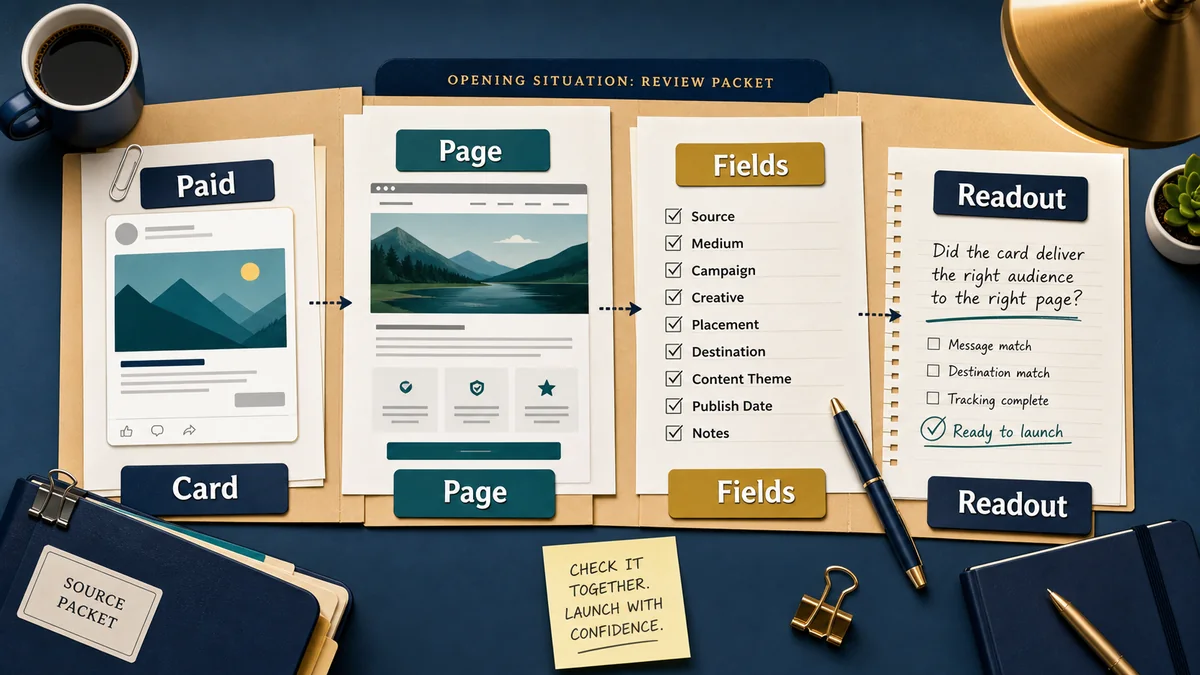
Native approval map
Use the map before copying a pattern from the gallery. A native unit should not move into trafficking until the offer, card, destination, launch fields, and result language can all be reviewed from the same record.

Source fit is settled
The sponsor category, resource, and supporting source trail match a professional reader task already served by the page set.
The promise is inspectable
The paid label, sponsor identity, headline, body copy, and image describe a specific resource without sounding like an editorial endorsement.
The page continues the promise
The landing page opens on the same resource or task, gives useful context before a form, and avoids a surprise gate or unrelated sales page.
The record is trafficable
Creative ID, destination ID, package ID, placement ID, and comparison rule are separated before the unit enters a campaign.
The boundary is written first
The team knows whether the campaign can support descriptive response, format comparison, lead-quality review, or designed lift language.
Review lens
| Field | Accepted pattern | Revise pattern |
|---|---|---|
| Sponsor label | The sponsor name or buyer category is visible before the headline is read. | The reader has to infer who is behind the unit or why it is paid. |
| Headline | Names a concrete report, checklist, webinar, product explainer, template, or service page. | Uses a broad promise, urgency cue, or certainty claim that does not name the resource. |
| Body copy | Explains the professional job the resource helps with in plain language. | Sounds like editorial recommendation, category ranking, or a guaranteed outcome. |
| Destination | Continues the same promise and gives useful information before a form, demo path, or registration ask. | Leads to a thin page, unrelated page, surprise gate, or different claim than the card made. |
| Measurement field | Creative ID, destination ID, placement ID, package ID, and comparison rule are available before launch. | The final report would pool native, display, context, and destination response into one total. |
Score the example before approval
A quick score keeps review from turning into taste. Give each row 0, 1, or 2 points, then use the total to decide whether the card can launch, needs a specific revision, or should stay out of trafficking until the buyer supplies a stronger packet.
| Area | 0 points | 1 point | 2 points | Decision cue |
|---|---|---|---|---|
| Source fit | Offer, audience, or category fit is unclear. | Fit is plausible but source support is thin. | Offer, source trail, and reader task are specific. | A low score here means revise upstream before judging copy. |
| Card promise | Headline borrows certainty or hides the paid nature. | The resource is named but the job or boundary is vague. | Label, sponsor, resource, and reader task are easy to inspect. | A weak card can be rewritten without rejecting a good offer. |
| Destination match | The click changes the promise or opens on a thin gate. | The page matches the topic but hides useful context. | The page continues the card and gives substance before the ask. | Do not launch if the page breaks the promise. |
| Launch fields | Creative, page, package, or comparison fields are missing. | Fields exist but would be hard to join in the report. | IDs, destination version, and comparison rule are separated. | Missing fields usually require a hold, not a caption fix. |
| Readout boundary | The campaign expects lift language from observed response. | The limit is acknowledged but not written into the launch note. | The strongest allowed result language is written before launch. | Boundary language protects renewal conversations later. |
Action threshold8 to 10 points can usually move to final traffic checks, 5 to 7 points should return a focused revision list, and 0 to 4 points should stay on hold until the offer, page, fields, or reporting boundary is rebuilt.
Native card examples
These examples show how to keep a paid module useful without making it sound like editorial judgment.
| Use case | Accepted card | Revise before launch | Why |
|---|---|---|---|
| Measurement planning report | Sponsored by an analytics platform: "A worksheet for planning incrementality tests before budget decisions." Body copy names holdouts, outcomes, and readout limits. | "The measurement guide every marketer needs now." | The accepted version names the resource and reader task. The revise version borrows editorial certainty and does not reveal the evidence job. |
| Research operations webinar | Sponsored by a research software provider: "Webinar: improve sample-quality checks before brand tracking readouts." Body copy names respondent balance and fielding controls. | "Finally fix unreliable brand research." | The accepted version is specific enough to judge fit. The revise version implies a universal solution without showing what will be taught. |
| Data-quality product explainer | Sponsored by a data infrastructure team: "How event-quality monitoring protects campaign source fields." Body copy names UTM, creative ID, destination ID, and event rules. | "Stop bad data from ruining revenue." | The accepted version connects the product to a source-trail problem. The revise version is too broad for a careful evidence page. |
| Professional learning course | Sponsored by a professional learning provider: "Short course: read MMM, lift-test, and attribution reports with cleaner claim language." Body copy names the skills and audience. | "Become the smartest person in every marketing meeting." | The accepted version sets a believable learning scope. The revise version sells status rather than a useful decision workflow. |
Landing page examples
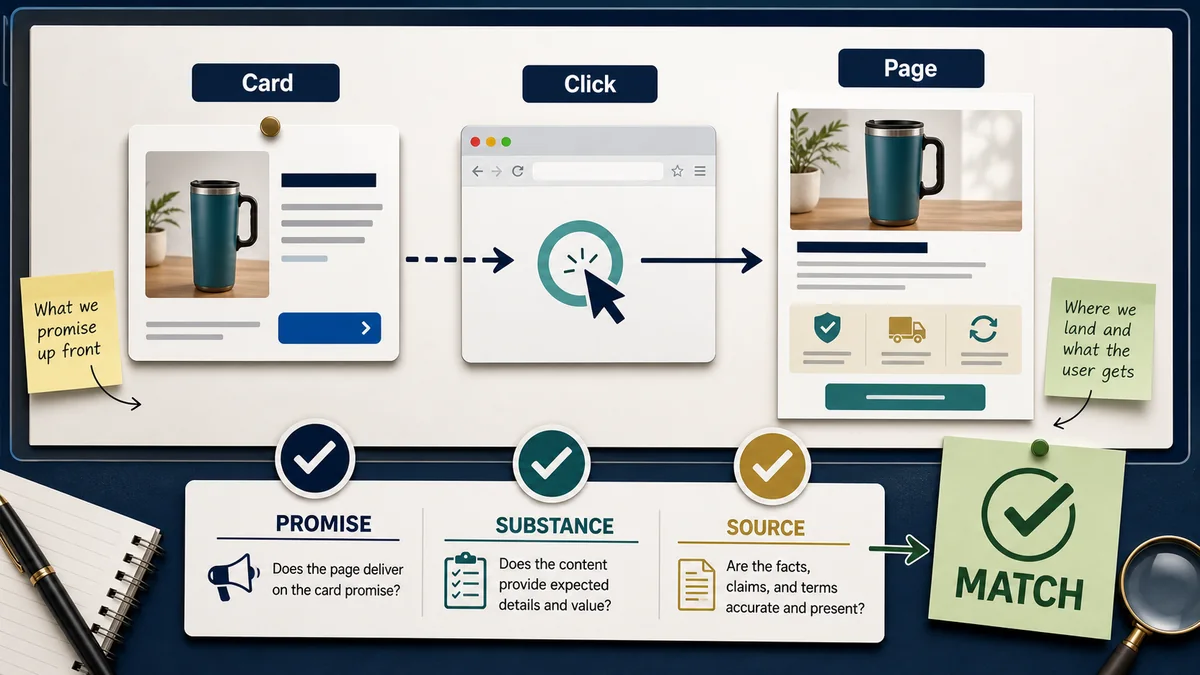
The landing page should deepen the same reader task introduced by the card. It can still include a form or demo path, but the useful content should not disappear behind the first click.
| Destination type | Accepted page | Revise before launch | Reporting implication |
|---|---|---|---|
| Report download | Summary, method note, sample or data source, date range, limitations, and form fields below the summary. | Only a form and a vague report title with no method or preview. | Accepted pages can support qualified-visit and download-quality reads. Thin pages make response hard to interpret. |
| Webinar registration | Agenda, speaker role, learning objectives, date, expected audience, and what will not be covered. | Broad event promise with no agenda, source trail, or professional task. | Accepted pages let the readout separate context fit from event-fit problems. |
| Product explainer | Use case, workflow screenshots or diagrams, integration fields, measurement limits, and next action. | Feature list with no reader problem, no evidence trail, and no connection to the card. | Accepted pages make destination quality inspectable before the campaign is judged by clicks alone. |
| Advisory service page | Service scope, deliverables, method outline, required inputs, limitation statement, and contact path. | Generic services page promising results without naming the work or assumptions. | Accepted pages keep lead quality tied to a defined need instead of broad sales interest. |
Card-to-page match
A native card can be acceptable by itself and still fail if the destination changes the promise. Check the transition before trafficking.
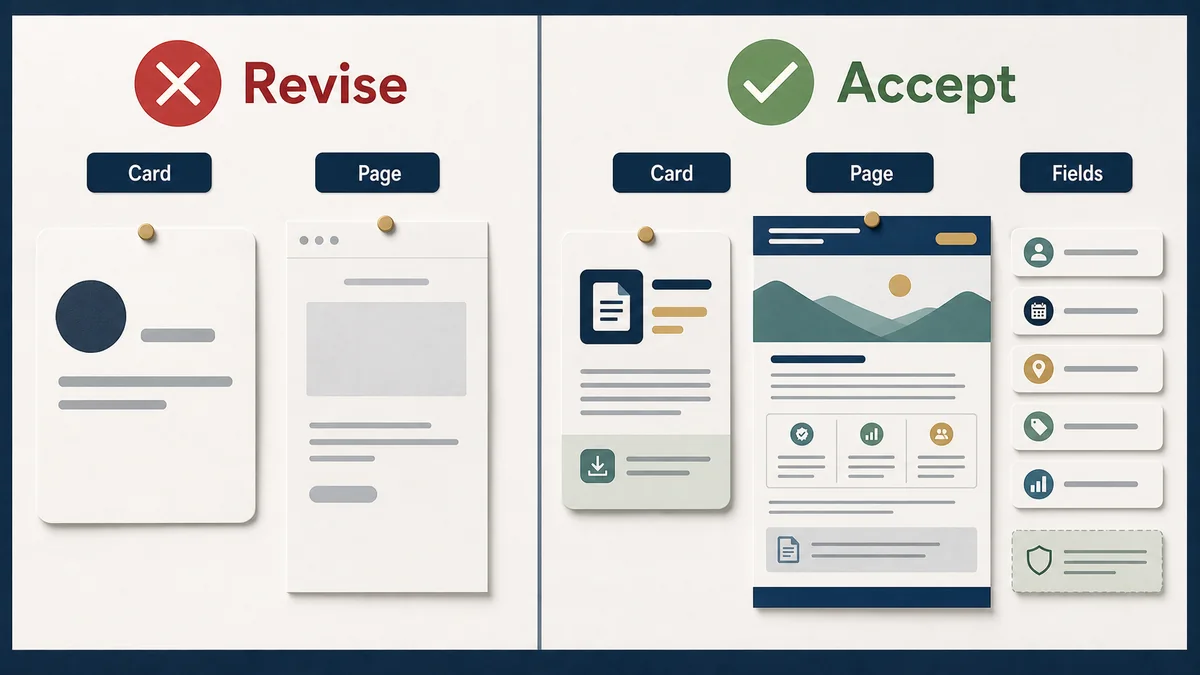
Accepted matchThe card promises a checklist for planning geo lift tests. The destination opens with the same checklist, explains market matching and leakage checks, then offers a demo path for teams that need implementation support.
Revise matchThe card promises a checklist, but the destination opens on a general sales page with no checklist, method note, or direct path to the promised resource.
Readout language by setup
The approved creative should shape the strongest report language before results are visible.
| Setup | Fair readout language | Do not write |
|---|---|---|
| Native card with clean destination, no comparison. | The card generated observed response in the selected context and should be compared with a protected design before lift language is used. | The native card proved incremental demand. |
| Native and display split by creative ID and placement ID. | Native and display response differed by format, placement, and destination; keep the lanes separate in renewal decisions. | Native outperformed display in every context. |
| Landing page includes lead status. | Qualified, disqualified, duplicate, follow-up, and missing lead status should be shown beside form volume. | The campaign produced high-quality leads because form fills were high. |
| Reserved holdout or matched baseline exists. | The readout can use the designed comparison, uncertainty, leakage checks, and limitations to discuss lift. | Any positive cell can be treated as causal proof. |
Revision notes that help buyers
- Replace broad superiority claims with the exact report, template, event, product explainer, or service scope.
- Move useful context above the first form when the destination asks for registration or contact details.
- Add a short method note when the card or page uses benchmarks, survey results, model claims, or performance examples.
- Keep native creative IDs separate from display creative IDs so the readout does not average unlike formats.
- Name the comparison rule before launch, even when the rule is that no comparison is available.
Evidence trail, source-to-decision handoff, and a simulated review packet
The disclosure test is grounded in the Federal Trade Commission's native advertising guidance, which emphasizes clear, prominent, nearby language that a reasonable reader can recognize as advertising. Google's native-ad elements guidance identifies the ad attribution, advertiser name, title, body, and call to action as structured parts of a native unit, while its native styles guidance describes the required ad badge and title fields for standard content formats. Google's destination-mismatch policy adds a separate check: the displayed destination should accurately reflect the final and mobile destinations, and the landing page should be functional, useful, and easy to navigate. These sources support the review method; they do not prove that any particular card, destination, or campaign will perform.
Source-to-decision handoff
Record the source observation beside the packet field it changes. This makes the review reproducible and keeps policy guidance separate from performance evidence.
| Verified source | Packet field to inspect | Hold or revise trigger | Allowed conclusion |
|---|---|---|---|
| FTC native advertising guide | Disclosure text, placement, contrast, and proximity to the card's focal point on feed and click-through surfaces. | The reader must infer that the unit is paid, or the label is distant, ambiguous, or absent on a surface. | The disclosure is easier to recognize; this is not a finding of legal compliance. |
| Google Ad Manager native ad elements | Ad attribution, advertiser, title, body, image, and call-to-action fields in the creative record. | A required field is missing or the final rendered unit cannot be reconciled to the approved record. | The creative packet is incomplete or needs revision before trafficking. |
| Google Ad Manager native styles | Style, badge, title, and field rendering at the declared desktop and mobile breakpoints. | The badge, title, or required style treatment disappears or changes the reader's interpretation on either surface. | The rendered asset needs a cross-device QA pass; no performance claim follows. |
| Google Ads destination mismatch | Display URL, final URL, mobile URL, crawl response, page substance, and message match. | The destination redirects to a different domain, fails to load, cannot be crawled, or hides the promised resource behind an unexplained gate. | Hold the packet until the destination is functional, useful, and traceable to the card. |
Implementation boundary: The FTC check asks whether a reasonable reader can recognize the unit as commercial content on the feed and the click-through page. The Google Ad Manager checks describe the fields and rendering rules of a particular native implementation, including the required ad badge and title in standard programmatic native formats; they are not a performance score. The Google Ads destination check is separate again: it tests whether the displayed and final destinations agree and whether the destination is functional, useful, and easy to navigate. Keep those three observations in separate packet fields before making a launch or readout decision.
Reproduction rule: Save the final card text, disclosure screenshot, creative and destination versions, desktop/mobile URLs, five score rows, and comparison rule in one review record. A second reviewer should be able to reproduce the same hold/revise route from those fields without relying on memory or a performance result.
Simulated worked example -- not a real campaign, approval, benchmark, or forecast: Assume one proposed packet is scored across the five records used on this page. Source fit earns 2 points, card promise 2, destination match 1, launch fields 1, and readout boundary 1. The total is 2 + 2 + 1 + 1 + 1 = 7 / 10. Under the rubric above, the packet returns a focused revision list rather than moving straight to final traffic checks: repair the destination mismatch, separate the missing launch identifiers, and write the no-comparison boundary before approval. The example demonstrates the arithmetic and routing decision only; it says nothing about Measurement Press inventory or buyer results.
| Record | Simulated finding | Points | Action |
|---|---|---|---|
| Source fit | Offer, source trail, and reader task are specific. | 2 / 2 | Keep the proposed resource in scope. |
| Card promise | Paid label and resource are clear, but the body copy is still broad. | 2 / 2 | Keep, then check the final copy against the source. |
| Destination match | The page topic matches, but the promised worksheet appears below an unexplained form. | 1 / 2 | Revise the page opening and put useful context before the ask. |
| Launch fields | Creative and package IDs exist; destination version is missing. | 1 / 2 | Hold trafficking until the join key is recorded. |
| Readout boundary | No comparison is available, but the draft report says “proved demand.” | 1 / 2 | Rewrite as observed response or design a comparison. |
Assumptions and limits: The five records are scored once on a 0-to-2 scale, so the maximum is 10 and the rows are not performance metrics. A real review must name the final URL, mobile behavior, disclosure placement, creative and destination versions, record grain, time window, outcome definition, and comparison design. A packet score can route review work; it cannot establish audience quality, incrementality, revenue impact, or legal compliance by itself.
Choose the next card-quality check.
Use these routes when an example exposes a missing source trail, creative field, landing-page promise, intake record, launch approval, or reporting field.
Source qualityReview the offer trailCheck advertiser fit, source support, destination substance, and claim quality before acceptance.
Creative acceptanceApprove the asset fieldsConfirm labels, image use, copy, click URL, creative ID, and traffic-ready handoff notes.
Landing page QAMatch card to pageCheck message match, page substance, speed, consent, source capture, and lead routing before launch.
Advertiser intakeRecord proposal qualityDocument audience fit, source claims, destination quality, exclusions, and hold/revise triggers.
Launch readinessSequence the approvalCarry source fit, package proof, creative approval, destination QA, inventory, and readout fields into launch.
Reporting fieldsKeep results separatedName package, placement, creative, destination, quality, outcome, and comparison fields before reporting.
Pair with
Use this gallery with the advertiser source-quality standards for offer fit, the creative asset acceptance checklist for display and native handoff, the landing page launch QA worksheet for destination checks, the contextual campaign brief template for launch language, and the private marketplace package performance readout before renewal language is written.