Lift-test planning
Minimum detectable effect planning checklist
Organization byline: Measurement Press editorial desk. This page does not list an individual author or reviewer. Read the editorial method and corrections policy.
About 14 min read
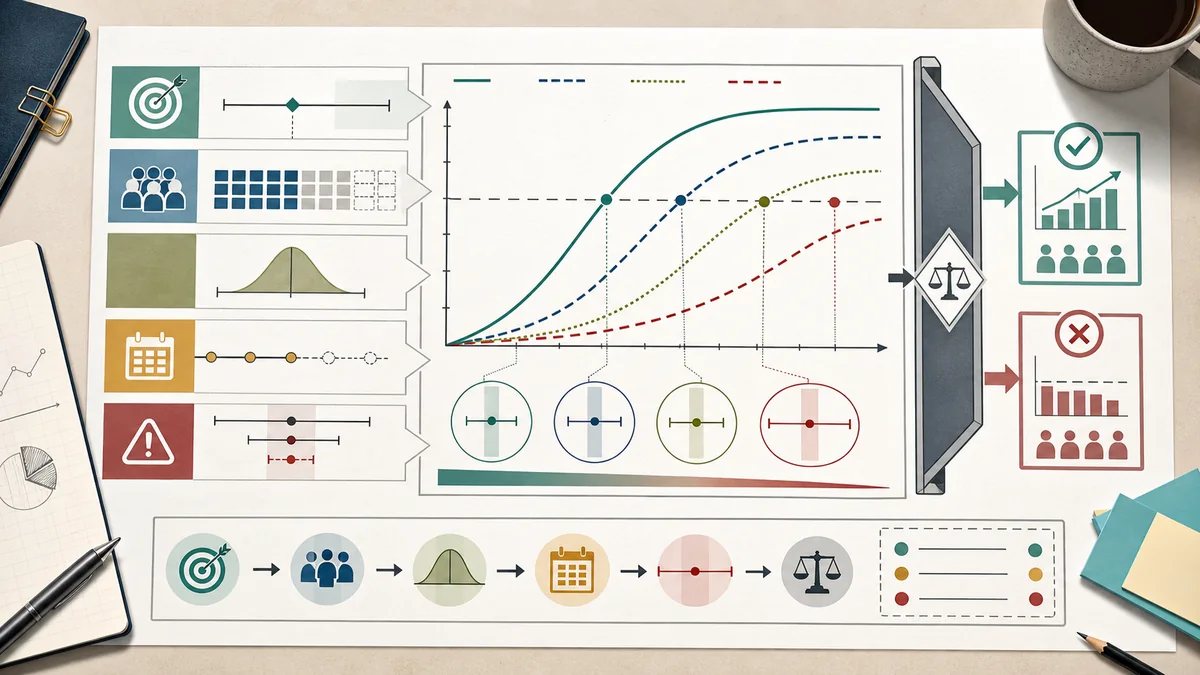
A lift test can be well randomized and still be unhelpful if it cannot detect the effect the decision needs. Minimum detectable effect planning keeps the test honest before the campaign, audience, outcome, and budget are locked.
Use this checklist before launching a conversion lift test, geo lift test, brand study, retail-media incrementality test, or private marketplace campaign readout. The goal is to decide whether the planned test can separate a meaningful effect from ordinary noise.
Start with the decision threshold
The minimum detectable effect should not be chosen only because a calculator returns it. Start with the smallest effect that would change the decision, then check whether the planned sample, base rate, and test window can detect it.
| Planning field | Make visible before launch | Weak shortcut |
|---|---|---|
| Decision | The spend, renewal, creative, audience, market, or vendor decision the test will inform. | Running a test because a platform can provide one. |
| Action threshold | The minimum lift, margin, qualified lead rate, pipeline movement, brand shift, or revenue effect that would justify action. | Accepting any positive estimate as useful. |
| Base rate | The current outcome rate for the eligible population, with seasonality and conversion lag noted. | Planning around a category benchmark that does not match the tested audience. |
| Absolute effect | The percentage-point or unit difference implied by the business threshold. | Using relative lift alone, especially when the base rate is small. |
| Assigned unit | User, household, account, store, market, or placement group, plus the reason that unit can be separated. | Choosing the unit that is easiest to report rather than the unit that protects the counterfactual. |
| Available sample | Eligible units, expected delivery, reachable control size, event volume, and any matching or survey completion loss. | Counting all site traffic, customers, impressions, or markets as if all are eligible for the test. |
| Test window | Exposure period, outcome maturity window, lag allowance, and reporting cutoff. | Stopping when the first favorable readout appears. |
| Power and precision | Minimum detectable effect, planned power, interval width, and whether the test can detect the action threshold. | Calling an underpowered result negative or a noisy positive result proven. |
Translate the business hurdle
From relative lift to absolute liftA 20 percent relative lift can be tiny if the base outcome rate is tiny. Translate the decision into an absolute change in conversion rate, lead rate, margin, qualified pipeline, or brand response before judging whether the test is large enough.
From outcome volume to commercial valueIncremental outcomes should be tied to the metric that changes the decision. A test planned around raw leads may still be underpowered for qualified leads, pipeline, margin, or retained customers.
From statistical threshold to action thresholdStatistical detection is not the same as business usefulness. A test can detect a small effect that does not clear the payback hurdle, or miss a useful effect because the sample is too small.
From aggregate to segmentIf the decision is about a segment, market, device, creative, or audience slice, plan power for that unit. A well-powered aggregate test does not automatically support confident slice rankings.
Power-readiness gates
| Gate | Pass condition | If it fails |
|---|---|---|
| Outcome is common enough | The planned window produces enough observed outcomes to estimate the decision metric with useful precision. | Extend the window, choose a more mature outcome, increase eligible sample, or lower the decision stakes. |
| Control group can be protected | Suppression, holdout, market separation, or survey control rules keep the comparison meaningful. | Use the result as operational learning, not strong causal evidence. |
| Effect threshold is realistic | The action threshold is large enough to matter and small enough for the test to detect under the available sample. | Do not launch a high-stakes test that can only detect effects larger than the business expects. |
| Lag is included | The outcome window covers the expected response delay, sales cycle, survey fielding, or conversion maturity period. | Separate early diagnostics from final outcome claims. |
| Segments are preplanned | Priority slices, minimum bases, and downgrade rules are written before results are visible. | Label slice findings exploratory and retest before concentrating spend. |
| Stop rule is locked | The team knows when the test will end and what evidence triggers scale, redesign, repeat, or no action. | Avoid reading every interim result as a final decision. |
MDE readiness score
Use this score before launch to decide whether the planned test can support the decision, should be redesigned, or should be labeled as a learning readout. The score is deliberately practical: it separates business threshold, available evidence, and allowed language.
| Review field | Green | Yellow | Red |
|---|---|---|---|
| Action threshold | The smallest useful effect is written as an absolute outcome, margin, pipeline, or brand-response change. | The threshold exists, but it is still stated mostly as relative lift or a soft goal. | Any positive estimate will be treated as useful. |
| Detectable effect | The planned MDE is at or below the action threshold with the stated power and uncertainty method. | The MDE is slightly above the threshold, so the result can guide learning but not a high-stakes action by itself. | The test can only detect an effect larger than the business would realistically expect. |
| Outcome volume | Eligible units and mature outcomes remain sufficient after exclusions, match loss, survey completion loss, and conversion lag. | Volume is plausible, but one loss factor or maturity window still needs a written assumption. | The plan counts all traffic, impressions, customers, or markets as if all are eligible and mature. |
| Control protection | Treatment and control separation is enforceable for the assigned unit and the measurement window. | Some contamination risk is named, but the readout language has a downgrade rule. | Suppression, market separation, or holdout protection is assumed rather than operationally checked. |
| Segment language | Only preplanned segments with minimum bases can receive decision-grade language. | Segments can be reported as directional diagnostics if they are visibly underpowered. | Slice rankings will be used to move budget even when only the aggregate is powered. |
If any row is red, do not launch the test as decision-grade without repair. If two or more rows are yellow, the launch brief should name the test as a learning readout, a design rehearsal, or a bounded decision rather than a broad proof of effectiveness.
Planning worksheet
| Worksheet prompt | Record before launch |
|---|---|
| What decision changes if the test clears the threshold? | Scale, renew, pause, change creative, change audience, change bid, change market mix, or run a larger test. |
| What is the current base rate? | Outcome rate, qualified outcome rate, or brand response rate for the eligible population and period. |
| What absolute effect is worth acting on? | Percentage-point change, incremental outcome count, incremental margin, qualified pipeline, or material brand movement. |
| What sample is actually eligible? | Assigned units, expected treatment delivery, reachable control, exclusions, matching loss, and survey completion loss. |
| What is the planned minimum detectable effect? | The smallest effect the design is expected to detect with the stated power and uncertainty method. |
| What happens if the detectable effect is larger than the action threshold? | Change design, extend duration, reduce decision stakes, or mark the readout as learning-only. |
| Which slices matter before results are visible? | Preplanned segments, minimum bases, interval requirements, and exploratory labels. |
| Which language is allowed after each result pattern? | Scale within tested bounds, directional learning, inconclusive, operational issue, or unsupported causal claim. |
Decision language by power pattern
| Pattern | Careful interpretation | Do not say |
|---|---|---|
| The test is powered to detect the action threshold, assignment is clean, and the interval clears the hurdle. | The result supports the stated decision within the tested population, period, and outcome definition. | The channel will produce the same lift everywhere. |
| The test is underpowered for the action threshold and returns a near-zero estimate. | The result is inconclusive for the decision; it may not have been able to detect a useful effect. | The campaign had no effect. |
| The point estimate is positive but the interval is wider than the threshold. | The result is directional at best and needs more sample, stronger outcome quality, or a repeat test. | The test proved lift because the estimate was positive. |
| The aggregate is powered but planned segments are not. | The aggregate can guide a bounded decision; segment rankings need quieter language or a dedicated test. | The top segment won. |
| The test detects a statistically visible effect below the commercial hurdle. | The media may have moved the outcome, but the effect may not justify the planned action. | Statistical lift means the budget should scale. |
Worked downgrade example
A campaign team wants a lift test to decide whether to renew a private marketplace package. The business owner writes that renewal needs at least 300 incremental qualified leads over the campaign window. Current qualified-lead rate is low, match loss is expected, and the planned test can only detect about 700 incremental qualified leads with useful precision.
The test can still be worth running, but the launch brief should downgrade the decision language before results are visible. A positive point estimate below the 700-lead detectable effect can be described as directional learning, not renewal proof. A near-zero estimate cannot be treated as evidence that the package had no value because the design could not reliably detect the smaller effect that would still matter to the business.
The repair is not to hide the power problem. The repair is to change one of the planning inputs: extend the test, increase eligible sample, use a more common mature outcome, lower the decision stakes, or precommit that the readout will only decide whether a larger test is justified.
Source check for power and timing
Power is a design assumption, not a property that appears after the report is exported. Google’s Conversion Lift guidance says study power depends on historical data, estimated lift, conversion actions, budget, duration, and the holdout share; it also warns that a smaller holdout may require a longer study. Its guidance recommends setting the study duration to cover average conversion lag. For platform experiments, Google experiment guidance separately recommends allowing enough time for the experiment and conversion cycles rather than treating an early read as final.
NIST’s sample-size guidance makes the broader statistical boundary explicit: there is no correct sample size without assumptions about error rates, the effect to detect, and variability. That means a calculator output should be recorded with its outcome definition, alpha or certainty target, power target, baseline, expected loss, and maturity window—not copied into a brief as a universal threshold.
Source-to-decision handoff
These references establish planning boundaries; they do not validate the fictional counts below or predict a real campaign result. Use each source to choose a check, then keep the claim no broader than the design and data allow.
| Source boundary | What the source supports | Check before launch | Claim ceiling |
|---|---|---|---|
| Google Conversion Lift feasibility | Study power is shaped by historical data, estimated lift, conversion actions, budget, duration, and holdout share; holdout size trades off opportunity cost and data collection speed. | Record the platform feasibility range, selected outcome, holdout share, budget, duration, and conversion-lag assumption. | A conditional feasibility estimate for the configured study, not proof that the campaign will produce the estimated lift. |
| Google experiment timing | Experiments can be less reliable when run together, and Google recommends allowing for conversion cycles and longer delays. | Lock the end date, ramp-up treatment, overlapping-test rule, and maturity window before reading interim results. | A result for the defined test window and outcome, not a timeless channel effect. |
| NIST sample-size guidance | Required sample depends on the error risks, effect to detect, and variability assumed in the design. | Retain alpha or certainty target, beta or power target, baseline/variance estimate, effect threshold, and rounding method. | A calculation conditional on stated assumptions, not a universal sample-size rule. |
Simulated planning gate
This is a Simulated Worked Example, not a Measurement Press campaign result. Assume a team is deciding whether to fund a larger lift test for one defined audience. The eligible population is 10,000 units: 8,000 treatment units and 2,000 holdout units. The current qualified-lead rate is 5.0%, and the smallest useful action threshold is a 1.5 percentage-point improvement in the mature outcome.
| Planning input | Simulated value | Why it matters |
|---|---|---|
| Holdout share | 2,000 / 10,000 = 20.0% | The comparison must remain protected; the chosen split also carries an opportunity cost. |
| Baseline outcome | 5.0% qualified-lead rate | The baseline is stated for the eligible audience and must be checked against the actual pre-period. |
| Action threshold | 6.5% - 5.0% = 1.5 percentage points | The business hurdle is absolute, not only a relative-lift percentage. |
| Illustrative outcomes | 8,000 x 6.5% = 520 treatment leads; 2,000 x 5.0% = 100 holdout leads | These are planning counts, not observed results or a formal power calculation. |
| Illustrative incremental count | 8,000 x (6.5% - 5.0%) = 120 treatment-equivalent leads | The 120 is the expected scale of the threshold for this simulated population, not proof that the campaign caused 120 leads. |
Simulated gate: 1.5 percentage points x 8,000 treatment units = 120 illustrative incremental leads.The plan is aligned with the stated business hurdle only if the treatment and holdout units are mutually exclusive, the qualified-lead definition stays fixed, the outcome window reaches maturity, and the design’s actual power or certainty check supports a 1.5-point effect. If those checks fail, label the test learning-only, extend or redesign it, or lower the decision stakes.
Assumptions: the 5.0% baseline is stable enough for planning, treatment and holdout assignment is valid, no material spillover reaches holdout, all 10,000 units are eligible, and the mature outcome window captures relevant conversion lag. Limitations: every number is invented for this example; the arithmetic does not provide an uncertainty interval, account for clustering or multiple segments, or establish causality. A real launch still needs a design-specific power calculation or platform feasibility assessment.
Sensitivity before calling the test decision-grade
Small changes in qualification, leakage, or effect size can move the plan below its action threshold. Recalculate the same fictional inputs when the outcome definition or comparison quality changes; do not keep the headline MDE while silently changing the denominator.
| Scenario | Treatment rate | Holdout rate | Absolute difference | Illustrative incremental leads | Decision effect |
|---|---|---|---|---|---|
| Base simulated plan | 520 / 8,000 = 6.50% | 100 / 2,000 = 5.00% | 1.50 pp | 8,000 x 0.015 = 120 | Meets the stated rate threshold, subject to power and maturity checks. |
| Observed effect is only 0.75 pp | 460 / 8,000 = 5.75% | 100 / 2,000 = 5.00% | 0.75 pp | 8,000 x 0.0075 = 60 | Below the 1.50-point action threshold; treat as learning unless the decision rule changes. |
| Qualification removes 20 treatment leads | 500 / 8,000 = 6.25% | 100 / 2,000 = 5.00% | 1.25 pp | 8,000 x 0.0125 = 100 | The approved outcome definition no longer clears the action threshold. |
| Leakage adds 10 holdout leads | 520 / 8,000 = 6.50% | 110 / 2,000 = 5.50% | 1.00 pp | 8,000 x 0.010 = 80 | Control contamination weakens the comparison; hold the decision until leakage is resolved. |
Decision rule: (treatment rate - holdout rate) x treatment denominator; pass only when the absolute difference is at least 1.50 percentage points.Under these invented counts, the decision changes when the effect is smaller than the business hurdle, qualification is tightened, or leakage raises the holdout rate. This is a planning sensitivity, not a power calculation: it shows why the outcome definition and comparison protection must be fixed before the result is interpreted.
Reproduction: copy the displayed treatment and holdout counts, divide by their displayed denominators without rounding intermediate values, subtract the rates, and multiply the difference by 8,000 treatment units. All rows are simulated; none is an observed Measurement Press or campaign result. The table does not estimate uncertainty, clustering, multiple-testing risk, or conversion lag.
Questions before launch
- What is the smallest effect that would change the budget, renewal, creative, or audience decision?
- Is that threshold stated as an absolute effect, not only a relative lift?
- How many eligible units and mature outcomes will exist after exclusions, matching loss, and survey completion loss?
- Can the planned design detect the action threshold with useful precision?
- Which slices are decision-grade, and which will be labeled exploratory?
- What readout language is allowed if the result is positive but underpowered, precise but too small, or inconclusive?
Takeaway
Minimum detectable effect planning protects the reader from false certainty in both directions. It prevents a noisy positive estimate from becoming a confident win, and it prevents an underpowered near-zero estimate from being treated as proof that nothing worked.
Move from power math into decision evidence.
Use these routes when the minimum detectable effect raises a design, leakage, uncertainty, or campaign readout question that needs to be settled before results are trusted.
Test designLock the counterfactual planDefine the decision, assignment unit, eligibility rules, primary outcome, and readout rule before the result is visible.
Leakage reviewCheck control protectionUse when the sample size only matters if treatment and control remain meaningfully separated.
UncertaintyRead intervals before point estimatesUse when a positive lift number needs precision, threshold, and downgrade rules before action.
Decision routeTurn the test into readout languageMove from power and lift evidence into delivery quality, outcome maturity, comparison strength, and renewal posture.