Geo lift testing
The Geo Lift Test That Mistook Seasonal Markets For Media Lift
Organization byline: Measurement Press editorial desk. This page does not list an individual author or reviewer. Read the editorial method and corrections policy.
About 10 min read
A realistic geo-lift measurement scenario showing how selected markets with stronger baseline momentum and seasonal timing can turn a post-launch gap into an overstated incrementality and ROAS claim.
Simulated Worked Example. This is a constructed, synthetic, and anonymized editorial scenario using simulated data; no named advertiser, campaign, client, or observed result is asserted. The figures are for method demonstration and are not reported client results.
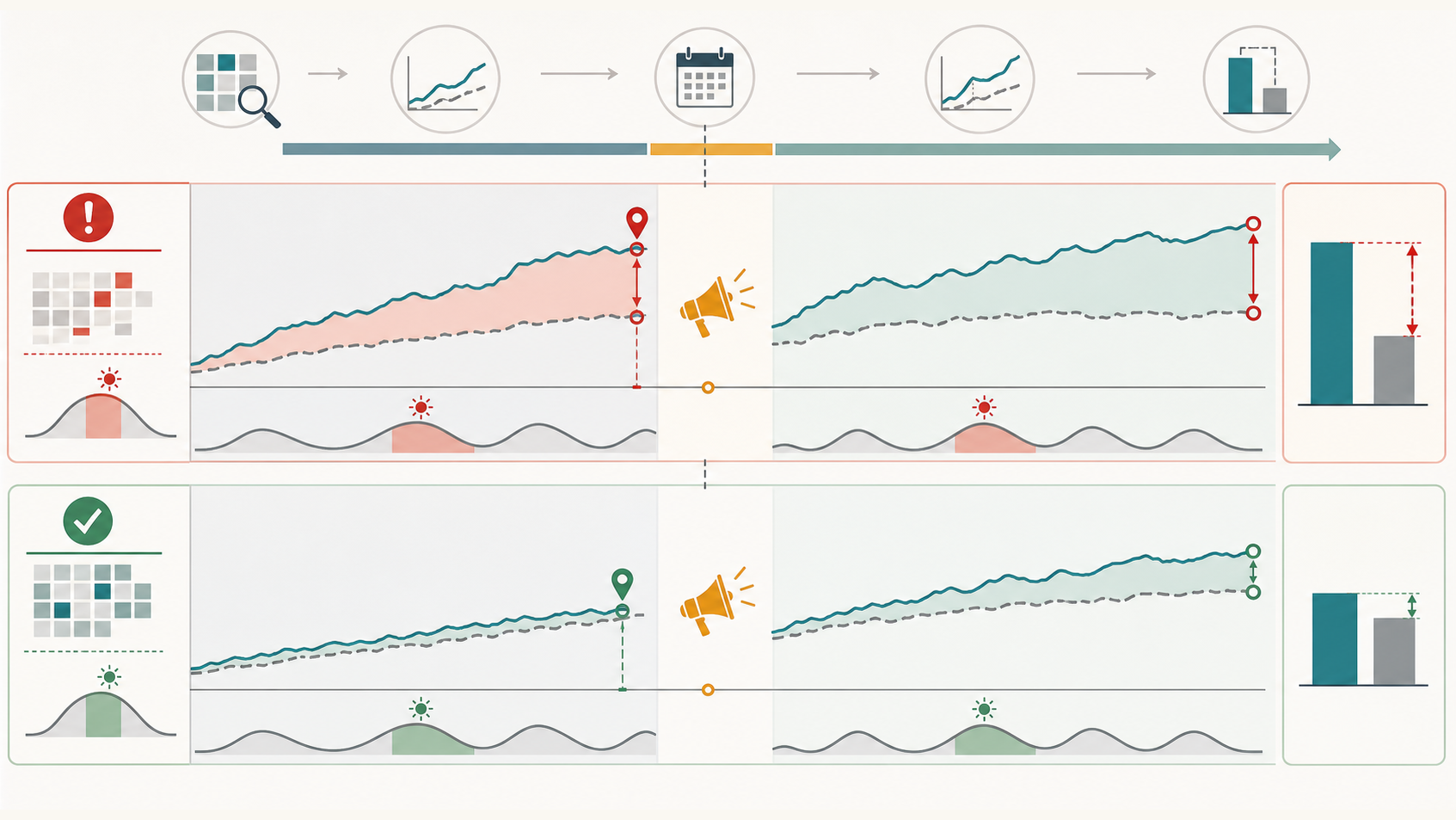
Archetype: Matched-market geo lift campaign with uneven pre-period demand
Bias mechanism: The treated markets already had stronger category momentum, higher baseline demand, and more favorable timing before the campaign, so the readout treats market selection and seasonality as incremental media impact.
Business model pressure
A regional media campaign earns budget by showing that activated markets produced more sales than comparison markets. The buyer needs to know whether the campaign changed demand, not only whether the chosen markets were already on a better path.
Advertiser proof claim
A readout reports higher sales, stronger ROAS, and a clean-looking lift percentage in exposed markets, but the counterfactual question is whether similar markets with the same pre-period trajectory would have grown without the extra media.
Primary-source boundary for the method
These official references define the controlled geographic comparison, contamination risk, feasibility checks, and seasonality limitations used in this review. They do not validate this fictional scenario, its simulated figures, or any real advertiser result.
- Official geographic Conversion Lift setup guide — defines comparable exposed and unexposed geographic groups, lift as their conversion difference, single-country geo-split eligibility, feasibility levels, and contamination risk before a study.
- Official Conversion Lift measurement-data guide — distinguishes incremental conversions and incremental ROAS from standard attributed reporting and explains why uncertainty matters.
- Display & Video 360: set up Conversion Lift measurement — identifies randomized treatment/control design, conversion-lag considerations, contamination, seasonality, external factors, and concurrent-test limitations.
Source-to-decision handoff
Use the official guidance to define what a credible geo readout must show. The sources constrain the claim boundary; they do not validate this fictional scenario, its simulated figures, or any real advertiser result.
| Official finding | Evidence to request in the readout | Decision consequence |
|---|---|---|
| Geographic Conversion Lift setup Comparable exposed and unexposed geographic groups, single-country eligibility, feasibility, and contamination controls are design conditions for a geographic lift study. | Request the predeclared market universe, assignment rules, eligibility or feasibility result, excluded-market log, and travel or cross-market contamination checks. | If those records are missing, describe the result as a selected-market performance gap, not geographic incrementality. |
| Conversion Lift measurement data Incremental conversions and incremental value are treatment-control differences and are distinct from standard attributed conversions and ROAS. | Request treatment and comparison counts, the outcome window, value definition, conversion-lag treatment, and the reported uncertainty or credible interval. | Do not relabel the simulated 20.0-point market gap, modeled conversion/value totals, or naive efficiency ratio as incremental or iROAS without a credible counterfactual. |
| Display & Video 360: Conversion Lift setup Randomized treatment and control, conversion lag, contamination, seasonality, external events, and concurrent experiments can affect an incrementality readout. | Request daily pre-period levels and trends, holidays and event calendars, promotion and distribution changes, study-end lag coverage, and evidence that concurrent tests did not contaminate the comparison. | If timing and external-change checks do not survive sensitivity analysis, keep the conclusion at timing-sensitive diagnosis and require a new test before renewal proof language. |
Statistical result
| Metric | Naive read | Stratified read | Modeled benchmark |
|---|---|---|---|
| Sales-rate lift | 20.0 pts | 1.2 pts | 0.9 pts |
| Modeled conversions under read | 16,339 | 949 | 736 |
| Modeled value under read | $1,094,721 | $63,558 | $49,283 |
| Modeled value / media cost | 1.30x | 0.08x | 0.06x |
The market-gap readout is 17.2x larger than the pre-period-balanced estimate in this worked example.
Reproduce the seasonal-market downgrade
Run the repository's seeded simulator with this scenario JSON, then apply the displayed formulas. The outputs are simulated diagnostics, not observed campaign data; rounded page values may differ from unrounded calculations by display rounding.
| Item | Calculation or assumption |
|---|---|
| Seed and population | seed = 5312027; sampleSize = 132,000 fictional market-audience cells. The generator uses the seeded pseudo-random stream and the parameters in this scenario file. |
| Activated-market split | Use the generated treated count / 132,000 for the activated-market share; the remaining records form the comparison path. The page's sample-size and share metrics are generated, not observed. |
| Naive lift and value | Naive lift = activated-market conversion rate - comparison-market conversion rate; naive incremental sales = naive lift x treated records; naive value = naive incremental sales x $67 per conversion. |
| Propensity-stratified diagnostic | For each usable propensity decile, calculate activated-market rate - comparison-market rate, weight by the decile's total records, and divide by the total usable records. This produces the displayed adjusted lift; it is not a randomized estimate. |
| Adjusted value and efficiency | Adjusted value = adjusted lift x treated records x $67; adjusted ROAS = adjusted value / $840,000 simulated media cost. The modeled benchmark uses trueLiftPoints = 0.9. |
| Claim ceiling | A post-launch market gap can support a descriptive performance statement only. Use lift, incrementality, or ROAS language only after predeclared comparable markets, contamination checks, seasonality review, and uncertainty support the causal claim. |
Assumptions: Treatment assignment, affinity, prior intent, outcomes, propensity strata, $67 value per conversion, $840,000 media cost, and the 0.9-point benchmark are simulated inputs. The stratified diagnostic assumes the modeled propensity variables capture the main selection differences; it does not remove unmeasured confounding or prove that seasonality was fully balanced.
Limitations: No real market universe, excluded-market log, randomized or predeclared holdout, daily baseline series, event calendar, distribution file, confidence interval, contamination audit, conversion deduplication, or observed advertiser result is supplied. A real readout would need those materials, plus mature post-period and sensitivity checks, before supporting incremental demand, iROAS, or renewal claims.
Readout audit questions
Use this pass before the case becomes a budget argument, buyer proof point, or channel lesson. The goal is to separate what the dashboard observed from what the campaign plausibly changed.
| Check | Question to ask | Evidence in this case | Safer claim boundary |
|---|---|---|---|
| Credited outcome | What is the report counting as campaign impact? | Separate attributed outcomes from incremental outcomes. In this case, the naive lift is 20.0 pts while the stratified read is 1.2 pts. | Treat path, click, form, survey, or matched-outcome reporting as descriptive until the counterfactual is visible. |
| Comparison group | Were treatment and control groups comparable before the campaign? | The treated markets already had stronger category momentum, higher baseline demand, and more favorable timing before the campaign, so the readout treats market selection and seasonality as incremental media impact. | Ask for a protected holdout, balanced market, suppression test, or matched comparison before using causal verbs. |
| Budget threshold | Would the decision survive the adjusted read? | The naive read is 17.2x larger than the stratified estimate, and adjusted ROAS is 0.08x after media cost. | Use the result for diagnosis, repair, or test planning unless the adjusted evidence clears the decision threshold. |
| Next evidence | What would change the conclusion? | Balance pre-period trend, seasonality, market exclusions, and alternate comparison sets. | Name the missing evidence request before turning one worked example into a general rule. |
For the next review, pair this case with Geo lift test design checklist and the claim confidence rubric.
Market-balance decision logic
Before this case becomes proof that regional media created demand, read the result through the market-selection record. The useful question is whether comparable markets with similar pre-period momentum would have grown without the extra media.
| Review point | Evidence to request | Decision consequence |
|---|---|---|
| Candidate-market universe | The complete list of eligible markets before launch, including excluded markets, market-size thresholds, distribution constraints, and any sales-team or operations overrides. | If the readout starts only with activated markets, describe the result as a selected-market performance gap rather than geo lift. |
| Pre-period trend fit | Weekly or daily baseline sales, category demand, prior campaign pressure, organic growth, store coverage, and product availability for activated and comparison markets before launch. | If activated markets were already climbing faster, remove causal lift and ROAS wording until the comparison set is rebalanced. |
| Seasonality and event overlap | Local holidays, weather, retail calendars, category peaks, promotion windows, competitive events, and distribution changes that overlap the campaign window. | If the campaign starts into a favorable seasonal window for treated markets, downgrade the claim to timing-sensitive response unless sensitivity checks hold. |
| Holdout protection | A predeclared comparison-market plan, randomized or matched holdouts where possible, frozen market exclusions, leakage checks, and rules for replacing unusable markets. | If controls were rebuilt after seeing results, treat the readout as diagnostic and require a new test before budget-renewal proof language. |
| Claim boundary | A written ladder separating market coverage, observed sales gap, trend-adjusted response, and randomized or predeclared geo incrementality. | If renewal depends on causal proof, require pre-period-balanced markets, alternate control sets, and mature post-period checks before using lift or ROAS language. |
Worked downgrade
The headline version of this case says the regional campaign produced a 20.0 point sales-rate gap, 16,339 modeled conversions under the naive read, and $1,094,721 of modeled value under that same assumption. That version sounds usable because the campaign launched in markets that mattered and the post-launch chart shows a large gap.
The weaker read appears when the market file shows that activated regions already had stronger baseline demand, cleaner distribution, favorable seasonal timing, and category momentum before launch. After comparing market-audience cells within similar pre-period propensity strata, the modeled movement falls to 1.2 points and $63,558 of modeled value against $840,000 of media cost. The modeled benchmark is 0.9 points.
The safer readout sentence is: activated markets outperformed comparison markets during the campaign window, but the evidence does not prove incremental demand because the market plan selected regions that were already on a stronger seasonal path. The next action is to rerun with predeclared comparison markets, trend-balance diagnostics, frozen exclusions, event calendars, and sensitivity checks before using lift or ROAS language.
The advertiser-facing story
The campaign appears to work because activated markets outpace comparison markets during the readout window. A clean chart shows a post-launch gap, the bar chart converts the gap into incremental sales, and the budget story sounds plausible because the markets receiving media were also commercially important.
What broke
The activated markets were not exchangeable with the comparison markets. They had stronger pre-period growth, better category conditions, cleaner distribution, or more favorable seasonal timing before media pressure increased. A post-period gap can therefore measure market choice, launch timing, and operational readiness as much as media effect.
Better design
Choose comparison markets before launch, balance pre-period levels and trends, document excluded markets, keep promotion and distribution changes visible, and run sensitivity checks against alternate matched controls. A useful readout should show whether the conclusion survives a better baseline and whether the decision changes when high-momentum markets are removed from the headline estimate.
Propensity-strata audit
The adjusted estimate compares treated and comparison observations within similar pre-period propensity strata. That does not replace a randomized geo holdout, but it shows how much of the naive result was carried by which markets entered treatment.
| Propensity stratum | Market-audience cells | Activated-market sales rate | Comparison-market sales rate | Within-stratum difference |
|---|---|---|---|---|
| 2 | 5,158 | 8.3% | 6.5% | 1.8 pts |
| 3 | 14,864 | 10.2% | 9.8% | 0.4 pts |
| 4 | 15,209 | 14.3% | 12.8% | 1.5 pts |
| 5 | 10,222 | 17.6% | 17.1% | 0.5 pts |
| 6 | 7,147 | 24.2% | 23.5% | 0.6 pts |
| 7 | 11,516 | 36.7% | 35.1% | 1.6 pts |
| 8 | 25,600 | 45.4% | 44.5% | 1.0 pts |
| 9 | 35,921 | 56.4% | 55.5% | 1.0 pts |
| 10 | 6,363 | 68.0% | 63.4% | 4.6 pts |
Takeaway
A strong geo-lift readout should not stop at a post-launch market gap. It should show how markets were selected, whether pre-period trends were balanced, which operational changes overlapped the campaign, and how much of the result survives alternate comparison sets.
Move from this case to the next review.
Use the case to tighten claim language, choose a better measurement method, and review the next campaign readout without treating a worked example as a rule.
Claim review
Set the claim language
Score whether this evidence supports strong, qualified, tentative, or diagnostic wording.
Method choice
Choose stronger evidence
Pick the holdout, matched-market, MMM, survey, or QA method that fits the next decision.
Readout route
Inspect the report handoff
Move from the case lesson into delivery, response quality, outcomes, comparison strength, and renewal language.