Incrementality
Geo lift test design checklist
Organization byline: Measurement Press editorial desk. This page does not list an individual author or reviewer. Read the editorial method and corrections policy.
About 12 min read
Geo lift tests are useful when advertising, retail distribution, pricing, or operations change at a market level. They can also create confident-looking results from weak comparisons if markets are chosen because they are convenient instead of comparable.
The goal is not to make every market identical. The goal is to show that the treatment markets and comparison markets would have moved similarly if the campaign had not changed.

Geo test routes
Choose the weak design field before launch.
Use the route that matches the unresolved part of the test: market comparison, pre-launch brief, power, leakage, baseline language, or uncertainty.
Market matchPick the comparison before resultsUse when candidate markets, holdouts, matching rules, and downgrade triggers need to be set before launch.
Test briefLock the decision designUse when assignment, counterfactual, outcome, exclusion policy, and readout rule need one plan.
Power checkConfirm the action thresholdUse when market count, base rate, variance, and decision risk need review before spend moves.
Leakage reviewProtect control marketsUse when media, sales outreach, reseller demand, or household paths may reach the comparison group.
Baseline claimName what the lift compares againstUse when a readout depends on prior periods, matched markets, holdouts, or modeled demand.
UncertaintyBound the budget conclusionUse when intervals, thresholds, noisy slices, or decision language need review before action.
When a geo test fits
| Good fit | Weak fit | Design implication |
|---|---|---|
| Media can be bought or withheld by market. | The campaign spills heavily across market borders. | Use larger market groups, exclude border areas, or choose another design. |
| Outcomes are observed consistently by location. | Sales, leads, or visits are missing for some regions. | Fix measurement coverage before assigning treatment. |
| Enough pre-period history exists to check trend similarity. | The product, price, or tracking system just changed. | Delay the test or treat the result as directional only. |
| Markets are not being changed by unrelated launches. | A store rollout, promo, supply issue, or pricing change overlaps the test. | Remove affected markets or pre-register adjustment rules. |
Market-selection packet
Before markets are assigned, keep a short packet that lets someone outside the campaign see why the tested geography is a fair read of the decision. The packet should be written before treatment markets are known to be flattering. Google's geography-based Conversion Lift guidance likewise treats comparable geographic groups, feasibility, and contamination as design conditions rather than after-the-fact footnotes (Google Ads: Set up Conversion Lift based on geography).
| Packet field | What to record | Why it protects the test |
|---|---|---|
| Decision scope | The budget, region, package, channel, or rollout choice the result can change. | Prevents a local test from being used for a broader national claim without evidence. |
| Candidate pool | All markets considered, the inclusion rule, and markets removed before assignment. | Shows whether the comparison was selected from a fair universe rather than after seeing a convenient pattern. |
| Balance snapshot | Pre-period outcome level, trend, volatility, spend, stores, distribution, and seasonality by candidate market. | Lets reviewers see whether treatment and control would plausibly have moved together without the campaign. |
| Local shock log | Promotions, pricing changes, stock issues, weather, events, competitor launches, and tracking changes by market. | Separates media effect from operating changes that can shift local demand. |
| Exposure boundary | How media, sales outreach, retail activity, and audience extension will be kept inside treatment markets. | Protects control markets from hidden treatment that weakens the counterfactual. |
| Readout downgrade rule | The conditions that would make the result directional, inconclusive, or not usable for the decision. | Keeps the conclusion from being rewritten around a positive point estimate. |
The minimum design brief
Before spend moves, write a short brief that can survive a skeptical readout. It should state the business decision, the test markets, the control markets, the treatment period, the primary outcome, the expected lag, and the rule for calling the result useful.
DecisionName the decision the result will change. A test for national budget expansion needs a different readout than a test for a local launch playbook.
EstimandState the lift being estimated: incremental sales, leads, visits, subscriptions, qualified accounts, or another primary outcome during a defined window.
AssignmentExplain why each market is in treatment or control. Avoid letting the highest-opportunity markets become treatment simply because the campaign team wants them most.
GuardrailsList changes that would invalidate or downgrade the readout: inventory breaks, channel outages, price changes, competitor shocks, tracking changes, or major weather disruptions.
Pre-period checks
| Check | What to inspect | Red flag |
|---|---|---|
| Level balance | Average outcomes, spend, customer base, stores, distribution, and seasonality. | Treatment markets are much larger, richer, or more mature than controls. |
| Trend balance | Weekly or daily movement before the campaign. | Treatment is already accelerating faster before media changes. |
| Volatility | Noise in the primary outcome and any extreme weeks. | A few markets swing enough to dominate the readout. |
| Covariates | Price, promotions, stock, distribution, local events, holidays, and competitor pressure. | Important drivers are only tracked after the test starts. |
| Placebo timing | Apply the proposed method to an earlier period with no treatment. | The method finds lift where no campaign change happened. |
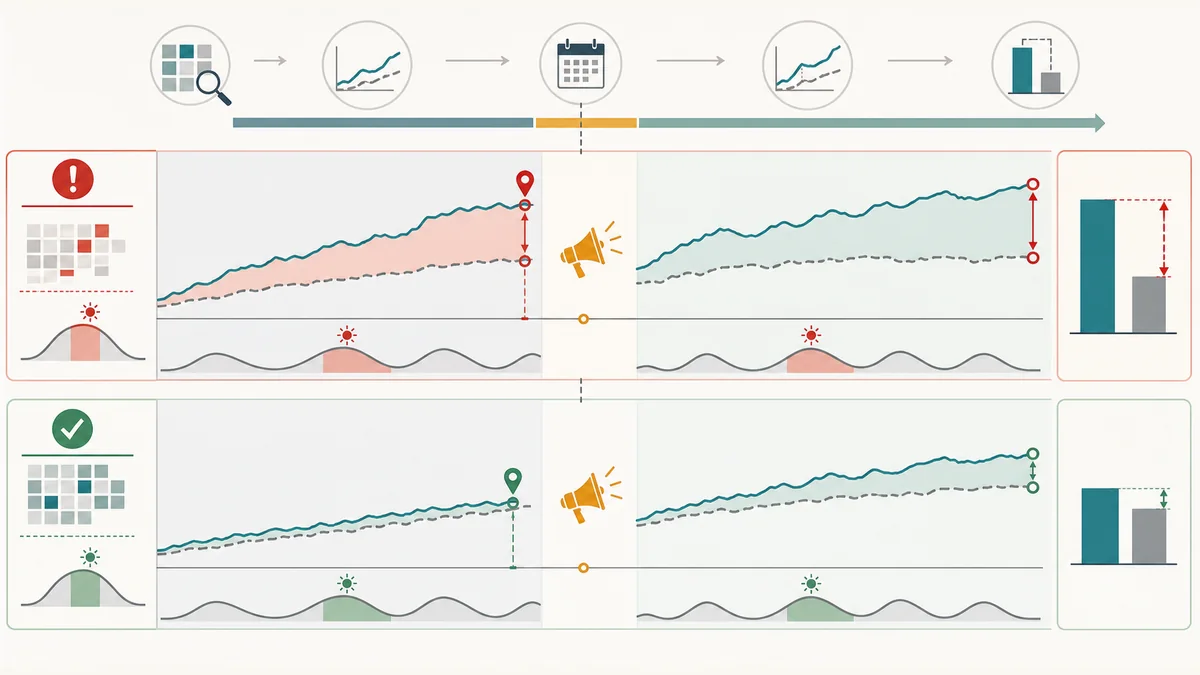
Geo launch readiness score
Use this score before the test starts, not after the result is known. A simple rule works better than a long debate: green items can support lift language, yellow items require directional wording, and red items should stop the test or move the decision to a weaker evidence standard.
| Design field | Green | Yellow | Red |
|---|---|---|---|
| Market pool | Candidate markets are listed before assignment with clear inclusion and exclusion rules. | The pool is known, but some removals rely on judgment that needs a written note. | Treatment markets are chosen first and controls are found later. |
| Trend similarity | Treatment and control markets show similar pre-period levels, slopes, and volatility for the primary outcome. | One balance field is weak, but the difference is stable and documented before launch. | Treatment is already rising faster, or the control series is too noisy to anchor the readout. |
| Local shock log | Pricing, distribution, promotions, stock, tracking, and local events are tracked by market before the test. | Known shocks are tracked, but smaller operating changes may be missed. | Major business changes can happen by market without appearing in the test record. |
| Exposure separation | Media, audience extension, sales outreach, and retail activation stay inside treatment boundaries. | Some spillover is plausible, but suppression checks and border exclusions are planned. | Control markets can receive material treatment through another buying or sales path. |
| Outcome maturity | The outcome source, lag window, duplicate handling, and readout date are locked before launch. | The source is stable, but late-arriving outcomes require a second bounded readout. | The team can choose the outcome window after seeing which one looks favorable. |
Analysis choices to lock early
A credible geo readout is usually won before the campaign starts. Lock the outcome, exclusion rules, matching approach, covariates, readout date, and uncertainty treatment before anyone can see whether the answer looks favorable. A comparison group should represent the same source population and be chosen independently of the exposure being evaluated; matching alone does not remove confounding (CDC Field Epidemiology Manual: Designing and Conducting Analytic Studies).
- Choose one primary outcome and keep secondary metrics clearly labeled.
- Use pre-period performance to create controls, but do not tune the control group after seeing test-period lift.
- Show absolute lift, percentage lift, confidence or credible intervals, and the implied business value.
- Report market-level variation instead of hiding it behind one average.
- Run sensitivity checks with obvious outliers removed and explain whether the conclusion changes.
- Separate media effect from distribution, pricing, promotion, and product availability changes.
What the verified sources establish
The linked guidance supports the design boundary, not the fictional values in this page's examples. Google Ads describes geographic Conversion Lift as a controlled comparison of comparable regions and warns that cross-region exposure can contaminate the control and reduce the estimated difference. The CDC manual supports defining exposure consistently and using a relevant comparison group; the Census quality standards support documenting methods, assumptions, computation checks, limitations, and uncertainty.
Reader boundary: those sources do not choose a reader's markets, prove that matching removed confounding, validate the illustrative thresholds below, or turn an observational before-and-after into causal evidence. Treat this checklist as a pre-launch protocol until the assignment, contamination, outcome maturity, and uncertainty checks are documented for the actual study.
Simulated worked example: the comparison changes the answer
This is a simulated arithmetic check, not a reported campaign result. Assume six treatment markets and six comparison markets each contain 12,000 eligible accounts, the same conversion definition is used in both groups, and every post-period conversion has matured before the readout.
| Measure | Treatment markets | Comparison markets | Calculation |
|---|---|---|---|
| Pre-period conversions | 480 / 12,000 = 4.0% | 480 / 12,000 = 4.0% | Equal starting rate |
| Post-period conversions | 660 / 12,000 = 5.5% | 540 / 12,000 = 4.5% | Both groups increased |
| Within-group change | +1.5 percentage points | +0.5 percentage points | 5.5% - 4.0%; 4.5% - 4.0% |
| Adjusted incremental estimate | +1.0 percentage point, or 120 conversions | (660 - 480) - (540 - 480) = 120 | |
| Illustrative spend | $18,000 | $18,000 / 120 = $150 per incremental conversion | |
The conclusion is narrower than "the campaign drove 120 conversions." Under these assumptions, the treatment group improved by 180 conversions while the comparison group improved by 60, leaving 120 conversions above the comparison change. The result is only a candidate incremental estimate until uncertainty, market-level variation, leakage, conversion lag, and concurrent business changes are checked. Google's lift documentation distinguishes incremental conversions from standard attributed conversions and defines incremental cost per action as spend divided by incremental conversions (Google Ads: Understand Conversion Lift measurement data).
What would change the conclusion: unequal eligible populations would require rate normalization or a documented weighting method; control-market exposure would shrink the estimated difference; late conversions would require a mature readout window; and a pre-period trend imbalance or a simultaneous price, promotion, stock, or sales change would downgrade the causal language. The Census Bureau's statistical quality standards call for documenting the data, methods, limitations, assumptions, computation checks, and statistical uncertainty before comparisons are reported (U.S. Census Bureau Statistical Quality Standards).
Simulated geo-design decision packet
This packet is a reproducible planning exercise, not a campaign result. Assume four matched treatment/control pairs, 2,000 eligible accounts in every market, one unchanged conversion definition, and a fully observed pre/post window. The pair-level table makes the average inspectable instead of allowing one favorable market to carry the headline.
| Pair | Treatment pre → post | Control pre → post | Difference in changes |
|---|---|---|---|
| A | 100 → 118 | 98 → 105 | (18 − 7) = +11 |
| B | 120 → 126 | 122 → 125 | (6 − 3) = +3 |
| C | 80 → 95 | 79 → 88 | (15 − 9) = +6 |
| D | 60 → 84 | 59 → 65 | (24 − 6) = +18 |
| Total | 360 → 423 | 358 → 383 | +38 conversions; 38 ÷ 8,000 = +0.475 percentage points |
The simulated difference-in-differences is (423 − 360) − (383 − 358) = 38. That is an arithmetic estimate above the comparison change, not proof that the campaign caused 38 conversions. Pair D contributes 18 of 38, so the packet does not earn a strong lift headline until the analyst checks whether that pair had a local shock, a pre-period trend break, or a different exposure boundary.
| Sensitivity case | Recomputed result | Decision consequence |
|---|---|---|
| Exclude volatile pair D under a pre-registered rule | 20 incremental conversions across three pairs; 20 ÷ 6,000 = +0.333 percentage points | Result remains positive but is materially smaller; use directional language until the pair rule is justified. |
| Add six treatment and four control conversions after the lag window | 429 − 360 versus 387 − 358 = 40 incremental conversions | Do not publish the early snapshot as final; maturity must be fixed before the result is compared. |
| Eight control conversions are flagged as possible treatment exposure | Removing them would produce 46, but the correction is not automatically valid | Hold the causal claim unless the exposure definition and correction rule were set before seeing lift. |
| Placebo window produces a simulated +0.10 percentage-point gap | The method finds a smaller pre-treatment difference | Document it as a diagnostic; do not use the post-period estimate without a pre-trend explanation. |
Packet decision: revise before launch if any market-level shock, maturity gap, or leakage rule is unresolved; hold the causal headline if the comparison is not credible. The Google source explains its own geo-lift eligibility, feasibility, and contamination model, while the CDC source supports the need for a relevant comparison group and consistently documented exposure. The Census source supports the packet's emphasis on assumptions, computation checks, uncertainty, and sensitivity analysis; these sources do not establish the illustrative thresholds above.
Worked downgrade example
A regional advertiser wants to test a new paid-media package in six metro areas and compare it with six untreated areas. The first pass looks usable: the markets are similar in population and store count, the campaign can be bought by geography, and the primary outcome is weekly qualified leads.
The readiness score changes the conclusion. Two treatment metros were already improving faster during the pre-period, one control metro will receive a separate sales push, and the lead system has a two-week lag that is not included in the original readout date. The test can still teach something, but it should not be allowed to produce a clean causal headline.
| Finding before launch | Decision | Allowed readout language |
|---|---|---|
| Treatment trend is stronger in two of six paired markets. | Keep the markets only if the analysis plan names the imbalance and runs a sensitivity readout without those pairs. | "Observed lift is sensitive to market selection." |
| One control market will receive sales outreach during the treatment window. | Remove it, replace it before launch under the original matching rule, or downgrade the design. | "The comparison is partially contaminated." |
| Qualified leads mature over two weeks, but the original readout is after seven days. | Set the primary readout after the maturity window and mark the early result as operational only. | "Early lead volume is not the final lift estimate." |
Readout language that stays honest
| Weak phrasing | Stronger phrasing |
|---|---|
| The campaign drove a 12% sales lift. | In the tested markets, observed sales were 12% above the matched comparison estimate during the readout window. |
| The test proves this channel works nationally. | The test supports expansion if future markets have similar demand, media delivery, and operating conditions. |
| The control group was similar in size. | The control group had similar pre-period levels, trends, volatility, and tracked business drivers. |
| The result was positive, so the test passed. | The result cleared the pre-set decision threshold after uncertainty, costs, and operational constraints were considered. |
Takeaway
A geo lift test is a comparison discipline, not just a map with shaded regions. The central question is whether the control markets make a believable estimate of what would have happened anyway.