Media framing
Anecdote and exemplar framing checklist
Organization byline: Measurement Press editorial desk. This page does not list an individual author or reviewer. Read the editorial method and corrections policy.
About 11 min read
A vivid example can make a real situation legible. It can also make a narrow case feel like a proven pattern.
Use this checklist when a story, report, speech, dashboard, or campaign recap leans on one person, one company, one classroom, one city, one customer, one charted moment, or one quote to carry a broader claim. The goal is not to remove human detail. The goal is to keep the example in its proper evidence lane: illustration, signal, documented case, representative pattern, or causal proof.
Picture an editor reviewing a draft before publication. The opening story is vivid: a family, buyer, classroom, campaign, or local official describes a real experience. The next sentence turns that case into a broad claim about what people face, what is changing, what the public believes, or what a media plan caused. That is the danger point. The example may belong in the story, but the inference needs a separate evidence check.
Plainly: an anecdote is a story about one case. An exemplar is a case chosen to show what a type of thing looks like. Neither one automatically tells the reader how common, typical, fast-growing, or caused-by-something the issue is. The proof for those stronger claims has to come from the record around the example.

Start with the role of the example
Before judging the example, decide what job it is doing in the piece. A fair anecdote should disclose whether it is showing what can happen, what usually happens, or what the evidence shows happened at scale.
| Example role | What it can support | What it cannot support alone | Required next evidence |
|---|---|---|---|
| Illustration | What the issue can look like in one concrete setting. | How common, typical, severe, or causal the issue is. | Rate base, comparison class, or source note that marks it as an example. |
| Documented case | That the described event occurred under the cited record or testimony. | That similar events are widespread or increasing. | Record universe, denominator, trend, or comparable cases. |
| Expert example | A mechanism, method problem, or plausible interpretation. | That the mechanism explains the full observed outcome. | Data showing frequency, fit, and alternative explanations. |
| Representative sample | A broader pattern only if selection and sampling are disclosed. | Population claims when selection is unclear. | Sampling method, inclusion rules, weighting, and uncertainty. |
| Campaign case result | What happened in one flight, package, audience, or measurement window. | General lift, channel value, or future performance. | Preselected comparison, holdout, matched baseline, and outcome-quality checks. |

Representativeness checks
The first question is not whether the example is emotionally compelling. The first question is whether the article has earned the broader inference it asks the reader to make.
| Check | Raise confidence when | Lower confidence when |
|---|---|---|
| Selection path | The piece explains how the example was found and why it belongs in the story. | The most vivid case appears without selection context. |
| Denominator | The story names the population, eligible cases, record universe, or sample base. | The anecdote stands in for a rate, share, or prevalence claim. |
| Comparison | The example is compared with a baseline, peer group, prior period, or typical case. | The reader only sees an extreme or unusual case. |
| Counterexample | The piece shows whether opposite, neutral, or ordinary examples exist. | The story treats the absence of counterexamples as evidence they do not exist. |
| Source role | The person or organization in the example has a clear relationship to the claim. | The source supplies emotion, interpretation, and conclusion without role boundaries. |
| Method link | The example is tied to records, survey method, field notes, or report data that readers can inspect. | The example is memorable but detached from the cited evidence. |
Decision map for example claims
When a vivid case starts carrying the story, decide the wording ceiling before polishing the headline, deck, or campaign readout. A wording ceiling is the strongest sentence the current evidence can honestly support.
| Evidence state | Reader decision use | Question that decides the next step | Wording ceiling |
|---|---|---|---|
| One vivid case with direct quotation or observation. | Use to make the issue understandable. | How was this case found, and what ordinary cases were not shown? | "This example illustrates how the issue can appear." |
| Several cases from one source path, city, buyer, desk, or advocacy file. | Use to identify a possible recurring report. | Do independent sources and eligible-case counts show the same pattern? | "Several examples from this source path show a reported pattern." |
| Examples plus a defined record universe or denominator. | Use to discuss prevalence within that record boundary. | Are inclusion rules, missing records, and counterexamples visible? | "Within this record universe, the examples fit this rate or share." |
| Examples drawn from a disclosed sample or survey. | Use to describe the sampled population with limits. | Do sampling method, weighting, question wording, and uncertainty support the claim? | "Within the sampled population, the examples match the measured response pattern." |
| Case result plus a designed comparison or holdout. | Use for a bounded causal or incrementality claim. | Was the comparison chosen before results were visible, and did assignment hold? | "The design estimates impact for this audience, window, and outcome." |
Common framing moves
Anecdote-as-prevalence
One case is used to imply how common a problem is without a denominator or sample base.
Anecdote-as-trend
A recent example is treated as evidence that the issue is rising, falling, spreading, or disappearing.
Extreme-case anchor
The most dramatic available example sets the reader's sense of the typical case.
Quote-as-consensus
A source with access, expertise, or strong feeling is allowed to stand in for a broader group.
Case-study halo
A detailed success or failure story is used to imply repeatable results without comparable baselines.
Missing ordinary case
The story shows the exception but not the routine outcome a reader needs for proportion.
Evidence upgrade path
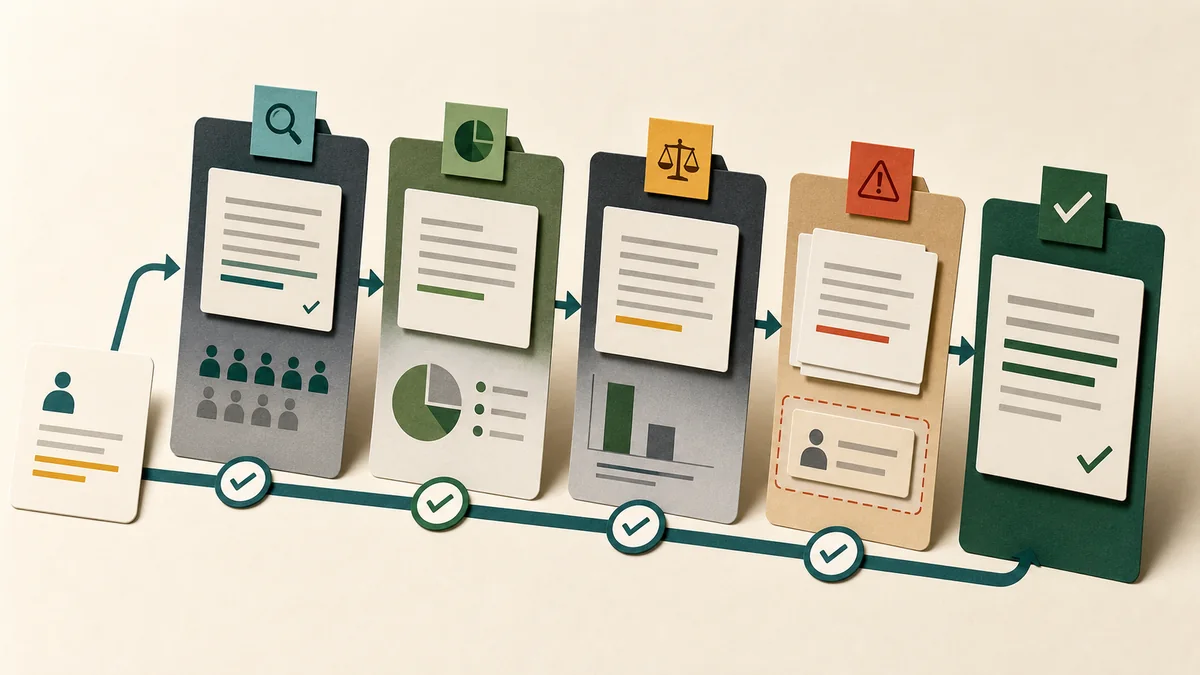
Anecdotal evidence becomes more useful when the story adds enough context to place it. Use this path to decide what evidence would make the example support a stronger claim.
| Current evidence | Supportable wording | Upgrade needed |
|---|---|---|
| One vivid case with direct quotation. | "This case illustrates how the issue can appear." | Record universe, comparable cases, and reason the case was selected. |
| Several cases from the same source path. | "Several examples from this source path show a recurring reported pattern." | Independent source trail and denominator for the eligible universe. |
| Examples plus official records. | "The examples are consistent with the record trend under this definition." | Definition notes, rate base, revisions, and counterexamples. |
| Examples plus disclosed survey or sample. | "Within the sampled population, the examples match the measured response pattern." | Question wording, sample source, weighting, uncertainty, and subgroup base. |
| Campaign case plus designed comparison. | "This campaign result estimates impact for this audience, window, and outcome." | Leakage checks, assignment integrity, outcome quality, and uncertainty intervals. |
Rewrite the frame
The cleanest fix is usually not to delete the example. Keep the human detail, then rewrite the sentence around it so the reader can tell whether the story is showing existence, scale, trend, consensus, or cause.

| Weak wording | Cleaner wording | Evidence needed to go stronger |
|---|---|---|
| "This example shows what is happening everywhere." | "This example shows one documented case; prevalence depends on the broader record." | Population denominator, comparable cases, and trend evidence. |
| "Families are increasingly facing this problem." | "The story documents affected families; it needs a time-series or survey base to support an increase." | Consistent records across time, stable definitions, and eligible population. |
| "Experts say the practice is failing." | "The cited expert identifies a failure mode; the article should show how often it appears." | Representative data, counterexamples, and method disclosure. |
| "The case proves the strategy works." | "The case describes a successful implementation; repeatability depends on baseline, context, and comparison." | Matched examples, holdout, or preselected success criteria. |
| "The backlash shows public opinion has shifted." | "The story documents visible reaction; opinion shift requires a measured population and field dates." | Survey disclosure, source count, response rate, and comparison to prior measurement. |
Meeting questions
- What sentence is the example being used to prove?
- How was the example selected, and what ordinary cases were not shown?
- What denominator would tell us whether the example is rare, typical, or frequent?
- Does the example show existence, prevalence, trend, or cause?
- Which source role would most likely narrow the example's meaning?
- What wording remains true if the example is not representative?
Primary source trail and a simulated selection check
The checklist treats selection context, population definition, comparison, and limitations as part of the evidence—not as optional footnotes. AAPOR's Transparency Initiative requires public methodological disclosure such as the population under study, sampling or recruitment method, dates, sample sizes, precision, processing, and design limitations, but AAPOR explicitly says the initiative does not judge the quality of the methods. The federal Reference Manual on Scientific Evidence explains why a few selected cases do not establish prevalence or causation without a broader comparison and attention to alternative explanations. Census guidance likewise distinguishes sampling error from nonsampling error; a margin of error belongs to an estimate based on a sample and does not repair coverage, response, question, or processing problems. These sources set an inspection boundary for the simulated selection check, not a quality seal for a real anecdote.
- AAPOR Transparency Initiative - lists disclosure expectations for population, selection method, dates, sample size, precision, processing, and limitations.
- Reference Manual on Scientific Evidence: The Admissibility of Expert Testimony - explains why isolated case reports do not establish population rates or causation by themselves.
- U.S. Census Bureau: What Is the Margin of Error? - explains that a margin of error describes uncertainty in an estimate based on a sample of a population.
- U.S. Census Bureau: Methodology - distinguishes sampling variability from nonsampling error such as coverage, response, question, and processing problems.
Simulated worked example - not a real content audit or survey: suppose an editor selects 12 vivid cases from a record of 240 eligible stories because each has a strong personal account. Nine of the 12 selected cases mention the issue under review, while 72 of all 240 eligible stories mention it.
| Calculation | Result | What it supports |
|---|---|---|
| Selected-case issue rate | 9 / 12 = 75% | How often the issue appears in the editor's vivid-case subset. |
| Full-record issue rate | 72 / 240 = 30% | How often the issue appears in the stated eligible record. |
| Selection amplification | 75% / 30% = 2.5x | The selected subset makes the issue look 2.5 times as common as it is in this simulated record. |
| Selected share of record | 12 / 240 = 5% | Only 5% of the eligible record is represented by the vivid examples. |
The narrow conclusion is that the selection rule can overstate the issue relative to the stated record; it does not estimate the broader population, prove a trend, or establish cause. The conclusion changes if the 240-story frame is incomplete, the 12 cases were selected using a different rule, issue coding changes, or missing stories are not counted. A real audit should publish the frame, inclusion rules, dates, coding decision, and uncertainty or coverage limits before using the result as a prevalence claim.
Selection acceptance gate
Use the simulated rows as a publication gate, not as proof that the underlying issue is common. A case can remain useful as an illustration when the selection is disclosed; a prevalence, trend, or causal sentence needs every missing gate resolved.
| Gate | Question for the editor | Simulated result |
|---|---|---|
| Frame | Can a reader identify the 240 eligible stories, dates, and inclusion rule? | Pass for the stated example; verify the real frame. |
| Selection | Is the rule that produced the 12 vivid cases visible before the claim is written? | Pass: strong personal accounts are disclosed as the selection rule. |
| Denominator | Are the selected subset and full record shown as separate denominators? | Pass: 9 / 12 is not substituted for 72 / 240. |
| Ordinary and counterexamples | Can the review show what was not vivid, neutral, or inconsistent with the frame? | Fail: no counterexample set is supplied. |
| Uncertainty and coverage | Are missing records, coding limits, and uncertainty described? | Fail: the fictional example has no coverage or uncertainty estimate. |
| Wording ceiling | Does the sentence stay at illustration or documented-record language? | Pass: no prevalence, trend, or causal claim is earned. |
Gate result: 4 of 6 pass. The example is publishable as a bounded illustration and selection-bias demonstration, not as a population estimate. To raise the claim ceiling, add the ordinary/counterexample set, disclose coverage and coding rules, and state the uncertainty method; if those rows remain missing, keep the claim at “this selected record illustrates” language.
Use with
Pair this checklist with the headline and source-mix checklist when the example appears high in the story, the source role and incentive map when a quoted source carries too much of the frame, the denominator framing examples when the story needs a rate base, the disconfirming evidence checklist when the strongest counterexample is missing, the survey and poll claim checklist when examples are paired with respondent evidence, and the campaign baseline comparison checklist when a case result is being treated as proof of media impact.
Takeaway
Anecdotes are useful when they make an evidence-backed pattern understandable. They are misleading when they quietly replace the evidence that would show scale, typicality, change, or cause. Keep the example, but label the inference it has actually earned.