Brand measurement
Brand lift study readout checklist
Organization byline: Measurement Press editorial desk. This page does not list an individual author or reviewer. Read the editorial method and corrections policy.
About 10 min read
A brand lift study can be useful evidence, but it is rarely the whole decision. Before a team treats survey movement as proof that a campaign worked, the readout should show who was surveyed, what changed, how uncertain the estimate is, and what business decision the result can support.
Use this page when a platform, publisher, agency, or research partner presents brand lift results for awareness, ad recall, favorability, consideration, purchase intent, or message association.
Source trail for the measurement terms
The review fields below follow the definitions used in first-party platform documentation, then add an editorial claim-boundary check. Google Ads describes Brand Lift as a comparison between people who saw an ad and people eligible to see it but withheld from the ad; its help page lists baseline and exposed response rates, absolute lift, relative lift, and headroom lift as separate aggregated measures.
- Google Ads: About Brand Lift — use for the study purpose, exposed/baseline framing, and metric names.
- Display & Video 360: Understand Brand Lift measurement data — use for absolute-lift subtraction, response-count limits, and the distinction between point estimates and confidence intervals.
- Google Ads: About certainty of lift — use when a report supplies certainty, p-values, or intervals; a positive point estimate is not the same as a decision-ready business claim.
References checked for this source trail. These references define platform terms; they do not validate any specific campaign, vendor, audience, or sales outcome. Platform confidence or certainty settings are not interchangeable with a universal statistical standard, so the readout must name the platform, interval type, and study configuration beside the result.
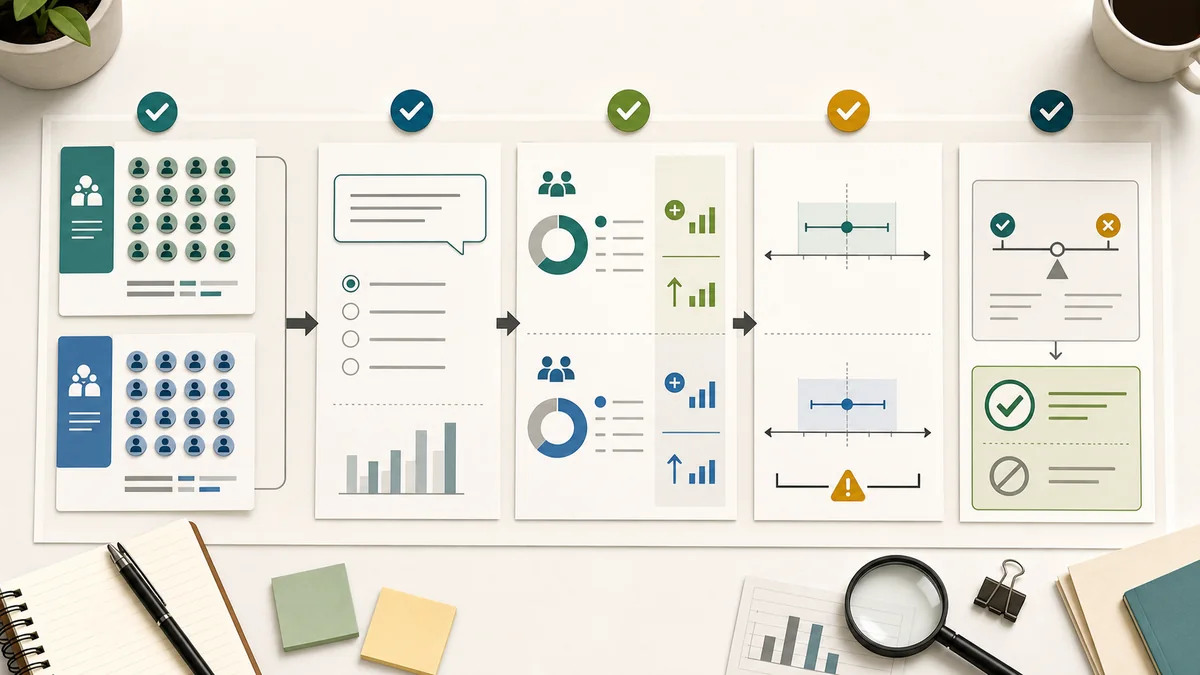
Readout route
Confirm the survey lift before it becomes a budget claim.
Move from the planned outcome to respondent quality, uncertainty, decision language, and the next test. The goal is to keep brand learning useful without letting a survey chart carry a sales or renewal claim it cannot support.
Outcome
Check the planned metric
Start with the primary question, base rate, field dates, and whether the result was promoted after the fact.
Recruitment
Inspect exposed and control paths
Use the worked case to spot respondent pools that differ before the campaign effect is estimated.
Uncertainty
Put intervals beside lift
Read sample size, absolute movement, relative lift, base rate, and uncertainty together.
Language
Bound the readout claim
Keep recall, persuasion, consideration, and sales language in separate evidence lanes.
Next test
Escalate when sales are implied
Use a stronger test plan when the decision needs incremental sales, retention, or budget evidence.
One-page review
| Question | What a strong readout shows | What weakens confidence |
|---|---|---|
| What was measured? | A named primary brand outcome, fixed before analysis, with exact question wording. | A positive secondary metric is promoted after the planned outcome was flat. |
| Who entered the study? | Eligibility rules, exposure definition, control definition, geography, devices, and field dates. | The exposed group and control group came from different contexts or recruitment paths. |
| Were groups comparable? | Balance checks for demographics, prior brand familiarity, buying intent, frequency, and placement mix. | Exposed respondents were already more likely to know or prefer the brand. |
| How large is the estimate? | Absolute point change, relative lift, sample size, confidence or credible interval, and base rate. | The report emphasizes percent lift while hiding that the absolute movement is small. |
| What could have contaminated the contrast? | Other campaigns, retargeting, household exposure, organic news, promotions, and seasonality are named. | The study treats every difference as campaign-caused without checking outside influences. |
| What decision can it support? | A specific next action, such as creative learning, audience planning, or whether to run a stronger sales test. | The study is used as proof of profitable sales impact without sales evidence. |
Read the result in order
1. Start with the base rateA five-point movement means something different when awareness starts at 8% than when it starts at 78%. The readout should show both the starting level and the changed level, not only relative lift.
2. Separate recall from persuasionAd recall can improve because a creative was memorable. Favorability, consideration, and purchase intent ask different questions. Do not let one moved metric stand in for every brand outcome.
3. Inspect respondent qualitySurvey evidence depends on who answered, when they answered, and whether the survey recruited comparable exposed and control respondents. Small or skewed respondent pools can make a precise-looking chart fragile.
4. Check frequency and placement mixHigh-frequency exposed respondents can look different from lightly exposed respondents for reasons that are not just brand persuasion. Ask whether the readout separates reach, frequency, format, and placement quality.
5. Keep business impact separateA brand lift study can justify creative iteration, audience learning, or a larger causal test. It should not be treated as proof of incremental sales unless a sales outcome and credible counterfactual are also measured.
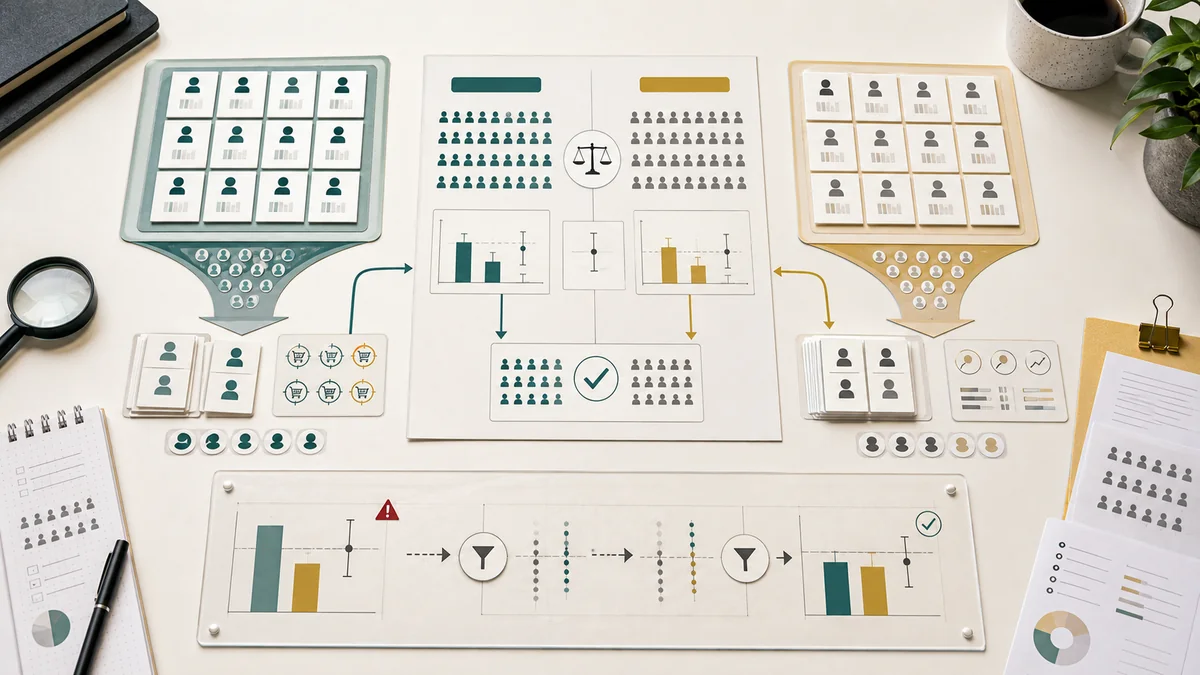
Minimum tables to request
- Survey field dates, respondent counts, and completed interviews by exposed and control group.
- Question wording, answer choices, screening rules, and whether the primary outcome was selected before results were visible.
- Base rate, absolute point change, relative lift, and uncertainty interval for each reported metric.
- Balance checks for demographics, prior brand use, likely category need, device, geography, and placement mix.
- Frequency distribution and whether high-frequency respondents drove most of the reported lift.
- Known concurrent campaigns, promotions, public events, or media bursts that could influence survey answers.
Simulated worked example: reconstruct the lift
This is a simulated calculation, not a Measurement Press campaign result. It shows the minimum arithmetic a reviewer can reproduce from a readout. Replace the values with the report's own positive-response counts, sample sizes, field dates, and platform-reported interval.
| Field | Simulated value | Calculation or reading rule |
|---|---|---|
| Baseline positive responses | 240 of 1,200 | 240 / 1,200 = 20% positive-response rate for the withheld/baseline group. |
| Exposed positive responses | 288 of 1,200 | 288 / 1,200 = 24% positive-response rate for the exposed group. |
| Absolute lift | +4 percentage points | 24% − 20% = 4 percentage points. |
| Relative lift | +20% | (24% − 20%) ÷ 20% = 20%; do not present this without the base rate. |
| Illustrative uncertainty check | About +0.7 to +7.3 percentage points | Approximate two-sided 95% interval for two independent proportions: 4.0% +/- 1.96 x sqrt[(.24 x .76 / 1,200) + (.20 x .80 / 1,200)]. This is a teaching calculation, not the platform-reported interval. |
| Decision boundary | Brand learning only | Without a sales outcome and credible counterfactual, the result does not prove incremental sales or profitable growth. |
Limit: The 2,400 total responses and 4-point difference are simulated, and the simple interval assumes independent samples with no weighting, clustering, or platform-specific design effect. This arithmetic does not repair recruitment imbalance, omitted concurrent exposure, response bias, multiple metric selection, or a wide platform interval. A reviewer should copy the report's sample counts, field dates, question wording, certainty or interval, and study configuration into the evidence record before accepting the conclusion.
Brand lift readout quality score
Score the readout before it moves into a renewal memo, creative recap, or budget discussion. The test does not need to be perfect to be useful, but the final sentence should change when a survey result is missing the fields that keep brand learning inside its evidence boundary.
| Review field | Green | Yellow | Red |
|---|---|---|---|
| Planned outcome | The primary metric, question wording, answer choices, and decision use were fixed before results were visible. | The primary metric is named, but secondary metrics are emphasized because they look stronger. | The report promotes whichever brand metric moved and does not identify the planned outcome. |
| Respondent comparability | Exposed and control respondents came through comparable recruitment paths with visible balance checks. | One balance field or recruitment source needs more explanation before broad claims are used. | Exposed respondents were recruited from a more brand-aware context than control respondents. |
| Base-rate math | Base rate, absolute point change, relative lift, sample size, and interval are shown together. | The direction is useful, but one arithmetic field or interval is missing from the summary. | The headline relies on relative lift without enough detail to reconstruct the absolute movement. |
| Exposure and contamination | Frequency, placement mix, other campaigns, promotions, and field dates are named in the readout. | Outside influences are plausible and need a narrower audience or time-window caveat. | The report treats all survey movement as campaign-caused despite overlapping media or promotions. |
| Claim boundary | The conclusion says which brand outcome moved, for which audience, and what decision it can support. | The result can guide creative or audience learning, but it needs stronger evidence before sales or budget language. | The readout turns survey movement into proof of incremental sales, profitable growth, or broad market impact. |
If any row is red, keep the result out of proof language. If two or more rows are yellow, use the study as learning input and name the follow-up evidence needed before the decision gets larger.
How to phrase the conclusion
| If the study shows | Stronger wording | Overclaim to avoid |
|---|---|---|
| Balanced groups and meaningful movement in the planned metric. | The campaign is associated with a credible lift in the measured brand outcome for this audience and time window. | The campaign proved overall brand growth. |
| Ad recall moved, but consideration did not. | The creative was noticed or remembered, but persuasion evidence is limited. | The campaign changed buyer intent. |
| Only a small subgroup moved. | The finding is directional for that subgroup and should be validated before budget changes. | The campaign worked for the market. |
| Survey lift exists without sales evidence. | The result supports brand learning and may justify a stronger incrementality test. | The campaign generated profitable incremental sales. |
| Wide intervals or low sample size. | The estimate is too uncertain for a confident decision, even if the point estimate is positive. | The report is positive because the chart points upward. |
Worked readout downgrade
A campaign readout reports an 18% relative lift in ad recall and a 7% relative lift in consideration. The headline calls the study proof that the campaign improved buyer intent. The reviewer reconstructs the tables and finds three limits: awareness was the planned primary metric and it was flat, exposed respondents were recruited after a high-frequency placement while control respondents came from a broader panel, and the consideration interval includes changes too small to affect the planned decision.
The stronger conclusion is narrower. The campaign appears to have been noticed by the exposed respondent pool, and the consideration result is directionally useful, but the study does not prove broad persuasion or support a sales-impact claim. The next action is to document recruitment balance, rerun or extend the survey with the primary outcome locked, and use a stronger incrementality design if the decision requires sales or budget evidence.
That downgrade preserves the useful signal without letting a favorable chart outrun the study. Creative and frequency teams can learn from the recall movement; budget teams should wait for comparable respondents, visible uncertainty, and an outcome that matches the decision.
Brand lift readout questions
What should I read first in a brand lift report?
Start with the planned outcome, exact survey question, field dates, exposed and control definitions, respondent counts, and base rate before reading the lift chart.
When is a positive lift result not decision-ready?
A positive result is not decision-ready when recruitment paths differ, the primary metric was not fixed before analysis, intervals are wide, outside campaigns were not named, or the proposed action is broader than the survey outcome.
How should base rate and relative lift be read together?
Base rate shows the starting level, absolute change shows the point movement, and relative lift shows proportional movement. All three should be shown together so a small base does not make a modest absolute change look larger than it is.
What if only ad recall moved?
A recall-only result can support creative or frequency learning, but it should not be described as persuasion, consideration, purchase intent, or sales impact without separate evidence for those outcomes.
When should a brand lift readout lead to another test?
A brand lift readout should lead to another test when it informs creative or audience learning but the business decision requires stronger evidence of incremental sales, retention, or budget effect.
Use it with other measurement
Brand lift is strongest when it is one signal in a measurement system. Use it with creative diagnostics, reach and frequency reporting, experiments where possible, MMM calibration, and clean sales readouts. The habit is simple: let brand lift answer brand-perception questions, and use stronger causal designs for sales and budget claims.
For a worked recruitment-bias example, read the brand lift survey recruitment case study. For a broader method map, pair this checklist with the advertising measurement method selector, the incrementality test plan template, and lift-testing and brand-study traps.