Incrementality
Where lift tests and brand studies quietly lose truth
Organization byline: Measurement Press editorial desk. This page does not list an individual author or reviewer. Read the editorial method and corrections policy.
About 9 min read
A familiar readout problem starts with a confident slide: the campaign created lift, the brand score moved, or the tested audience beat the control group. The number may be useful, but it is not yet a decision. Before a budget owner renews, scales, or changes creative, someone has to ask whether the test actually protected the comparison it depends on.
A lift test compares what happened with advertising to what probably would have happened without it. That missing "without it" world is the counterfactual. A brand study asks exposed and control respondents survey questions, then compares answers. Both approaches can beat last-click attribution, but both can also lose truth when assignment, exposure, survey response, outcome capture, or claim language gets loose.
Source and evidence boundary before the headline
Google describes Conversion Lift as a treatment-versus-control comparison intended to estimate incremental conversions, while Brand Lift compares survey responses from people who saw an ad with people who were eligible but did not see it. Those are different evidence objects: a conversion lift result cannot be substituted for a brand metric, and a brand metric cannot be rewritten as proven sales.
Study mechanics also change what the result can support. Google's guidance says the holdout size trades off opportunity cost against the amount of data collected, and that study duration should capture the average conversion lag. For campaign experiments, an even traffic or budget split still does not guarantee even impressions because auction dynamics and budget limits can change exposure. The official Conversion Lift, Brand Lift, user-study, and custom-experiment pages were re-read for this source trail; they define the measurement objects and constraints, but they do not validate the synthetic examples on this page. Read the Conversion Lift overview, Brand Lift overview, user-based study setup guidance, and custom experiments guidance alongside the actual study export.

The practical question is not "was there lift?" It is "what claim can this design support without overstating the evidence?" That shift matters because the same observed result can justify a careful renewal, a narrower retest, a creative learning note, or no budget movement at all.
What the study has to prove
A decision-grade study links five pieces: who was assigned to each group, whether the comparison stayed protected, what outcome was measured, how uncertain the result is, and what action threshold was chosen before the readout. If one piece is missing, the study may still teach something, but the claim needs to become narrower.

Plain language helps. "Assignment" means the rule that placed people, markets, stores, or impressions into exposed and control groups. "Compliance" means the groups actually received the treatment they were supposed to receive. "Power" means the test was large enough to detect the kind of effect the team cares about. "Uncertainty" means the result is a range, not a single perfect answer.
Seven traps
1. Holdout leakageThe control group is only meaningful if it is actually protected from exposure. Cross-device exposure, shared households, retargeting, and overlapping campaigns can contaminate the contrast.
2. Platform-only outcome visibilityA platform can only measure what it can observe or match. Missing conversions, modeled conversions, and identity graph limits should be disclosed.
3. Underpowered testsSmall tests often produce wide intervals that are summarized as a single lift number. A non-zero point estimate is not the same as a reliable decision signal.
4. Short window generalizationA two-week test during a promotional burst may not support a quarterly budget shift. The time window is part of the claim.
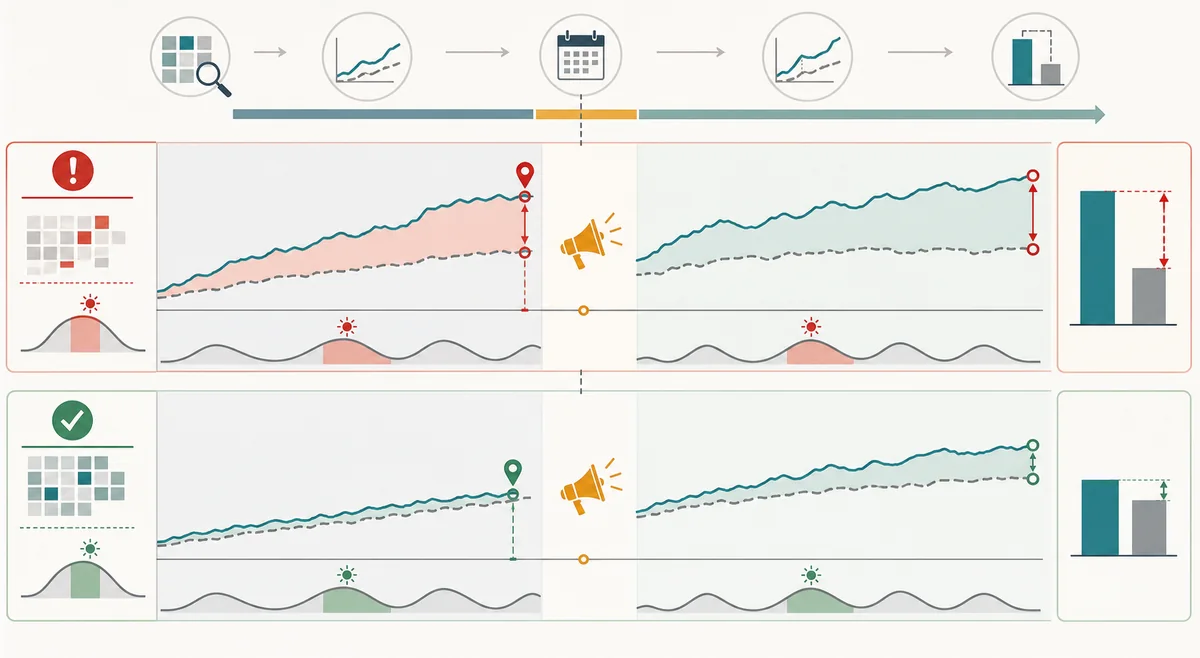
5. Survey recruitment biasBrand studies depend on who answers, when they answer, and whether exposed and control respondents are comparable after recruitment. See the brand lift survey recruitment case study for a worked example.
6. Proxy outcome confusionAd recall, awareness, consideration, and purchase are not interchangeable. A brand metric can move without proving profitable incremental sales.
7. Incentive opacityWhen the platform selling media also measures lift, the report should disclose methods, exclusions, uncertainty, and any modeling assumptions.
Before accepting the lift result
A lift result is ready for a budget, creative, or channel decision only when the report connects the result to a defined counterfactual. Use this first pass before arguing about the headline percentage.
| Readout question | What should be visible | Where to go next |
|---|---|---|
| What decision was the test supposed to inform? | Predefined action threshold, budget question, audience scope, and primary outcome. | Lift-test plan template |
| Was the comparison protected? | Holdout assignment, leakage checks, overlapping campaigns, and exposure compliance. | Holdout leakage checklist |
| Was the test large enough to support the claim? | Minimum detectable effect, interval width, sample exclusions, and stopping rules. | MDE planning checklist |
| Does the study measure the outcome named in the claim? | Clear separation between awareness, intent, matched conversions, modeled conversions, and revenue. | Brand-study readout checklist |
Trap-to-remedy map
The right response depends on the failure mode. Some issues call for a cleaner re-run; others only require more careful language in the readout.

Leakage or noncomplianceDo not treat the measured contrast as the full campaign effect. Ask for suppression logs, overlap checks, and a sensitivity readout that estimates how contamination could have moved the result.
Wide intervalsTranslate the interval into decision language. If the range includes outcomes that would change the recommendation, keep the result as directional evidence and plan a larger or cleaner test.
Survey imbalanceCheck recruitment source, respondent timing, exposed-control balance, weighting, and completion quality before using awareness or intent movement as proof of campaign value.
Proxy outcome mismatchKeep the claim at the level actually measured. A movement in recall can support a creative or message-learning decision, but it should not be rewritten as proven sales incrementality without matching outcome evidence.
Worked readout example
Suppose a report shows a positive lift point estimate, but the interval is wide and the test ran during a discount-heavy launch window. A weak readout says, "The campaign drove incremental sales, so increase spend." A stronger readout says, "This test saw a positive signal in the launch window, but uncertainty and seasonality keep it below a budget-scale threshold. Renew only the proven audience, keep the creative learning, and rerun with a protected holdout before broad expansion."
Simulated readout triage
This is a Simulated Worked Example, not an advertiser result. Assume 4,000 eligible units are assigned to treatment and 4,000 to control, the same conversion definition is used in both arms, and the study window is long enough to observe the stated conversion lag.
| Check | Simulated entry | Interpretation |
|---|---|---|
| Treatment conversions | 320 / 4,000 = 8.0% | Observed conversion rate among units assigned to receive ads. |
| Control conversions | 280 / 4,000 = 7.0% | Observed comparison rate under the stated holdout assumption. |
| Absolute difference | 8.0% − 7.0% = 1.0 percentage point | Rate difference before uncertainty, leakage, or generalization review. |
| Relative lift | 1.0% ÷ 7.0% = 14.3% | A ratio that is sensitive to a small control denominator. |
| Implied incremental conversions | 4,000 × 1.0% = 40 | Illustrative only; not a causal result without protected assignment and valid outcome capture. |
Simulated sensitivity before a budget decision
One positive point estimate is not a decision rule. Holding both group denominators at 4,000 and changing only the recorded conversion counts shows how quickly the recommendation can narrow. These are deliberately simple scenarios, not a confidence interval, power calculation, or estimate of a real study.
| Simulated case | Treatment | Control | Absolute difference | Relative lift | Implied incremental conversions |
|---|---|---|---|---|---|
| Lower contrast | 320 / 4,000 = 8.0% | 300 / 4,000 = 7.5% | 8.0% - 7.5% = 0.5 pp | 0.5% / 7.5% = 6.7% | 4,000 x 0.5% = 20 |
| Baseline example | 320 / 4,000 = 8.0% | 280 / 4,000 = 7.0% | 8.0% - 7.0% = 1.0 pp | 1.0% / 7.0% = 14.3% | 4,000 x 1.0% = 40 |
| No contrast | 300 / 4,000 = 7.5% | 300 / 4,000 = 7.5% | 7.5% - 7.5% = 0.0 pp | 0.0% / 7.5% = 0.0% | 4,000 x 0.0% = 0 |
| Higher contrast | 340 / 4,000 = 8.5% | 280 / 4,000 = 7.0% | 8.5% - 7.0% = 1.5 pp | 1.5% / 7.0% = 21.4% | 4,000 x 1.5% = 60 |
The bounded decision is: keep the result as a simulated positive signal, but do not call it proven incremental sales until the report shows assignment integrity, exposure compliance, uncertainty, conversion lag, and a preselected action threshold. If the decision would change between the lower-contrast, baseline, and no-contrast rows, the next action is a sensitivity readout or cleaner rerun——not a stronger headline. Google's documentation defines the treatment/control comparison and discusses holdout opportunity cost, exposure imbalance, and conversion lag; it does not validate these simulated counts, set a universal budget threshold, or establish that the pattern generalizes beyond the defined units and window. For a real readout, replace every simulated entry with the study export and retain the source, denominator, exclusions, and analysis date.

This is the difference between evidence and sales language. Evidence names the result and its limits. Sales language often turns a useful signal into a proof claim. The report should make the handoff visible enough that a buyer, editor, analyst, or finance partner can see which parts are measured and which parts are judgment.
Readout language rules
- Say "observed in this test window" when the campaign period, audience, season, or channel mix limits generalization.
- Pair every point estimate with uncertainty, sample size, and the preselected action threshold.
- Name the measurement owner and any modeled, matched, or excluded outcomes before summarizing the result.
- Separate the experiment result from the next recommendation: the same lift estimate can support continuing, narrowing, or retesting depending on cost and risk.
- When the result is a brand survey, keep recall, favorability, consideration, and purchase intent distinct from observed business outcomes.
What a strong report includes
- Assignment method and holdout definition.
- Primary outcome and decision threshold chosen before reading results.
- Exposure compliance and contamination checks.
- Power analysis or minimum detectable effect.
- Confidence or credible intervals, not only percent lift.
- Generalization limits: audience, channel, campaign, season, and creative.
Attention measurement note
The IAB, MRC, and CIMM attention measurement framework names multiple approaches to measuring attention and emphasizes consistency, transparency, validation, and disclosure. That is useful, but attention still needs to be connected to the decision being made. A high-attention impression is not automatically incremental business value.
Reference: IAB attention measurement framework.
Reader shortcut: if the study is being used to renew a campaign, pair this guide with the campaign readout QA checklist so the result, caveats, and next action stay in the same evidence trail.