Measurement science
Attention measurement is a diagnostic, not a verdict.
Organization byline: Measurement Press editorial desk. This page does not list an individual author or reviewer. Read the editorial method and corrections policy.
About 10 min read
Attention metrics can improve media judgment when they answer a narrow question: did this placement, format, creative, or environment create a better opportunity for a person to notice the ad?
They become fragile when teams treat attention as proof of sales lift, brand lift, or media quality in every context. A useful attention report should connect the metric to a decision while staying clear about what still needs experimental or business-outcome validation.

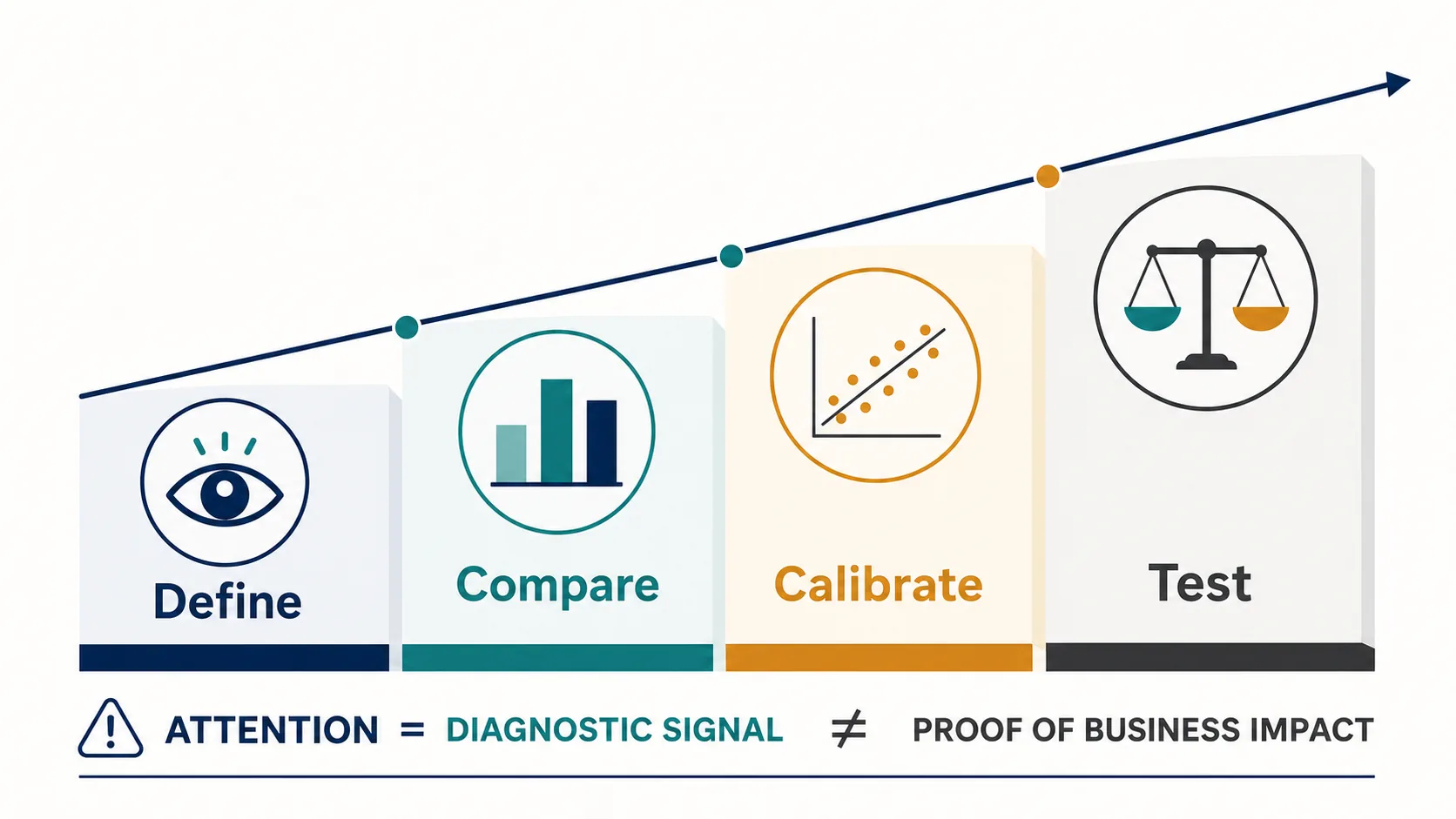
Attention evidence ladder
Before an attention score changes budget language, place it on the lowest rung that the supporting evidence actually reaches. This keeps a useful diagnostic from turning into a stronger claim than the comparison can defend.
| Evidence available | Best use | Claim boundary |
|---|---|---|
| Metric definition, eligible impressions, and measurement coverage. | Quality-control the report and decide whether the score is interpretable. | Say what was counted, not that the campaign worked. |
| Placement, format, device, and audience mix reviewed beside price and reach. | Improve media allocation where exposure conditions are clearly weak or costly. | Say the plan changed exposure quality, not business outcomes. |
| Attention calibrated against brand, qualified visit, lead, sales, or lift evidence. | Use attention as a supporting signal in the readout. | Say the signal aligned with an outcome, not that it caused the outcome. |
| Designed holdout, geo test, or other credible comparison confirms incremental movement. | Let attention explain a possible mechanism after the causal result is known. | Keep the lift claim inside the tested audience, window, and uncertainty range. |
Calibration routes
Keep the attention score tied to the next proof step.
Use these routes when an attention report is starting to influence budget language, inventory ranking, creative choice, brand interpretation, or renewal recommendations.
Method choicePlace attention beside the right methodUse when attention, attribution, MMM, lift tests, geo tests, and brand studies are competing for the same decision.
Exposure qualityCheck eligible impressions firstUse when the score depends on viewability, measurability, invalid traffic, frequency, device mix, or denominator rules.
Brand readoutSeparate noticeability from persuasionUse when attention is being interpreted as recall, preference, favorability, or survey movement.
IncrementalityDesign the outcome comparisonUse when higher attention needs a holdout, matched baseline, or test plan before it supports value language.
Claim languageWrite the bounded sentenceUse when the readout needs to say exposure quality improved without promoting the metric into causal impact.
Best uses
| Decision | How attention helps | What still needs proof |
|---|---|---|
| Creative quality | Compares whether assets hold visual or audio attention long enough to communicate the message. | Whether the stronger asset changes recall, preference, or purchase behavior. |
| Placement quality | Flags inventory where viewability, time in view, clutter, or user behavior makes noticing unlikely. | Whether higher-attention inventory is worth its higher price for this campaign. |
| Format comparison | Shows whether video, display, native, audio, or connected TV units create different exposure conditions. | Whether the format difference survives after audience, price, frequency, and objective are accounted for. |
| Frequency management | Identifies whether added impressions are still likely to be noticed or are mostly repetitive exposure. | The point where additional noticed impressions stop creating incremental value. |
| Context review | Helps compare environments where people are more or less likely to attend to the page, screen, or ad unit. | Whether the context improves business outcomes for the brand and offer. |
Questions a buyer should ask
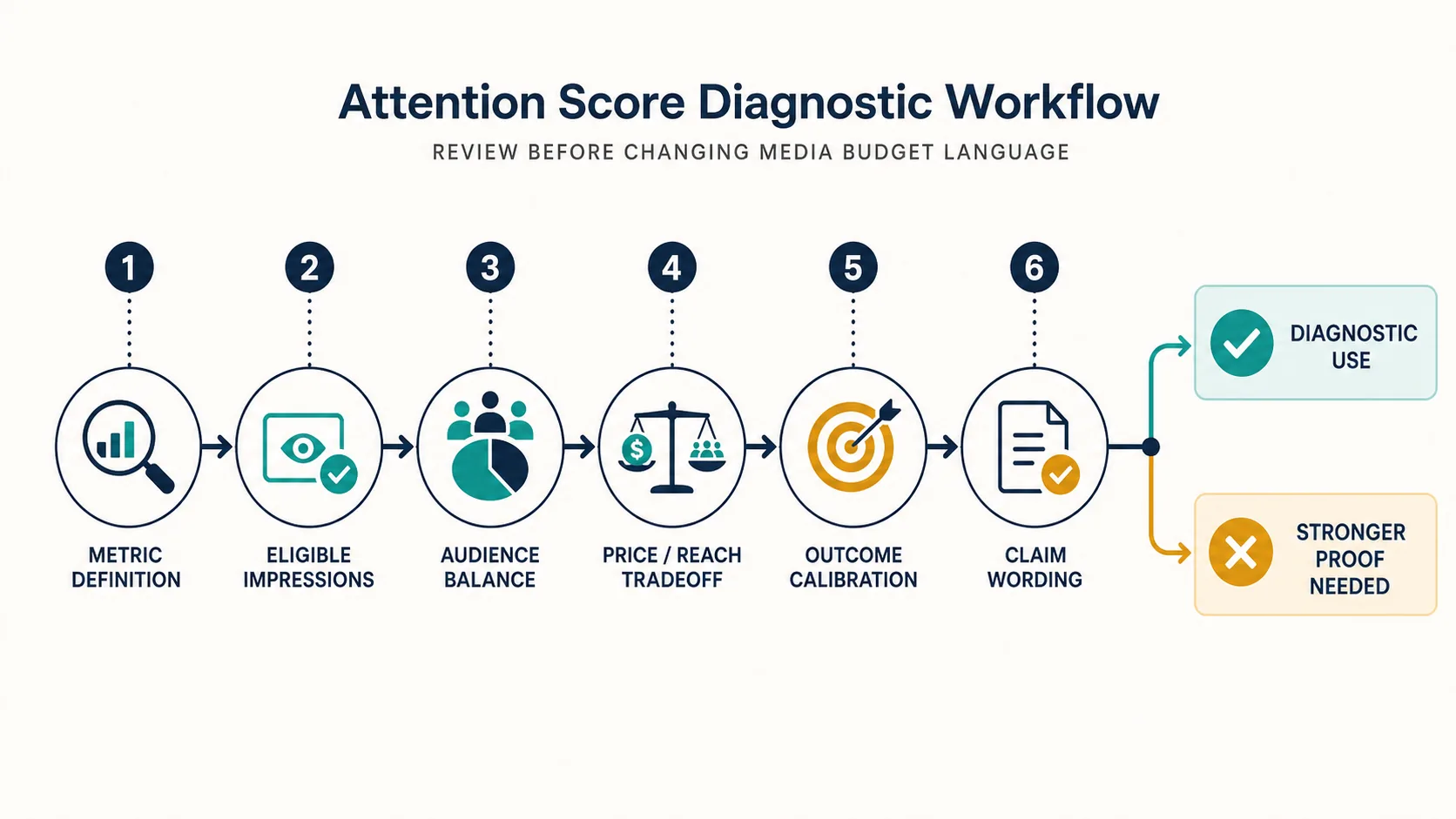
Metric definitionWhat exactly is counted as attention: pixels in view, duration, gaze, interaction, completion, audibility, active tab state, survey recall, or a modeled score? A report that uses the word attention without a concrete definition is not actionable.
Unit of comparisonAre placements compared at the impression, user, campaign, publisher, device, or creative level? A placement-level score can be useful for media QA but weak for causal budget claims.
Audience balanceDid high-attention inventory also reach a different audience? If the attentive group already had stronger intent, the attention score may be mixed with selection.
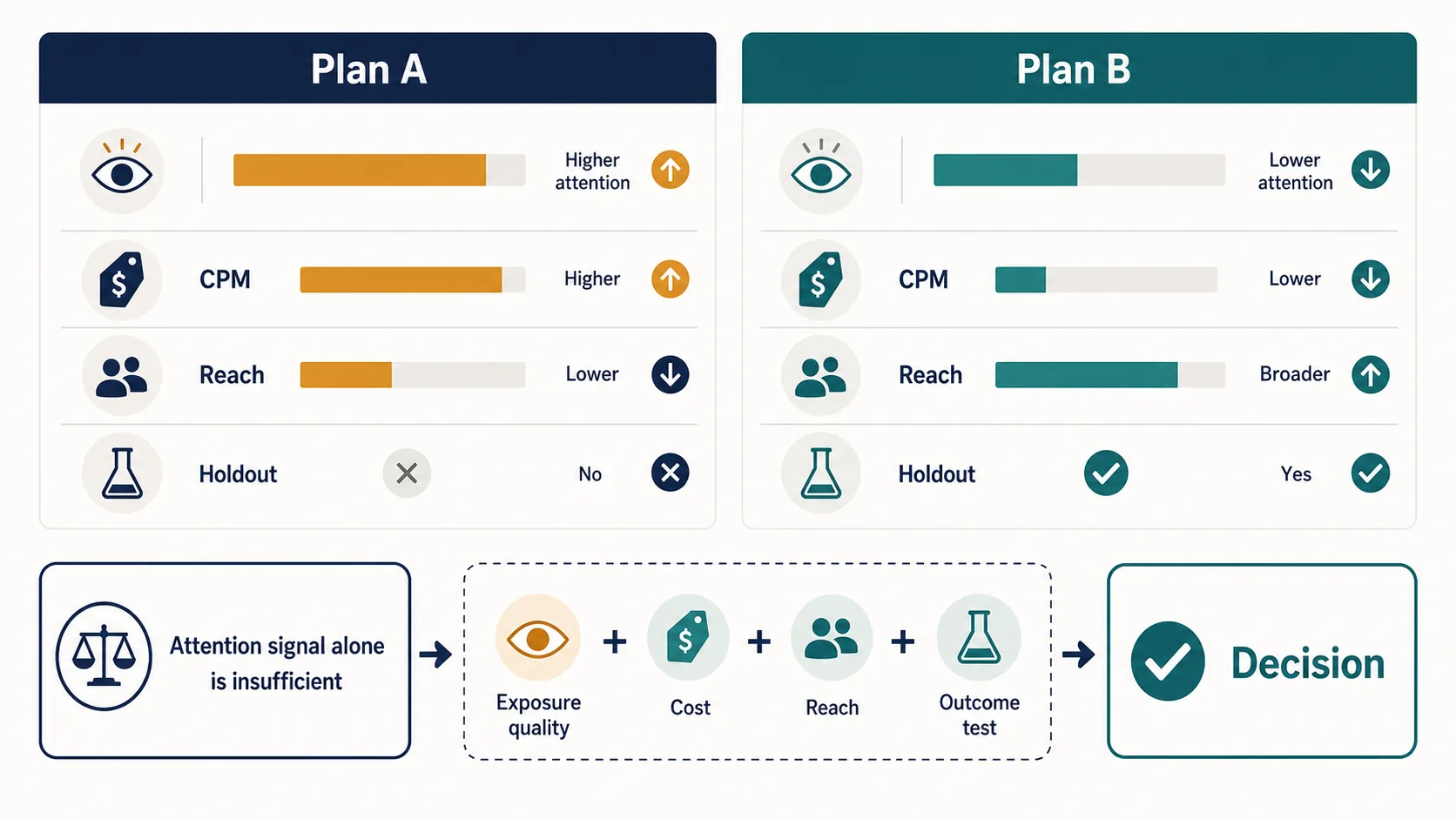
Price and reach tradeoffDoes higher attention come with higher CPMs, lower reach, or tighter frequency? The right question is not which impression looked best in isolation, but which plan improves the decision under budget constraints.
Outcome calibrationHas the attention metric been checked against brand lift, conversion lift, sales, or another outcome that matches the campaign objective? Correlation is useful, but it should not be sold as incrementality.
Readout structure
| Report section | Minimum useful disclosure |
|---|---|
| Objective | The media or creative decision the attention metric is meant to inform. |
| Method | The signal used, measurement window, eligible impressions, device coverage, and known exclusions. |
| Comparison | The benchmark group, matched placements, time period, and any audience controls. |
| Result | Distribution of scores, not only an average. Outliers and low-quality inventory should be visible. |
| Decision rule | What will change: creative rotation, publisher allocation, frequency cap, bid strategy, or test design. |
| Validation plan | The lift test, brand study, sales analysis, or MMM calibration that will check whether attention improved the outcome. |
Common overclaims
- "High attention means the campaign worked." It may only mean the ad had a better chance to be noticed.
- "Attention is a single currency across channels." Measurement conditions differ too much across screens, formats, and contexts for that claim to stand without calibration.
- "Low attention means wasted media." Some short exposures can still reinforce memory, and some high-attention exposures can be irrelevant to the buyer.
- "Attention replaces viewability." Viewability is a weaker exposure threshold, but attention models still need eligibility rules and measurement coverage.
- "The highest score should get the budget." Price, reach, duplication, audience quality, and incremental outcome evidence still matter.
How to use attention responsibly
Use attention measurement to improve the quality of the exposure before claiming the value of the exposure. It can help remove obviously weak inventory, compare creative assets, set up cleaner experiments, and explain why two placements with similar viewability performed differently.
The next step is calibration. Pair attention signals with holdout tests, geo tests, brand studies, or sales outcomes. If attention predicts useful movement under a clear decision rule, it deserves more weight. If it does not, keep it as a diagnostic rather than a planning currency.
Decision questions
Attention measurement questions
Use these answers when an attention score is about to become inventory guidance, creative direction, budget language, or a campaign conclusion.
When is attention measurement useful?
Attention measurement is useful when the decision is about exposure quality: whether an ad had a better chance to be noticed by the intended audience, in the intended context, under the stated format and device conditions.
Can attention prove incremental lift?
No. Attention can support a diagnostic read, but incremental lift needs a credible comparison such as a holdout, matched baseline, geo test, sales analysis, or other design that checks what would have happened anyway.
What should be checked before ranking inventory by attention?
Check the metric definition, eligible impressions, measurement coverage, device mix, viewability, invalid traffic, audience balance, price, reach, and frequency before treating a higher score as better media.
How should an attention signal be calibrated?
Calibrate attention against the outcome the campaign is meant to influence, such as recall, preference, qualified visits, sales, or a designed lift test, while keeping correlation separate from causal proof.
How should attention affect campaign language?
Use attention language for exposure-quality claims unless stronger outcome evidence is present. A careful readout can say the campaign improved noticeability or exposure conditions without claiming that attention created demand.
Primary source trail and a simulated allocation check
The boundaries here follow the current IAB and MRC Attention Measurement Guidelines: attention is a signal about exposure and engagement that should be used with outcome measures, not as a standalone business-outcome measure. The guidelines also separate content, placement, and creative effects and call for transparent methods, validation, and documented dimensions.
- IAB and MRC: Attention Measurement Guidelines - defines attention measurement as a family of data-signal, visual, physiological, and survey approaches and requires validation before stronger outcome interpretation.
- Google Ads: Understanding viewability and Active View reporting metrics - distinguishes measurable impressions from viewable impressions and warns that viewability is an opportunity to notice, not proof that a person looked at the screen.
- Google Ads: About Brand Lift - describes exposed and eligible-but-not-exposed survey groups for comparing ad recall, awareness, consideration, and related brand metrics.
- Google Ads: About the Experiments page - describes splitting budget or traffic between an original campaign and an experiment for comparison over a specified period.
Verified source boundary: Active View defines a measurable/viewable opportunity and explicitly cannot show that a person was looking at the screen. Brand Lift compares exposed people with eligible people who were not exposed for survey outcomes; a platform experiment is a comparison design, not automatically a causal lift study. Use this guide to bound exposure-quality language, then require the appropriate outcome comparison before claiming business impact.
Simulated worked example - not a live campaign: assume two placements report the same vendor-defined attention-qualified signal. Placement A has 40,000 measurable impressions, 12,000 attention-qualified impressions, and a $20 CPM. Placement B has 45,000 measurable impressions, 11,250 attention-qualified impressions, and a $12 CPM. No audience deduplication or outcome data is assumed.
| Calculation | Placement A | Placement B | Decision use |
|---|---|---|---|
| Attention-qualified rate | 12,000 / 40,000 = 30.0% | 11,250 / 45,000 = 25.0% | A has the higher reported rate. |
| Estimated spend | 40,000 / 1,000 x $20 = $800 | 45,000 / 1,000 x $12 = $540 | B costs less under the stated CPMs. |
| Cost per attention-qualified impression | $800 / 12,000 = $0.067 | $540 / 11,250 = $0.048 | B is more efficient on this narrow diagnostic. |
The narrow conclusion is that B is cheaper per reported attention-qualified impression in this simulated comparison; it is not that B creates more sales, brand lift, or incremental value. The result changes if the vendor definition, measurable-impression coverage, audience overlap, CPM, reach quality, or outcome comparison changes. A real allocation decision should retain those fields and add an appropriate test or calibrated outcome measure.
Simulated allocation acceptance gate
Simulated Worked Example - not a live campaign or buyer benchmark. Apply this five-gate check before the fictional comparison changes a budget or inventory recommendation. A pass means the packet is sufficient for that narrow decision step; it does not establish attention validity, business impact, or incrementality.
| Gate | Evidence in the example | Result |
|---|---|---|
| Denominator is visible | Both placements expose measurable impressions and attention-qualified impressions. | Pass |
| Arithmetic is reproducible | Rate, spend, and cost-per-qualified-impression formulas can be recalculated from the displayed values. | Pass |
| Audience and overlap are controlled | No deduplication, audience balance, device mix, or reach-quality evidence is supplied. | Hold |
| Outcome is calibrated | No brand, qualified-visit, sales, or designed lift outcome is included. | Hold |
| Claim and action stay bounded | The conclusion is limited to cheaper reported attention-qualified delivery, with no claim of value creation. | Pass |
The reproducible packet result is 3 / 5 = 60%, but the percentage is not a universal quality threshold: the two hold gates control the decision. Keep the example at a descriptive allocation handoff, not a budget shift. Re-run the gate after adding overlap, audience-balance, and outcome-calibration fields; the conclusion can change if those fields change.
Takeaway
Attention is most credible when it narrows uncertainty. It is least credible when it tries to replace the counterfactual. Treat it as an exposure-quality input, then test whether better exposure actually changed the outcome that matters.