Measurement planning
Measurement brief intake checklist
Organization byline: Measurement Press editorial desk. This page does not list an individual author or reviewer. Read the editorial method and corrections policy.
About 12 min read
A measurement brief is the moment to prevent the wrong dashboard from becoming the accepted answer.
Use this intake before a campaign launches, before a vendor scopes a study, or before an analyst starts a readout. The goal is to define the decision, counterfactual, primary outcome, evidence limits, and language standard while the team can still change the plan.
Picture a Thursday renewal meeting. The media team has a clean dashboard, the finance lead wants to know whether to renew the package, and the analyst has only been asked to "show impact." If the brief does not name the decision, the comparison, and the allowed claim language before results are visible, the dashboard will answer whichever question is easiest to answer after the fact.
Evidence behind this intake
These planning checks are grounded in first-party guidance, not in a claim that any particular campaign worked. Google Ads recommends a clear hypothesis tied to the business goal and warns that changing multiple variables at once makes the result hard to interpret in its Experiments guide. Its Conversion Lift overview distinguishes treatment and control groups when estimating incremental conversions, while study-setup guidance says feasibility depends on factors including conversion actions, duration, historical data, and traffic split. The conversion-window guide also recommends checking time lag so the measurement window does not silently omit late outcomes.
Source-to-decision handoff
Use each source to change a field in the brief or lower the claim ceiling. These references establish planning boundaries; they do not validate the simulated counts or a real campaign result.
| Verified source finding | Brief field to update | Decision consequence |
|---|---|---|
| Experiments guidance recommends a business-linked hypothesis, testing one variable at a time, and preselecting success metrics. | Hypothesis, variable, primary metric, and change log. | If multiple changes or a post-result metric switch remain, describe the result as mixed evidence rather than naming a winner. |
| Conversion Lift guidance defines lift through treatment and control groups and separates incremental outcomes from ordinary campaign reporting. | Counterfactual, assignment rule, exposure definition, and comparison owner. | Observed or attributed conversions stay descriptive until the comparison is protected and validated. |
| Study-setup guidance ties feasibility to conversion actions, history, duration, traffic split, holdout size, and study power. | Feasibility inputs, holdout plan, duration, power or uncertainty check, and limitations. | If feasibility is weak or unresolved, narrow the decision to directional learning or data repair; do not promise conclusive lift. |
| Conversion-window guidance warns that a shorter window can omit later conversions and recommends checking time lag. | Conversion definition, timestamp fields, window, lag distribution, and cutoff date. | Use “within the recorded window” and preserve the late-outcome limitation until the lag check is complete. |
Turn the intake into a claim contract
A brief is not ready because every field has a sentence. It is ready when each sentence has an owner, a source, a pre-readout check, and a claim ceiling if the check fails. Use this handoff table to keep the measurement plan and the final wording tied to the same evidence packet.
| Field | Record in the handoff | Pre-readout check | Claim ceiling if unresolved |
|---|---|---|---|
| Decision | Action, owner, due date, and the no-action condition. | Owner confirms which result would change the plan. | Describe the evidence; do not recommend a budget or renewal action. |
| Comparison | Unit IDs, treatment/holdout assignment, split, exposure rule, and leakage exclusions. | Groups are mutually exclusive and the assignment counts reconcile. | Report observed group differences without calling them incremental. |
| Outcome and window | Event definition, source table, timestamp fields, and fixed conversion lag. | Event and timestamp completeness are measured before analysis. | Say "within the recorded window"; do not imply that late outcomes were captured. |
| Eligibility | Population, geography, audience scope, exclusions, and missing-record counts. | Included plus excluded records reconcile to the eligible population. | Limit the statement to the observed, eligible records and name the omission. |
| Method and claim | Formula, analysis version, uncertainty or power check, and allowed wording tiers. | The calculation can be reproduced from the retained export and assumptions. | Use descriptive or directional language until comparison and uncertainty checks pass. |
Source boundary: Google's guidance informs the planning checks, such as defining a hypothesis, protecting a comparison, considering holdout size, and accounting for conversion lag. It does not validate the simulated counts below, establish a universal business threshold, or turn an unvalidated comparison into causal evidence.

What the brief must answer
The brief converts a broad business question into a bounded evidence request. A good version names what will change, what would have happened otherwise, who is eligible to be counted, which outcome is primary, and how strong the final wording may be.

| Intake field | Write this before work begins | Why it matters |
|---|---|---|
| Decision owner | The person or team that will act on the result, plus the date the decision is due. | Prevents a measurement project from becoming an interesting report with no owner. |
| Decision question | The exact choice in front of the team: renew, scale, pause, shift budget, change creative, change audience, or run a stronger test. | Separates operational decisions from broad curiosity. |
| Counterfactual | What would plausibly happen without the campaign, package, offer, creative, or channel being measured. | Keeps the team from treating observed activity as caused activity. |
| Primary outcome | One outcome that matches the decision, with a fixed source, definition, and window. | Stops a weaker proxy from replacing the metric that matters. |
| Eligible population | The audience, geography, placement set, customer status, device scope, or time window that can fairly enter the analysis. | Makes the denominator visible before results are filtered. |
| Comparison design | The best available comparison: randomized holdout, geo control, matched baseline, prior period, model baseline, or no valid comparison. | Sets the strongest claim the work can support. |
| Data readiness | Required IDs, placement fields, creative fields, dates, outcomes, exclusions, match rules, and known missing fields. | Finds tracking problems before the report is already late. |
| Claim boundary | The strongest wording allowed if the evidence is clean, mixed, weak, or incomplete. | Prevents descriptive reporting from being promoted into causal language. |
Pick the measurement lane
The intake should not force a single method. It should make the tradeoff visible enough that the team chooses a method on purpose.

| If the decision asks... | Start with... | Do not let it become... |
|---|---|---|
| Did this media create incremental outcomes? | A randomized, geo, store, or matched-market design with a protected comparison. | An attributed outcome report presented as lift. |
| How should budget move across channels? | MMM with controls, uncertainty, sensitivity checks, and credible calibration evidence where available. | A ranking of channels based only on predictive fit. |
| Did people notice or remember the message? | A brand or attention study with sample quality, field dates, and outcome meaning visible. | A proxy metric treated as proof of profitable demand. |
| Which creative, context, or page deserves iteration? | A diagnostic readout with delivery, audience, placement, destination, and outcome quality separated. | A winner claim from small or confounded slices. |
| Was the campaign delivered cleanly? | Delivery QA with placement, context, device, viewability, invalid traffic, frequency, and pacing fields. | A performance claim when only exposure quality was measured. |
| Which path or touchpoint appeared before conversion? | Attribution or path reporting labeled as descriptive and checked for window and lag rules. | Causal credit for the last observable touch. |
Red flags at intake
The decision is "show impact."Impact is not a decision. Rewrite the brief around the action the team will take if the evidence is strong, weak, mixed, or missing.
The primary metric is still open.If the team can choose the winning metric after the campaign, the readout will reward search rather than measurement discipline.
The comparison is described as "before launch."Before-and-after can be useful context, but it is weak causal evidence when seasonality, pricing, distribution, promotions, news, and other campaigns are moving too.
The data source is only a summary deck.A serious brief should name the source tables, fields, owner, exclusions, match rules, and change log that will support the final claim.
The readout language is decided by the result.Agree on language tiers before results are visible: delivered, observed, associated with, directionally consistent with, or estimated incremental lift.
Brief readiness score
Use the score before the kickoff ends. The goal is not to make every project experimental. The goal is to decide whether the project is ready for a causal claim, a directional readout, or a descriptive delivery report.
| Check | 0 points | 1 point | 2 points |
|---|---|---|---|
| Decision | The brief asks to "show impact" or "measure performance." | The action is named, but the owner or deadline is missing. | The action, owner, due date, and no-action condition are written down. |
| Comparison | No counterfactual is named. | A weak comparison is named with caveats. | A protected or clearly justified comparison is named before launch. |
| Outcome | Several metrics can become primary later. | One primary metric exists, but the source or window is loose. | The metric, source, window, exclusions, and denominator are fixed. |
| Data fields | The team only has a deck, dashboard, or vendor summary. | Key sources exist, but IDs, match rules, or ownership are incomplete. | Source tables, IDs, timestamps, owners, match rules, and missing-field risks are named. |
| Claim language | The final wording will be chosen after results are known. | Some caveats are discussed, but language tiers are not explicit. | Allowed wording is set for clean, mixed, weak, and incomplete evidence. |
A score of 8 to 10 can usually move into the planned method. A score of 5 to 7 needs a narrower claim or a stronger setup before launch. A score below 5 should not be used to support a renewal, budget shift, or public causal claim without rewriting the brief.
Simulated worked intake gate
This is a Simulated Worked Example, not a Measurement Press campaign result. It shows how a brief can expose the decision arithmetic before a real export or test is interpreted. Assume 1,000 eligible units, an 800-unit treatment group, a 200-unit holdout, and a fixed 30-day qualified-lead window.
| Gate | Simulated entry | Score | What it changes |
|---|---|---|---|
| Decision | Renew only if incremental qualified leads reach 12 or more at the approved cost threshold. | 2/2 | The owner can act on a result instead of asking for generic “impact.” |
| Comparison | 800 treatment + 200 holdout = 1,000 units; holdout share = 200 ÷ 1,000 = 20.0%. | 2/2 | A planned counterfactual exists, subject to assignment, leakage, and feasibility checks. |
| Outcome | Qualified leads within 30 days: 64 ÷ 800 = 8.0% treatment and 12 ÷ 200 = 6.0% holdout. | 2/2 | One definition, denominator, source, and window are fixed before the readout. |
| Data readiness | 960 of 1,000 records have assignment, campaign ID, exposure timestamp, and outcome timestamp; 40 are missing at least one field. | 1/2 | Missing-field ownership must be resolved before the result is treated as complete. |
| Claim boundary | Draft says “the campaign drove 16 leads,” although the comparison has not been validated. | 0/2 | Rewrite as a simulated rate difference until parity, lag, and uncertainty checks pass. |
Simulated arithmetic: 8.0% − 6.0% = 2.0 percentage points; 800 × 0.02 = 16 excess treatment conversions.The 16 is an illustrative calculation under the stated assumptions, not an observed or causal campaign result. The intake score is 2 + 2 + 2 + 1 + 0 = 7/10: narrow the claim and repair the 40 missing records before a renewal decision.
Decision-threshold sensitivity
Keep the decision rule visible instead of treating a single simulated lift as inevitable. Holding the 800-unit treatment denominator and the illustrative threshold of 12 incremental qualified leads constant, calculate treatment units x rate difference for each validated rate difference. These rows are a sensitivity worksheet, not a claim about campaign performance.
| Rate difference | Illustrative excess at 800 treatment units | Against threshold of 12 | Required wording before validation |
|---|---|---|---|
| 2.0 percentage points | 800 x 0.020 = 16 | Passes the simulated threshold | "A simulated 2.0-point difference would meet the rule if validated." |
| 1.5 percentage points | 800 x 0.015 = 12 | Exactly meets the simulated threshold | "A simulated difference at the threshold requires the comparison and uncertainty checks." |
| 1.0 percentage point | 800 x 0.010 = 8 | Does not meet the simulated threshold | "The simulated difference is below the pre-stated action rule." |
| 0.0 percentage points | 800 x 0.000 = 0 | Does not meet the simulated threshold | "No difference is shown in this illustrative row." |
To reproduce the worksheet, replace the treatment and holdout counts with the retained export, calculate each group's qualified-lead rate over the same 30-day window, subtract holdout from treatment, and multiply by the treatment denominator. Then test whether the result changes when missing fields, leakage, lag, or uncertainty assumptions change. If it does, the brief should preserve the sensitivity range and use the weaker claim until the unresolved check is closed.
Assumptions: treatment and holdout units are mutually exclusive, the qualified-lead definition is fixed, the 30-day window captures the relevant lag, and no material interference or assignment failure exists. Limitations: the numbers are invented for the worksheet, no uncertainty interval or power calculation is shown, and a rate difference is not causal evidence until the real comparison is validated.
Minimum handoff packet
The handoff packet is the practical output of the intake. It should let an analyst, vendor, or marketing lead see what the study may answer and what it must not claim.
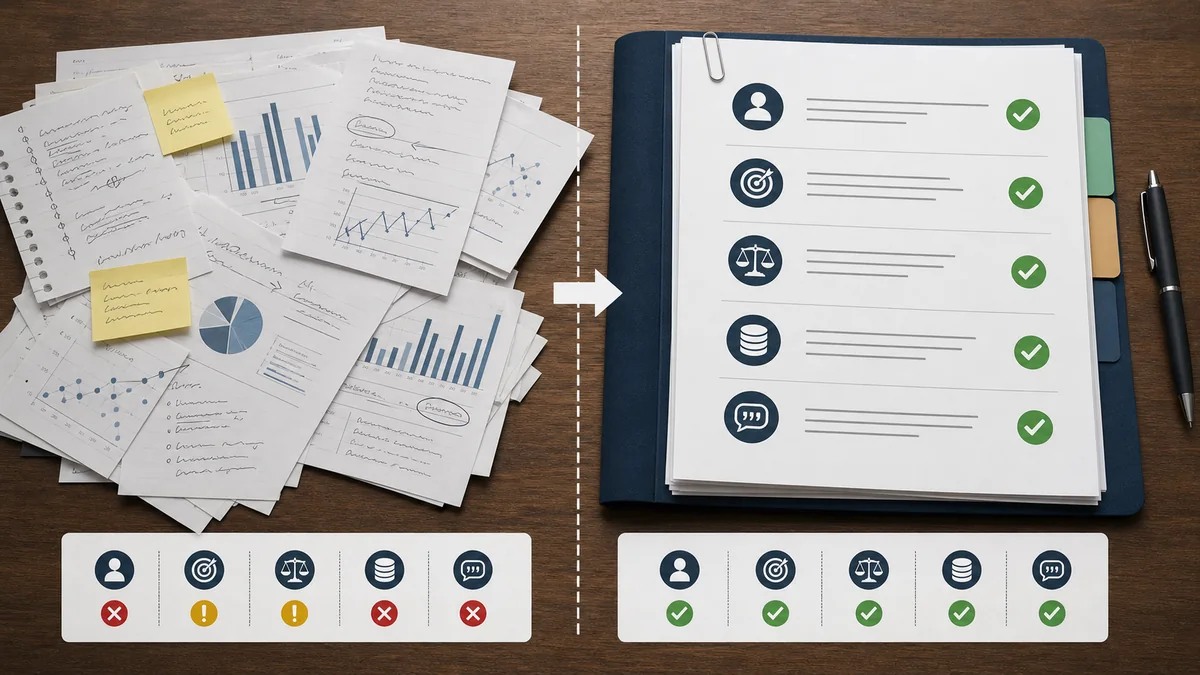
- Campaign or study brief with objective, dates, eligible inventory, audience, creative, destination, geography, and budget scope.
- Measurement plan with decision question, counterfactual, primary outcome, method, comparison, exclusions, and readout rule.
- Data map with placement IDs, creative IDs, destination URLs, audience fields, exposure fields, outcome fields, and source owners.
- Quality-control plan for viewability, invalid traffic, frequency, deduplication, match rates, conversion lag, and missing data.
- Claim-language ladder that states what wording is allowed for descriptive, directional, modeled, experimental, and inconclusive evidence.
Meeting prompts
| Ask this | What a useful answer includes |
|---|---|
| What decision will be different if this measurement is credible? | A budget, creative, audience, vendor, package, or testing action with an owner. |
| What result would make us do nothing? | A pre-stated inconclusive or no-action condition, not only a hoped-for win condition. |
| Who is excluded from the analysis, and why? | Named exclusion rules with counts or expected counts wherever possible. |
| What is the best comparison we can protect before results are visible? | A feasible holdout, market control, matched baseline, model baseline, or an honest statement that the work is descriptive. |
| Which fields must exist on day one? | Placement, creative, context, audience, destination, outcome, test-cell, and timestamp fields. |
| What is the strongest sentence this design can support? | A sentence that names the evidence type, population, window, and uncertainty or limitation. |
Pair with
Use this intake before the measurement method selector when a team is choosing between methods, the incrementality test plan template when the decision needs causal evidence, the campaign data-layer spec when the source fields must be fixed before launch, the campaign readout QA checklist when the report arrives, and the evidence-to-claim language matrix when the final wording needs to match the evidence.
Takeaway
A good measurement brief narrows the room for convenient interpretation. Decide the question, comparison, outcome, data fields, and language before the result exists. Then the readout can help the next decision instead of decorating a decision already made.