Buyer readiness
Private marketplace package brief template
Organization byline: Measurement Press editorial desk. This page does not list an individual author or reviewer. Read the editorial method and corrections policy.
About 13 min read
A private marketplace package brief should make the buy understandable before impressions run and make the renewal evidence auditable after results arrive.
Use this template between the media kit and the campaign brief. It is not a rate card or a performance promise. It is a compact buyer-facing record that connects package IDs, reader context, eligible placements, creative fit, reporting fields, and the decision rule the readout will later use.
Picture the review meeting before a contextual package goes live. Sales has a package name, ad operations has placement IDs, analytics has a reporting export, and the buyer wants to know what the buy will prove. The brief is the shared record that keeps those four views from drifting apart.
Primary sources and scope
This template uses Google Ad Manager and Authorized Buyers documentation for platform terms a buyer or publisher can verify. The documentation distinguishes non-guaranteed PMP deal types and price rules, treats Deal ID as an identifier rather than a delivery result, describes finalization and serving windows, and separates configured key-value reporting from a complete performance record. Those sources establish platform mechanics; they do not validate the fictional package values, prove that a deal served, establish audience quality, or demonstrate business impact.
- Google Ad Manager: About Private Marketplace deals - distinguishes Preferred Deals and Private Auctions and their inventory-selection model.
- Google Ad Manager: Deal ID report dimension - documents the deal identifier used to identify a buyer-publisher deal in reporting.
- Google Ad Manager: Report on targeting keys - explains reportable key-values, reporting setup, and limits that affect field design.
- Google Authorized Buyers: Deals - describes deal lifecycle, serving state, flight timing, and identifiers in bid requests.
- Google Authorized Buyers: OpenRTB integration - documents deal scope fields such as floors, buyer-seat or domain restrictions, and creative constraints.
Source-to-decision handoff
Use the sources as launch gates, not as endorsements of a fictional package. The brief is ready for activation only when the platform record, the sold scope, and the report configuration can be reconciled to the same identifiers and version.
| Platform fact | Record to reconcile | Decision boundary |
|---|---|---|
| Google describes Preferred Deals and Private Auctions as non-guaranteed PMP types with different price rules. | Deal type, fixed price or floor, buyer seat, proposal revision, and the wording used in the package brief. | If the brief implies guaranteed delivery or mixes a fixed-price lane with an auction floor, revise the terms before approval. |
| Authorized Buyers treats a Deal as inventory, terms, and targeting; finalization and serving depend on the accepted revision and applicable flight timing. | Finalized proposal revision, serving status, flight dates when applicable, and the buyer-side identifier used in the bid or platform export. | If the accepted revision or serving window does not match across the proposal, trafficking note, and report, hold package-level delivery claims. |
| Google's Deal ID report field identifies a deal, but a zero or absent deal ID can mean that the reported impression was not associated with the deal type covered by that field. | Deal ID value, report type, auction or demand channel, package label, and the exported impression metric used for the decision. | Do not treat a Deal ID match as proof of delivery, or a zero value as proof that the package was evaluated, without reconciling the report context. |
| Deal and bid-request records can carry scope and constraints such as floor, buyer-seat or domain restrictions, and allowed creative formats. | Included page groups, ad units or placements, seat/domain allowlists, creative-size or format set, and destination version. | Undocumented eligibility is not verified package delivery; report it as an exception or exclude it from the package result. |
| Google says targeting-key reports require configured keys and defined values; targeted impression metrics are needed for order or line-item delivery. | Key registry snapshot, reportable setting, first eligible date, selected report dimension, targeted-impression metric, and exported rows. | Do not compare a pre-configuration period or pooled key-value rows as if the field were complete; narrow the readout or retest. |

Where the brief fits
The package brief sits after package proof and before trafficking. It should be short enough for a proposal review, but specific enough that operations and analytics do not need to infer what the buyer purchased.
In plain language, a private marketplace package is a controlled buying path for a named slice of inventory. The brief explains that slice: who the reader is, where the ads may appear, what the creative is allowed to claim, which fields will survive reporting, and how the buyer should interpret the result.
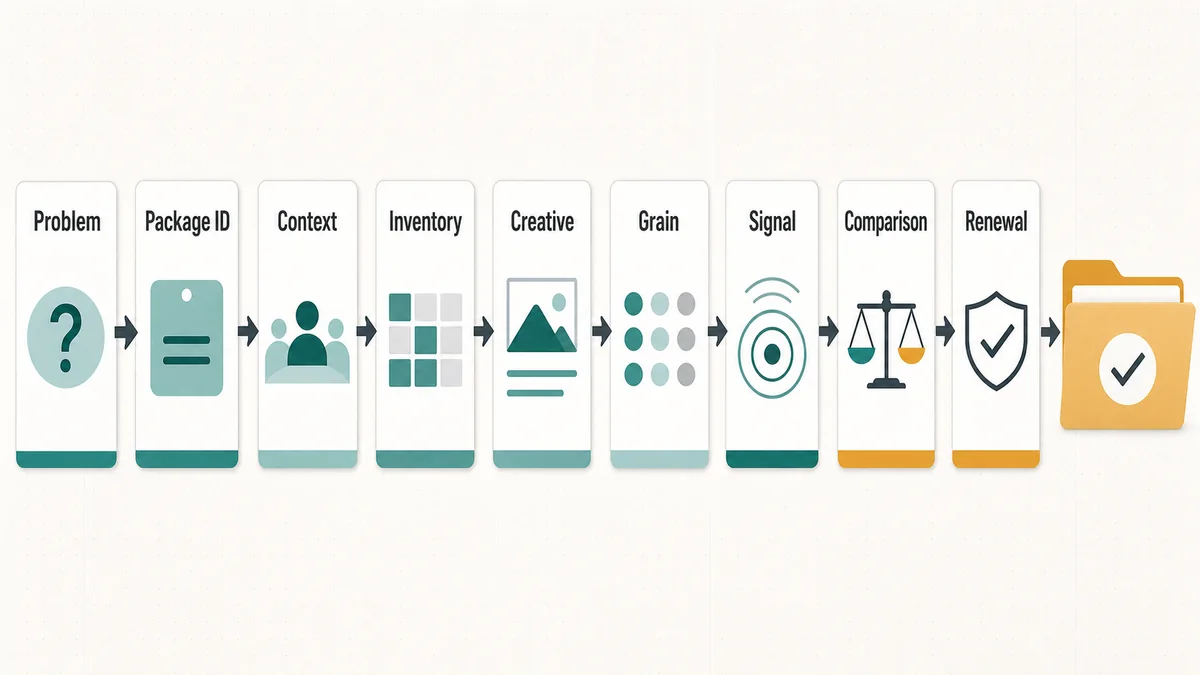
| Workflow moment | Package brief role | Fields that must be visible | Decision it protects |
|---|---|---|---|
| Package selection | Name the reader job and why the package fits the buyer's offer. | package_id, reader_job, clean-fit category, unsupported uses. | Whether this is the right context to buy. |
| Proposal review | Translate the package into buyer-facing scope and reporting expectations. | pmp_deal_key, placement_ids, eligible contexts, primary signal, comparison rule. | Whether the buyer understands what will and will not be reported. |
| Trafficking handoff | Give operations stable names, sizes, exclusions, and creative requirements. | creative_size_set, destination_id, device rules, excluded page groups, change-log owner. | Whether delivery can be audited against the sold context. |
| Readout setup | Lock the renewal evidence before results can favor one metric. | reporting_grain, quality flags, outcome status fields, renewal decision rule. | Whether the final report can support renewal, revision, or test planning. |
The one-page brief
Complete these fields before pricing, launch approval, or private marketplace activation. If a field is unavailable, state the readout limit beside it.
| Brief field | What to write | Why it matters |
|---|---|---|
| Buyer problem | The planning, evaluation, education, or decision task the buyer wants to support. | Prevents the package from becoming broad audience language. |
| Package ID | The stable package ID, label, deal key, reporting key, and buying path. | Connects proposal, ad operations, delivery exports, invoices, and readouts. |
| Reader context | The desks, guide groups, case-study groups, or buyer-reference pages that qualify as on-package delivery. | Keeps reader intent visible when URLs and placements are later summarized. |
| Eligible inventory | Placement IDs, size set, device rules, excluded pages, native-card status, and refresh rule. | Makes the package trafficable without changing editorial page behavior. |
| Creative fit | Message theme, offer type, destination ID, landing-page readiness state, and unsupported creative claims. | Separates context quality from message, format, and destination quality. |
| Reporting grain | Package by week, placement by device, creative by destination, or outcome status by source trail. | Stops one pooled metric from becoming the whole performance story. |
| Primary signal | Qualified delivery, engaged visits, lead quality, survey movement, or designed lift. | Reduces post-flight metric shopping. |
| Comparison rule | No comparison, prior flight, matched context, matched market, protected holdout, or survey design. | Sets the strongest conclusion language the report can support. |
| Renewal evidence | The evidence required to renew, revise creative, shift mix, add a lift test, or pause. | Turns the campaign readout into a decision instead of a favorable slide deck. |
Filled brief example
The values below are examples for structure, not performance benchmarks. Replace them with the real package, creative, and reporting values for the campaign being reviewed.
| Field | Example value | Readout boundary |
|---|---|---|
| Buyer problem | Help analytics leaders compare measurement methods before a quarterly planning cycle. | Supports contextual fit, not guaranteed business impact. |
| Package ID | measurement-science-desk, mp-msd-pmp, package.measurement_science_desk, private marketplace. | Defines the package being bought and reported. |
| Reader context | Method-selector guides, MMM readout pages, lift-test templates, campaign reporting checklists, and measurement-science topic pages. | Delivery outside these contexts should appear as an exception. |
| Eligible inventory | archive-leaderboard, article-inline-1, article-inline-2, article-rail-1, post-content; desktop and mobile inline sizes; pageview-only refresh. | Do not compare placements without device, size, and viewability fields. |
| Creative fit | Planning guide or webinar landing page with evidence-led copy, accepted display sizes, UTM values, and launch-ready destination state. | A strong destination can improve response, but it does not prove media lift. |
| Reporting grain | Package by guide group, placement ID, device class, creative size, destination ID, qualified visits, and lead status. | Small or incomplete cells should be pooled or marked directional. |
| Primary signal | Qualified visits and lead-quality status, with viewability and invalid-traffic review as exposure checks. | Observed response is not the same as incremental demand. |
| Comparison rule | Matched prior contextual flight; no protected holdout. | Supports directional renewal language, not causal lift language. |
| Renewal evidence | Renew if context delivery is complete, qualified visits concentrate in agreed guide groups, lead status is interpretable, and the next readout preserves the same fields. | Add a holdout or matched-market design if the next decision needs lift language. |
Simulated worked check: is the brief ready?
This is a simulated worked example, not a real buyer, publisher, or campaign record. The counts are completeness checks, not performance scores. A critical missing field is handled as a revise or hold decision; it is not hidden by averaging a high score from another lane.
| Field group | Fictional check | Calculation | Decision |
|---|---|---|---|
| Buyer problem and reader context | The example names one planning problem and five qualifying guide groups. | 2 required items present / 2 checked = 100% | Ready to review for fit. |
| Package identity | Package label, package ID, Deal ID placeholder, and reporting key are aligned. | 4 matching fields / 4 checked = 100% | Ready for an operations reconciliation. |
| Inventory contract | Placement IDs, sizes, devices, exclusions, and refresh are named, but the change-log owner is missing. | 5 complete fields / 6 required = 83.3% | Revise before activation; name the owner. |
| Creative and destination | Message theme, accepted sizes, destination ID, and launch-ready state are stated. | 4 complete fields / 4 required = 100% | Ready, subject to destination QA. |
| Reporting and outcome status | Reporting grain, placement, device, creative, and lead status are named, but the quality-flag owner is not. | 5 complete fields / 6 required = 83.3% | Revise the readout contract before launch. |
| Comparison and renewal rule | The example names a matched prior flight, a renewal condition, and the absence of a protected holdout. | 3 decision fields / 3 checked = 100% | Descriptive or directional language only. |
Decision: revise the fictional brief before activation. The overall pattern is not a weighted readiness score: two missing ownership fields can still change whether the handoff is auditable. After those fields are assigned, the example can support a bounded statement about the documented package scope and observed reporting fields. It cannot support causal lift, a claim about every intended buyer, or a promise that the package will improve business outcomes.
Reproduction rule: copy the filled brief into a review sheet, mark each required field present, missing, or not applicable, calculate complete fields / required fields for each lane, and apply the strictest lane to the launch decision. Preserve the proposal revision and Deal ID record, serving window, eligible inventory and creative versions, key-value configuration snapshot with its first eligible date, report definition, exported rows, and field-level exception log. Re-run the checks from those same snapshots; do not substitute a later configuration or a pooled report after the fact.
Once the brief is filled, it should travel with the campaign instead of sitting in a proposal folder. The same package label, placement set, destination ID, and reporting grain should appear in the trafficking handoff, launch QA, export, and readout.

Renewal evidence checklist
The renewal section should be written before results arrive. That makes the final recommendation easier to audit and harder to bend around the most flattering cell.
| Evidence area | Renewal-ready evidence | Quality flag | Decision if weak |
|---|---|---|---|
| Context delivery | Delivery matched the package ID, included page groups, placement IDs, device rules, and exclusions. | off_package_delivery | Rebrief or report exceptions before renewing. |
| Exposure quality | Measurable, viewable, invalid-traffic, frequency, and refresh fields are visible by placement and device. | exposure_fields_missing | Renew only if the decision does not depend on exposure quality. |
| Creative and destination | Creative IDs, size, message theme, destination version, page speed, form path, and change log are complete. | creative_or_destination_confounded | Revise creative or destination before judging the package. |
| Traffic quality | Engaged visit, duplicate, geography, return-visit, and landing-page rules are stated before rates are calculated. | traffic_quality_unclear | Keep the readout descriptive and retest with cleaner fields. |
| Outcome status | Qualified, disqualified, duplicate, missing, follow-up, and unavailable outcomes are separated. | outcome_status_incomplete | Do not let raw lead or match volume drive renewal. |
| Comparison strength | The report names no comparison, prior flight, matched context, holdout, or designed test with limits. | comparison_not_protected | Use descriptive or directional language unless a stronger design exists. |
The brief should also say what happens when evidence is incomplete. A missing exposure field, unclear outcome status, or weak comparison rule does not always mean the package failed. It does mean the conclusion needs a tighter boundary.
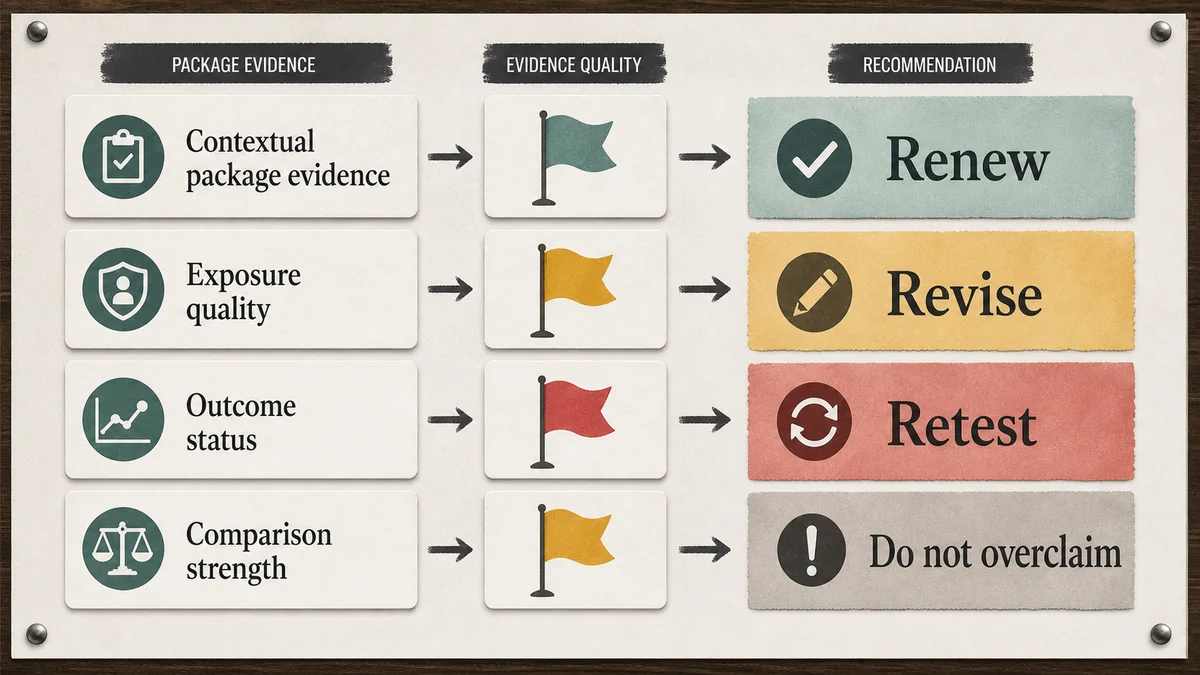
| Evidence state | What the brief should say before launch | Strongest responsible readout language | Next decision |
|---|---|---|---|
| Complete package scope, clean fields, and a named comparison rule. | The buy is ready to launch as scoped, with the comparison limit visible. | Renew, revise mix, or expand the test within the named context. | Renew if the agreed signal clears the threshold. |
| Context delivery is clear, but creative or destination changed mid-flight. | The package can be described, but response should be separated from creative and destination effects. | Directional context evidence with a creative or destination caveat. | Revise creative, destination, or landing-page readiness before scaling. |
| Outcome status is missing, pooled, or delayed. | The readout can describe delivery and traffic quality, not lead or pipeline quality. | Descriptive package performance only. | Retest with stable outcome-status fields. |
| No protected comparison exists and the buyer wants lift language. | The brief should name the missing design before launch. | Observed response or matched-history language, not causal lift. | Add holdout, matched-market, or survey design before claiming lift. |
Brief-to-readout language
Use the same words in the proposal, trafficking note, export, and readout. Stable language makes package performance easier to understand and keeps conclusion strength tied to evidence strength.
| Brief condition | Buyer-facing wording | Wording to avoid |
|---|---|---|
| Context and delivery are complete. | The campaign delivered inside the agreed package, page groups, and placement set. | The campaign reached every intended buyer. |
| Qualified traffic is observed. | Observed visit quality was strongest in the stated context, under the qualified-visit rule. | The context caused demand. |
| Lead status is mixed. | The campaign produced a mixed lead-quality profile, with missing status visible. | The campaign generated qualified pipeline. |
| Comparison is directional. | The result supports a focused renewal or retest, subject to the comparison limit. | The package proved incremental lift. |
| Protected comparison exists. | The design estimates change for this population, window, outcome, and leakage condition. | The result applies to every future package or buyer segment. |
Buyer review questions
- Can the buyer name the package ID, reader context, and decision the package is meant to inform?
- Are placement IDs, device rules, creative sizes, destination IDs, and exclusions specific enough for trafficking?
- Does the reporting grain preserve package, placement, creative, destination, traffic quality, and outcome status?
- Is the renewal evidence written before the campaign can favor one metric?
- Does the comparison rule match the strongest language expected in the readout?
Pair with
Use this brief with the private marketplace readiness index for the full audience-fit, activation, launch, reporting, and renewal sequence, the media kit for package IDs and placement specs, the inventory readiness matrix for deal keys and package contracts, the audience intent map for reader-job proof, the contextual package proof sheet for pre-launch package evidence, the contextual package proof export template when the brief needs exportable fields, the private marketplace deal review checklist for the activation approval gate, the contextual campaign brief template for launch planning, the private marketplace reporting field dictionary for stable field names, the private marketplace readout export sample for row-level reporting, the private marketplace package performance readout for buyer-ready readout language, and the private marketplace renewal scorecard before renewal, creative-change, budget-shift, or lift-test decisions.