Campaign measurement
Campaign reporting sample for contextual media buys
Organization byline: Measurement Press editorial desk. This page does not list an individual author or reviewer. Read the editorial method and corrections policy.
About 9 min read
A useful campaign report should help a buyer decide what to do next without turning a busy table into an overconfident performance story.
Imagine a contextual media buy has finished and the renewal meeting is tomorrow. Delivery looks clean, one guide context produced the most qualified visits, mobile response is mixed, and lead status is still partly open. This sample shows how to organize the readout so the team can see what ran, what response happened, which outcomes were qualified, which rows are still weak, and which claim the evidence can support.
The values below are example values for report structure, not performance benchmarks. Replace them with the campaign's own source-trail fields, package definitions, and outcome status before using the language in a buyer-facing report.
Source trail for the reporting choices
These first-party references support the reporting boundaries used here: Google Ads describes report dimensions and time segments; Analytics documents event parameters as the context behind report dimensions and metrics; and Google Ads' offline-conversion guidance explains why imported outcome status needs a defined event, date, and matching process. I checked these documents for this source trail. They explain how platform reporting is organized; they do not validate the simulated rows, prove that a contextual package caused the observed response, or replace the campaign's own source records.
- Measure your results — Google Ads Help for report dimensions, segments, and account/campaign analysis.
- Understand what is shown in reports — Google Ads Help for dimensions, metrics, and search-term/report interpretation.
- [GA4] Event parameters — Analytics Help for the event-level context that feeds dimensions and metrics.
- Offline conversion imports FAQs — Google Ads Help for the timing and matching limits on buyer-side outcome status.

What the report can say
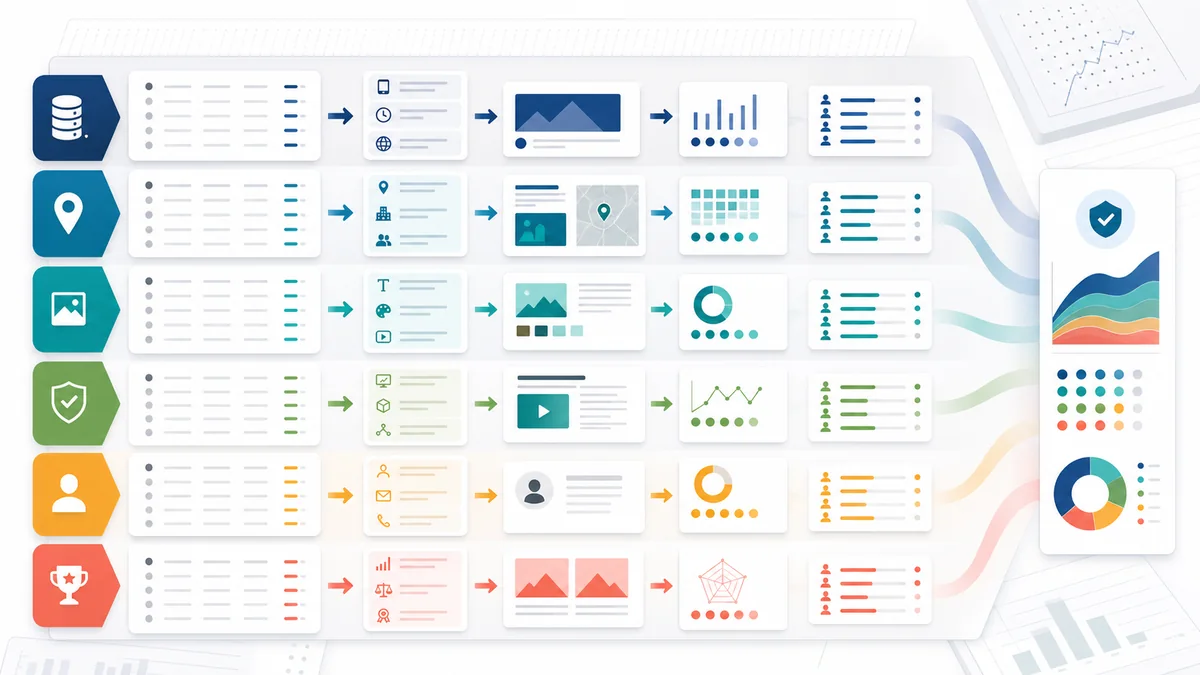
Open the readout with the claim boundary before showing the strongest chart. This keeps descriptive delivery, directional response, and causal lift in separate lanes.
| Evidence available | Report wording | Do not write |
|---|---|---|
| Delivery, viewability, clicks, and qualified visits. | The campaign delivered qualified exposure and observed response in the measured contexts. | The campaign created incremental demand. |
| Lead status supplied after the flight. | Reported leads varied by context, destination, and follow-up status. | The highest-volume placement created the best customers. |
| Prior flight or matched context comparison. | Results were stronger or weaker than the selected comparison, subject to known context differences. | The comparison proves lift without a protected counterfactual. |
| Designed holdout, geo test, or exposed-control study. | The campaign produced measured lift for this design, window, audience, and uncertainty range. | The lift estimate will hold for every future campaign. |
Report header
The header should be boring, explicit, and reusable across proposal, trafficking, billing, and readout records.
| Field | Sample value | Why it belongs in the report |
|---|---|---|
| Campaign objective | Qualified visits to a measurement planning resource. | Identifies the decision the campaign was meant to inform. |
| Package ID | measurement-science-desk | Connects the report to the contextual package definition. |
| Deal key | mp-msd-pmp | Connects buyer, seller, and trafficking records. |
| Primary signal | Qualified visits and lead quality, not causal lift. | Prevents the readout from choosing a stronger metric after results are visible. |
| Comparison rule | Prior contextual flight; no reserved holdout. | Sets the strongest language the report can use. |
| Decision limit | Renew, adjust creative, or plan a lift test. | Keeps the report tied to an action the evidence can support. |
Read the sample in four passes
Do not start with the row that looks most impressive. Read the report in passes so each section earns the next one.
| Pass | Question to answer | What to inspect | How it changes the readout |
|---|---|---|---|
| 1. Scope | Did the campaign run where the buyer thought it would run? | Package ID, deal key, eligible contexts, placements, dates, device classes, and exclusions. | If scope is weak, the report becomes a delivery correction before it becomes a performance story. |
| 2. Response | Which rows produced useful response after traffic quality is considered? | Clicks, qualified visits, destination behavior, device mix, creative theme, and page friction. | If response is narrow, renew or revise only the verified slice instead of scaling the whole package. |
| 3. Outcome quality | Are leads or matched outcomes mature enough to interpret? | Lead status, disqualified rows, follow-up state, missing status, matchback limits, and low-volume cells. | If status is incomplete, keep lead-quality language preliminary and set a closeout date. |
| 4. Evidence strength | What is the strongest claim the design can support? | Prior flight, matched context, holdout, survey control, or no comparison. | If comparison is weak, use descriptive language and plan a stronger test before claiming lift. |
Delivery by context and placement
Start with context and placement delivery. A campaign can look clean in total while one context, size, or device class carries the result.
| Context group | Placement ID | Impressions | Viewable rate | Clicks | Qualified visits | Readout note |
|---|---|---|---|---|---|---|
| Measurement guides | article-inline-1 | 84,200 | 72% | 318 | 146 | Strong upper-body delivery; compare against creative mix before calling the placement better. |
| Measurement guides | article-rail-1 | 36,800 | 68% | 64 | 29 | Lower response, but sustained desktop context may support awareness or return visits. |
| Guide archive | archive-leaderboard | 51,400 | 61% | 97 | 38 | Discovery context delivered reach; quality depends on destination behavior. |
| Post-content | post-content | 22,600 | 59% | 41 | 21 | Smaller scale, but readers had already completed the article context. |
Creative and destination read
Creative performance is rarely just creative performance. Format, placement, audience intent, page speed, offer clarity, and destination friction can all move the observed response.
| Creative theme | Primary size | Destination type | CTR | Qualified visit rate | Lead-start rate | Interpretation |
|---|---|---|---|---|---|---|
| Planning template | 728x90 | Download page | 0.43% | 49% | 9% | Useful response signal; verify lead quality before prioritizing this theme. |
| Analyst webinar | 300x250 | Registration page | 0.26% | 37% | 14% | Lower click rate with stronger lead start; destination intent may be narrower. |
| Product explainer | 320x100 | Product page | 0.31% | 34% | 5% | Mobile response needs destination-friction review before creative judgment. |
Lead-quality readout
Lead volume is a weak finish line unless the report carries buyer-side quality status. Keep status fields visible and avoid ranking contexts only by form fills.
| Context group | Form fills | Qualified | Disqualified | In follow-up | Missing status | Useful conclusion |
|---|---|---|---|---|---|---|
| Measurement guides | 31 | 14 | 8 | 7 | 2 | Best qualified volume, but still descriptive without a comparison design. |
| Guide archive | 8 | 2 | 4 | 1 | 1 | Archive reach produced some response; not enough status depth for budget claims. |
| Post-content | 5 | 3 | 1 | 1 | 0 | Small cell; useful for hypothesis building, not winner selection. |
Simulated worked example: turn rows into a bounded read
Simulated Worked Example — not a real campaign or benchmark. The delivery table above contains 195,000 impressions, 520 clicks, and 234 qualified visits. Recalculate the summary from those rows before deciding what a buyer-facing report can say:
| Calculation | Formula | Result | Interpretation |
|---|---|---|---|
| Overall click-through rate | 520 clicks ÷ 195,000 impressions | 0.267% | Describes observed response across the shown rows; it does not estimate incremental demand. |
| Qualified-visit rate | 234 qualified visits ÷ 520 clicks | 45.0% | Useful only if “qualified visit” has one stable definition across contexts and destinations. |
| Measurement-guide share of qualified visits | (146 + 29) ÷ 234 | 74.8% | Guide contexts carried most qualified visits in this simulation, but placement and creative mix remain confounded. |
| Qualified visits per 1,000 impressions | 175 ÷ 121,000 × 1,000 | 1.45 | A comparable descriptive rate for measurement-guide delivery; it is not a causal efficiency estimate. |
Bounded decisionIn this simulated read, renew or investigate the measurement-guide slice only if the next brief preserves the same row definitions and adds a pre-specified comparison. The calculation cannot show that the guide context caused the qualified visits because there is no protected control, random assignment, or matched design.
Assumptions and limits: the rows are complete, the qualified-visit definition is consistent, duplicate clicks are removed, and the three context groups use comparable attribution windows. If any assumption fails, recalculate by the affected slice and downgrade the recommendation; if the next decision needs incrementality, design the comparison before launch.
Simulated report handoff gate
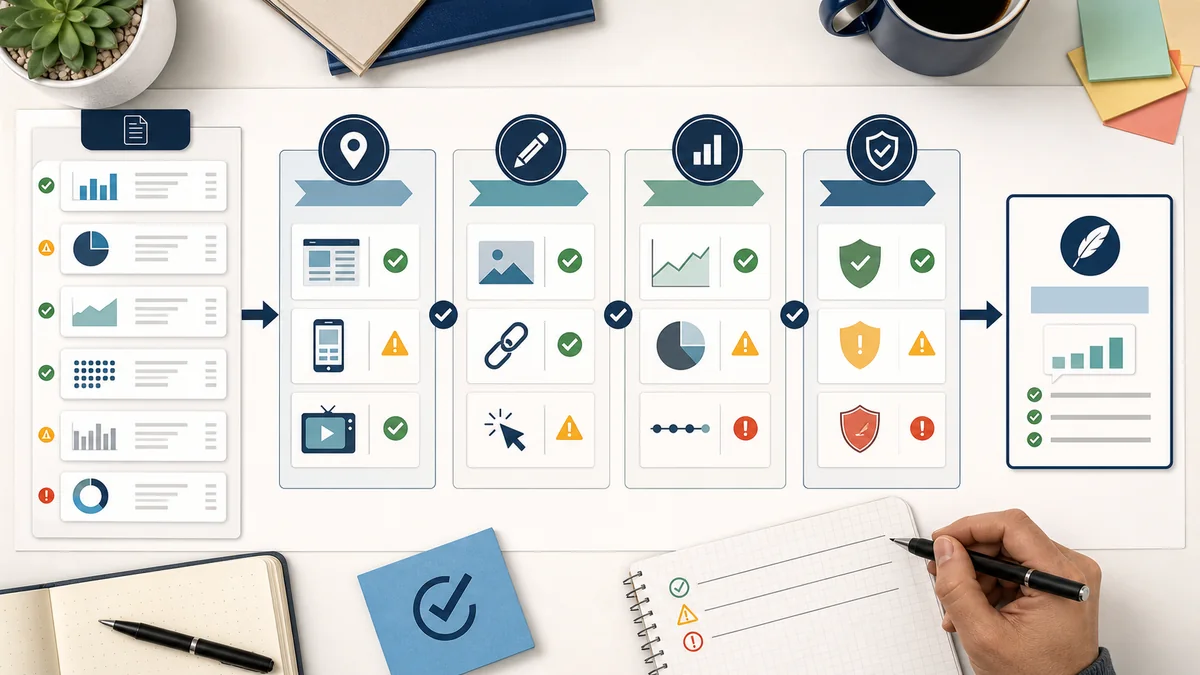
Simulated Worked Example - not a real campaign or benchmark. Use this six-gate check before a report becomes a renewal recommendation. A passing count is documentation readiness, not proof of performance.
| Gate | Evidence in this sample | Result | Decision effect |
|---|---|---|---|
| Scope and dates | Package ID, deal key, context groups, placements, and flight fields are named. | Pass | Delivery can be checked against the intended package. |
| Row-level delivery | Four context/placement rows show impressions, viewability, clicks, and qualified visits. | Pass | Totals can be recomputed before interpretation. |
| Creative and destination | Three creative themes are separated from destination type and response fields. | Pass | Creative is not treated as the only cause of response differences. |
| Outcome maturity | Qualified, disqualified, follow-up, and missing-status fields are shown by context. | Pass | Lead language stays bounded while statuses remain incomplete. |
| Claim boundary | The sample separates observed response from causal lift and states the missing counterfactual. | Pass | Descriptive renewal language is allowed; causal language is not. |
| Protected comparison | No holdout, random assignment, matched baseline, or exposed control is supplied. | Fail | Revise before renewal; plan the comparison before claiming incrementality. |
Reproducible decision rule: 5 passes / 6 gates = 83.3% documentation readiness, but the failed protected-comparison gate is critical, so the packet remains Revise before renewal. If scope, row definitions, or outcome status are missing, hold the packet instead of averaging the score. This gate is a reporting-control aid, not a Google Ads or Analytics benchmark.
Readout summary
Delivery qualityThe campaign delivered in the planned measurement-science context with enough placement detail to audit viewability, device mix, and creative rotation.
Traffic qualityQualified visits were strongest in guide contexts, but the result should be read alongside destination type and creative theme.
Lead qualityBuyer-side status made the report more useful than a form-fill count, but the result remains descriptive unless a comparison was designed before launch.
Next decisionRenew the strongest-fit context only if the next brief preserves the same report fields and adds a cleaner comparison for the decision that matters.

Renewal questions
- Was the campaign delivered in the package contexts that were sold before launch?
- Which result survives after separating placement, creative, destination, and device effects?
- Did qualified leads come from the same contexts that produced the highest delivery volume?
- Which missing field would change the interpretation most if it were known?
- Does the next decision require another descriptive flight, a matched baseline, or a designed lift test?
Pair with
Use this sample with the campaign reporting worksheet when a readout meeting needs a compact decision note, the campaign readout QA checklist after results arrive, the campaign reporting terms glossary when report language needs boundaries, the campaign data-layer spec before launch, the campaign KPI dictionary when naming metrics, the contextual package proof checklist before package pricing or trafficking, the private marketplace campaign measurement checklist when planning package readouts, the private marketplace readout export sample for row-level delivery and outcome fields, the private marketplace package performance readout for buyer-ready package language, the media kit for placement and package contracts, and the inventory readiness matrix for reporting keys.