Buyer readiness
Contextual package proof checklist
Organization byline: Measurement Press editorial desk. This page does not list an individual author or reviewer. Read the editorial method and corrections policy.
About 12 min read
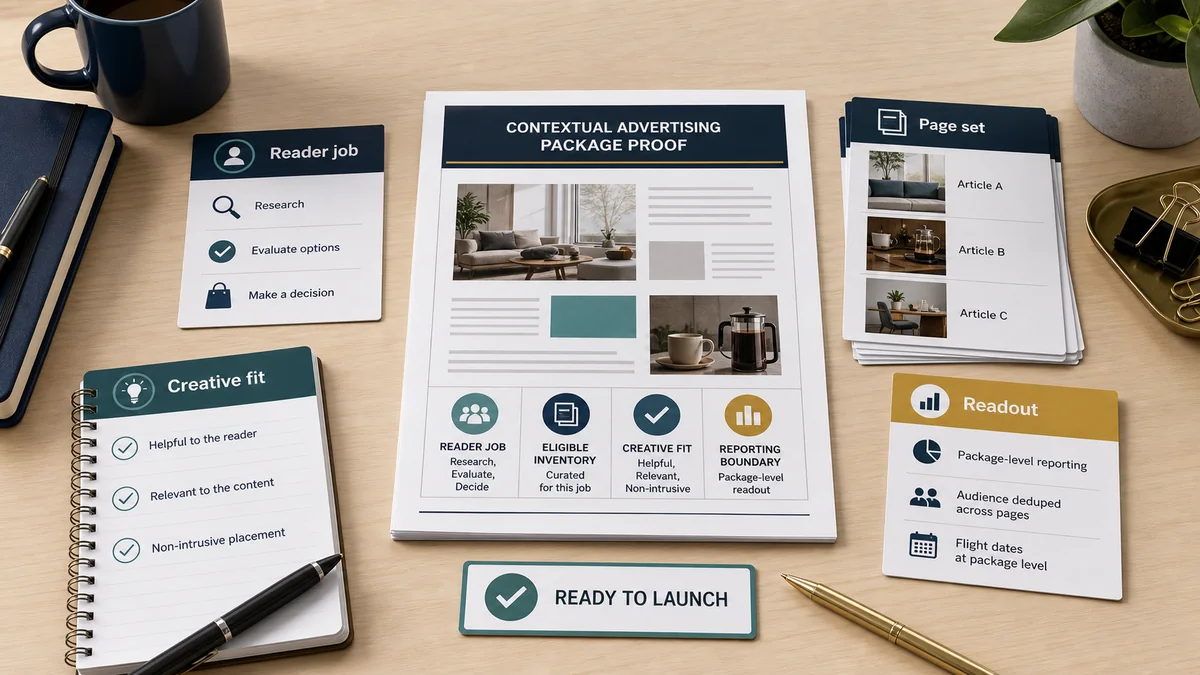
A contextual package is credible when a buyer can see the reader job, eligible pages, placement contract, creative fit, and readout language before the campaign is sold or judged.
Use this checklist to turn a broad package idea into a proof pack that traffic, sales, analytics, and the buyer can all read the same way. The goal is practical proof of context and reporting readiness, not a promise that context alone creates incremental demand.
Picture a renewal meeting where a buyer asks why a "measurement decision-makers" package deserves another flight. If the answer is only a bundle name and a click total, the package is still thin. A useful proof pack shows the reader task, the eligible pages, the sold placement contract, the creative and destination fit, and the exact report language the evidence can support.
The proof question
Before a package has pricing, it should have a plain answer to one question: what professional task is the reader trying to complete, and what evidence shows this inventory supports that task?
| Proof area | What to show | What it can support | What it cannot support alone |
|---|---|---|---|
| Reader job | Desk, guide group, search intent, or case-study context tied to a specific decision. | Contextual relevance and planning fit. | Incremental sales, brand lift, or pipeline creation. |
| Page set | Included URLs, URL patterns, companion guides, exclusions, and refresh cadence. | Package boundaries that can be trafficked and audited. | Guaranteed audience composition or outcome quality. |
| Placement contract | Package ID, deal key, placement IDs, device rules, sizes, and reporting keys. | Operational readiness and clean delivery reporting. | Creative effectiveness or causal performance. |
| Creative fit | Offer type, message theme, destination type, and the reader problem the creative helps solve. | Whether the campaign belongs in the context. | That the message itself caused the response. |
| Readout lane | Primary signal, comparison rule, decision threshold, and allowed conclusion language. | A report that can guide renewal or deeper testing. | Claims stronger than the comparison design permits. |
One-page proof pack
A useful proof pack should fit on one page. It should be specific enough for a campaign manager to traffic and for an analyst to report without rebuilding the package logic after launch. Use the contextual package proof sheet when this checklist needs to become a buyer, operations, and analytics handoff, the contextual package proof export template when the proof needs stable fields for first-party signal readiness and readout language, the ad yield and deal-readiness checklist when the package needs floor, sell-through, refresh, and renewal inputs, then use the creative asset acceptance checklist before display or native files are approved and the landing page launch QA worksheet before paid traffic reaches the destination.

1. Package thesisName the buyer problem and the reader task in one sentence: for example, reaching readers who are choosing a measurement method or checking campaign reporting language.
2. Eligible inventoryList the desk, guide group, case-study group, URL pattern, placement IDs, ad sizes, device classes, and page exclusions that define qualified delivery.
3. Creative and destination fitDescribe the offer, message angle, destination type, landing-page promise, and any creative sizes that must be supplied before trafficking.
4. Measurement boundaryChoose one primary signal and one comparison rule before launch: no comparison, prior flight, matched context, matched market, holdout, or survey design.
5. Renewal decisionState what evidence would justify renewal, creative change, package adjustment, deeper testing, or no further spend.
Package lane examples
The strongest proof changes by package lane. A case-study reader, a source-evaluation reader, and a buyer-reference reader should not be collapsed into one audience claim.
| Package lane | Reader job proof | Best-fit destination | Useful first readout |
|---|---|---|---|
| Measurement Science Desk | Readers are choosing methods, checking incrementality, or auditing readout language. | Planning guide, calculator, webinar, analyst workflow, or product explainer. | Qualified visits and lead quality by guide group, not pooled publication response. |
| Source and Vendor Evaluation Desk | Readers are reviewing reports, dashboards, vendor claims, or evidence quality. | Research asset, governance guide, demo page, benchmark explainer, or advisory resource. | Engaged sessions and downstream action by source-evaluation context. |
| Media Framing Desk | Readers are checking source balance, denominators, public records, and claim language. | Professional learning, newsroom tool, research reference, or source-quality resource. | Content depth and qualified destination behavior, not belief-change claims. |
| Case Study Library | Readers are studying practical measurement failure modes before changing process or spend. | Training asset, experiment design guide, analytics education, or consulting page. | Return visits, companion-guide movement, and qualified inquiries by case-study group. |
| Buyer Readiness | Readers are comparing placement maps, package boundaries, creative specs, and reporting fields. | Report, webinar, product page, service page, or planning template for media buyers. | Proposal-quality signals and follow-up status, kept separate from broad awareness delivery. |
Pre-launch QA
Pre-launch QA is not a final proofreading step. It is the moment to catch whether the package can be delivered, audited, joined, and compared at the same grain promised in the sales and renewal conversation.

| Question | Pass condition | If not |
|---|---|---|
| Can the package be trafficked without interpretation? | Package ID, deal key, placement IDs, page set, size set, device scope, and exclusions are written down. | Delay package activation until operations can use the contract as written. |
| Can delivery be audited by context? | Reporting can separate desk, guide group, placement ID, format, device, and flight period. | Report at the broadest honest level and do not rank page groups. |
| Can creative and destination effects be separated? | Creative ID, message theme, size, destination URL, landing-page version, and dates are stable. | Do not call one context or message the winner. |
| Can lead or outcome quality be joined cleanly? | Buyer-side status carries campaign, package, creative, destination, and source-trail fields. | Keep outcomes descriptive and identify the missing join fields. |
| Can the comparison support the decision? | The readout names a prior flight, matched context, holdout, survey design, or explicit no-comparison status. | Use delivery and response language only, then plan stronger evidence next. |
Report language
The proof pack should shape the report before results arrive. Strong readouts explain what the package delivered, how readers responded, and which claim level the evidence deserves.
| Evidence in hand | Careful report language | Language to avoid |
|---|---|---|
| Package delivery and viewability by context. | The campaign delivered the planned context with visible placement, format, and device detail. | The package reached the right buyers and created demand. |
| Qualified visits by creative and destination. | Observed response varied by context, message, format, and landing-page fit. | The highest-click creative caused the strongest business impact. |
| Buyer-side lead status joined after the flight. | Lead quality can be read by package, creative, destination, and follow-up status where fields are complete. | The package created qualified pipeline. |
| Matched prior flight or matched context. | The result is stronger or weaker than the selected comparison, subject to known context and creative differences. | The comparison proves incremental lift. |
| Protected holdout, geo test, or survey design. | The design estimates lift or survey movement for this population, window, and method, with stated limits. | The result applies to every future package and buyer. |
Worked language boundary
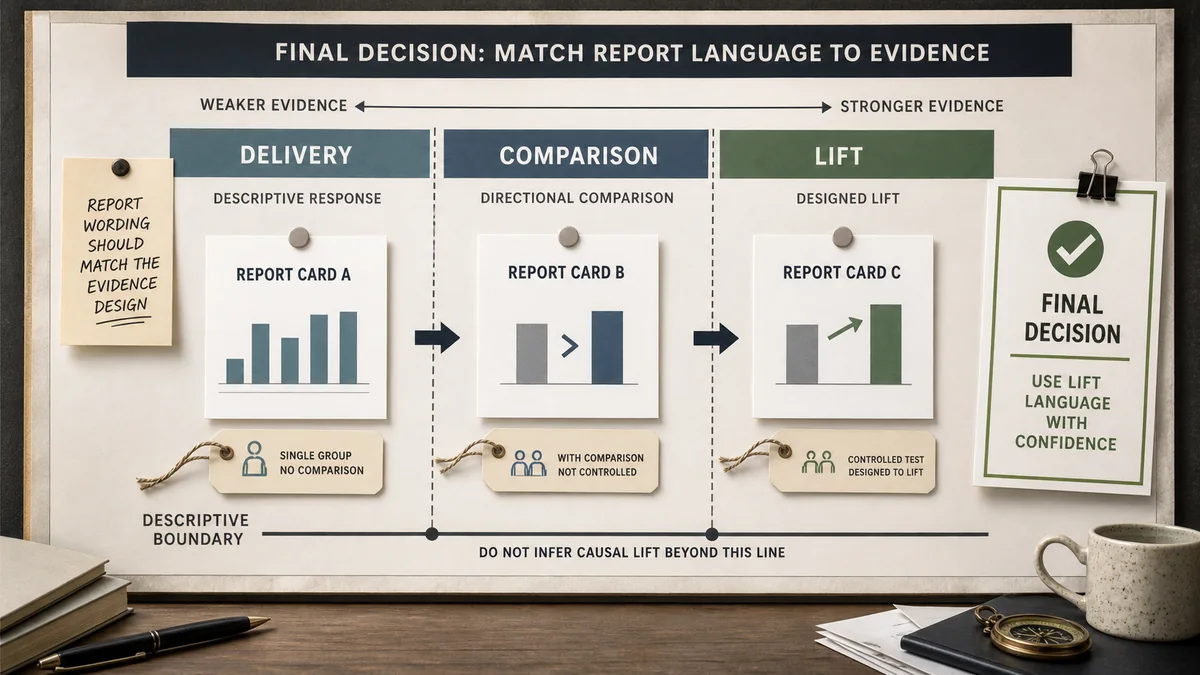
The easiest mistake is to let a useful contextual package inherit language from a stronger measurement design. Use the weakest missing proof record to set the ceiling for the conclusion.
| Proof record in hand | What the buyer can fairly learn | Strongest safe conclusion | Next evidence step |
|---|---|---|---|
| Delivery by eligible page group, with no response comparison. | Whether the package delivered the planned context and visible placements. | Delivery and context fit were documented. | Add qualified response fields before talking about performance. |
| Creative and destination response by context. | Which messages and destinations attracted more qualified visits inside the package. | Observed response differed by context, creative, and destination. | Hold creative and destination stable if comparing future flights. |
| Lead status joined to package, creative, and destination IDs. | Which contexts produced better post-click quality where buyer-side fields are complete. | Lead quality was stronger or weaker for the named records. | Check routing, sales follow-up, and missing status fields before renewal. |
| Matched prior flight or matched context comparison. | Whether the result looks stronger or weaker than a chosen reference point. | The package outperformed or underperformed the selected comparison with stated limits. | Use a holdout, geo test, or survey design before claiming lift. |
| Protected holdout, geo test, or survey design. | Whether the design estimates incremental lift or survey movement for the defined population and window. | The design estimates lift for this setup, with method limits named. | Repeat only if the future package keeps the same decision rule. |
Evidence trail and a simulated proof gate
The page-set and targeting logic should be documented as context, not as a proxy for a person. Google Ads contextual-targeting guidance describes matching page content to selected keywords or topics; it does not establish that every visitor has the intended identity or business need. For the delivery contract, Google Ad Manager key-value guidance shows how page or section values can be included in ad tags, while Ad Manager reporting guidance explains that keys must be configured for reporting and that overlapping values can complicate interpretation. For viewability, the MRC Viewable Ad Impression Measurement Guidelines define separate served, viewable, non-viewable, and undetermined states. These sources support a traceable proof pack; they do not prove audience quality, demand, or incremental lift.
| Source boundary | Supports in this checklist | Still requires package evidence |
|---|---|---|
| Contextual targeting guidance | Document page context, selected topics or keywords, and exclusions as targeting inputs. | That context is a reliable proxy for reader identity, intent, or buyer quality. |
| Key-value guidance | Use defined package, page, placement, and reporting values in the handoff and ad tags. | That values are complete, privacy-safe, reportable, and preserved in every delivered row. |
| Ad Manager reporting guidance | Check reportability, undefined values, overlap, and the chosen reporting grain before ranking contexts. | That a clean report is complete, comparable, or evidence of demand or lift. |
| MRC viewability guidance | Keep served, viewable, non-viewable, invalid, and undetermined states separate. | Actual viewability, invalid-traffic treatment, or causal effect for this package. |
Simulated worked example — not a real campaign, result, or forecast: Assume a package review has 25 planned page records. Twenty-one have a named reader job, page-set inclusion, placement ID, and reporting key; four are missing at least one of those fields. Treat the package as Revise, not Ready: 21 / 25 = 84% complete, so the 16% missing-record share is too large to describe the package as fully auditable. The calculation is descriptive only and uses invented values for method illustration.
| Gate | Simulated calculation | Decision | Limit |
|---|---|---|---|
| Proof-record completeness | 21 complete records ÷ 25 planned records = 84% | Revise before pricing or renewal | Completeness is not contextual relevance, viewability, or buyer quality. |
| Missing-record share | 4 incomplete records ÷ 25 planned records = 16% | List the four records and hold back stronger package language | The missing records may be systematically different; do not assume they resemble the complete records. |
| Readout ceiling | No protected comparison in the simulated brief | Report delivery and context documentation only | Clicks, leads, or viewable impressions alone do not establish incremental impact. |
To reproduce the gate, export one row per planned URL and mark four fields as complete or incomplete: reader job, page-set membership, placement ID, and reportable key. Count a row as complete only when all four are present, divide complete rows by planned rows, and record the missing rows before writing the conclusion. A real decision would also need the package’s measurement window, device split, viewability method, invalid-traffic treatment, and a comparison design suited to the business question.
Simulated activation decision
Do not average away a hard blocker. A package can have strong operational coverage and still be unready for performance or lift language if its records cannot be joined to a comparison. Use the following six-gate review on the same ten-record sample; the values are invented for method illustration, not a real campaign result.
| Gate | Passing records | Calculation | Decision boundary |
|---|---|---|---|
| Declared page-set membership | 10 of 10 | 10 / 10 = 100% | Pass only when every delivered row maps to an included URL or documented exclusion. |
| Reader job tied to page group | 9 of 10 | 9 / 10 = 90% | Revise the unmatched row before naming a package audience. |
| Placement and device contract | 10 of 10 | 10 / 10 = 100% | Pass only when placement ID, size, device, and refresh rules are stable. |
| Creative-to-destination join | 8 of 10 | 8 / 10 = 80% | Hold message or destination comparisons when two rows cannot be joined. |
| Reportable package and outcome fields | 7 of 10 | 7 / 10 = 70% | Use descriptive delivery language only until missing fields are recovered. |
| Protected comparison rule | 0 of 10 | 0 / 10 = 0% | Hard hold: no incremental or lift conclusion without a defined comparison. |
The five operational gates total 44 passing field-records out of 50, or 88%. Including the failed comparison gate gives 44 / 60 = 73.3% overall field coverage, but neither percentage makes the package Ready. In this example the correct decision is Revise and hold performance claims: repair the nine unmatched or incomplete records, define the comparison, and rerun the gate. A complete page-set join can establish delivery context; it cannot establish that context caused demand.
To reproduce this decision, export ten rows with page URL, reader-job label, placement ID, device and size, creative ID, destination URL, package and outcome fields, and comparison status. Mark each gate pass only when its row-level requirement is met. Report the six gate rates separately, list every failed row, and retain the comparison gate as a hard stop rather than folding it into a single score. The result is sensitive to the chosen rows and window; a real package needs an audit of exclusions, refreshes, invalid traffic, viewability definitions, and any change in creative or destination.
Red flags
- The package proof relies on a broad audience label but does not show the reader job.
- The sold page set differs from the delivered page set and the report does not call it out.
- Creative sizes, destinations, or UTM values changed without a readout note.
- All reader contexts are pooled into one performance total before any quality check.
- Attributed clicks, matched conversions, or form fills are described as incremental impact without a comparison design.
Pair with
Use this checklist with the audience intent map for reader-job proof, the media kit for package IDs and placement contracts, the inventory readiness matrix for deal keys and reporting keys, the contextual package proof sheet for the one-page handoff, the contextual package proof export template for exportable reader-job, package, signal-readiness, comparison, and conclusion fields, the ad yield and deal-readiness checklist before pricing or renewing a contextual package, the contextual campaign brief template before launch, the creative asset acceptance checklist before trafficking, the landing page launch QA worksheet before paid traffic reaches the destination, the campaign data-layer spec to preserve source-trail fields, the private marketplace readout export sample for package, placement, device, creative, traffic-quality, and outcome-status rows, the campaign reporting sample for readout tables, and the private marketplace campaign measurement checklist when deciding how strong the report language can be.