Buyer readiness
Direct sponsorship and native proposal review packet
Organization byline: Measurement Press editorial desk. This page does not list an individual author or reviewer. Read the editorial method and corrections policy.
About 13 min read
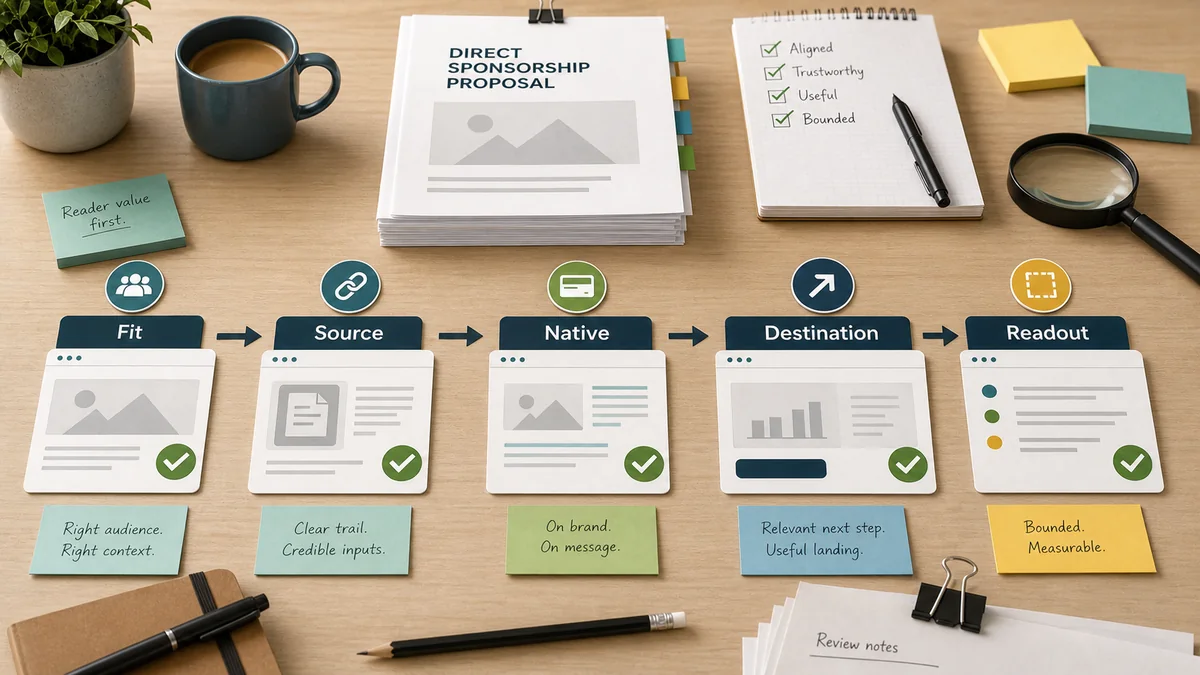
Use this packet when a direct sponsorship or native placement is close enough to review, but not ready to accept. It keeps advertiser fit, paid-card copy, destination quality, package scope, exclusions, and reporting language in one record before the campaign moves into launch QA.
A good proposal should make the reader job visible before pricing, trafficking, or creative approval. The packet below is built for direct sponsorships, clearly labeled native cards, and private marketplace proposals where the buyer's offer may fit the publication but still needs cleaner scope and claim boundaries.
Picture a sponsor proposing a paid resource next to measurement planning articles. The category is plausible and the budget is real, but the first card says "change everything," the destination hides the useful material behind a form, and the buyer asks for a renewal readout that sounds like lift. This packet slows the review down enough to separate a fixable proposal from a campaign that should not move forward.
Evidence boundaries for a paid proposal
This page applies the source guidance below to a practical review record. It is editorial guidance, not legal advice, and the proposal remains responsible for substantiating its own product or performance claims.
DisclosureThe FTC native-advertising guide says a native ad should not imply that it is independent editorial content; when a disclosure is needed, it should be clear, prominent, and close to the ad. That means the paid label belongs above or immediately beside the card headline and remains visible on the destination page.
SeparationGoogle's AdSense program policies prohibit formatting ads so they become indistinguishable from page content and prohibit placements that can be mistaken for navigation. Keep sponsorship modules visually and verbally distinct from this editorial packet.
Format and sourceThe FTC's enforcement policy statement focuses on the net impression: readers should be able to recognize the commercial source before deciding how much weight to give the message.
Industry cross-checkThe IAB Native Advertising Playbook also treats disclosure clarity and prominence as core requirements for paid native units. Use it as an industry reference alongside the FTC guidance, not as a substitute for applicable law.
What the sources support—and what they do not
These references define guardrails for a review record. They do not verify a sponsor, its product claims, a destination, or campaign performance.
| Reference | Use it for this decision | Do not infer |
|---|---|---|
| FTC native advertising guide | Place an understandable paid label close to the card headline and on the destination when the format could be mistaken for editorial content. | That the sponsor's product claims are substantiated or that the publisher endorses the offer. |
| FTC enforcement policy statement | Review the commercial source and overall impression before asking readers to act; a material omission can change the meaning of the unit. | That this worksheet is legal advice or resolves a specific disclosure question. |
| Google AdSense policies | Keep any publisher ad separate from editorial content and navigation, and do not place ads on non-content pages. | That an AdSense presentation rule approves a direct sponsorship proposal or proves its value. |
| IAB Native Advertising Playbook | Use as an industry vocabulary cross-check for disclosure and unit labeling. | That industry guidance supersedes law, platform rules, or the sponsor's substantiation duty. |
Production evidence still required: retain the actual approved card, sponsor identity, label placement, destination capture, exclusions, and readout wording with version and date. This page's simulated records cannot establish that a live proposal met those conditions.
Simulated worked gate: 12 review points
This is a simulated packet, not a report about a real sponsor or campaign. It shows how to make a decision reproducible before a buyer, budget, or performance result is known.
| Review lane | Points available | Simulated result | Points earned |
|---|---|---|---|
| Reader-job fit and exclusions | 0–3 | Offer supports measurement planning; claim-review pages excluded | 3 |
| Paid label and sponsor identity | 0–3 | Label appears above the card headline and on the destination | 3 |
| Destination substance and source capture | 0–3 | Useful preview is visible before the form; source fields persist | 2 |
| Readout boundary | 0–3 | Report is limited to observed response and qualified-lead status | 2 |
Arithmetic: 3 + 3 + 2 + 2 = 10 of 12 points, or 83.3%. The packet is revise before acceptance, not ready, because destination substance and the readout boundary each miss one point. A high average cannot override a material hold condition.
Sensitivity check: material fields control the dispositionThe simulated score changes only when the underlying proof changes. A better average is not a substitute for a missing disclosure, useful destination proof, or bounded readout.
| Scenario | Score | Decision | What changes |
|---|---|---|---|
| Baseline | 10/12 = 83.3% | Revise before acceptance | Useful destination preview and bounded readout each miss one point. |
| Destination preview fixed | 11/12 = 91.7% | Revise before acceptance | The readout ceiling still needs to be fixed. |
| Readout ceiling fixed | 11/12 = 91.7% | Revise before acceptance | Destination substance still needs a useful preview. |
| Both material gaps fixed | 12/12 = 100% | Ready to carry forward | Every material lane is evidenced; the result is still a workflow decision, not performance proof. |
| Paid label missing | 7/12 = 58.3% | Hold | Disclosure becomes a hard stop; do not trade clarity for a score average. |
Decision rule: Fix the named material field before moving from revise to ready. If the paid nature is unclear, the destination remains thin, or the proposal asks for unsupported business-impact language, hold it even if an arithmetic average looks acceptable.
Assumptions and limits: Each lane is equally weighted; the simulated reviewer has verified the label, preview, source-field behavior, and proposed readout wording; no traffic, conversion, revenue, lift, or business impact is observed. A different weighting, a missing paid label, or an unsupported outcome claim could change the decision. The score is a workflow aid, not evidence that the sponsor or campaign will perform.
Proposal proof snapshot
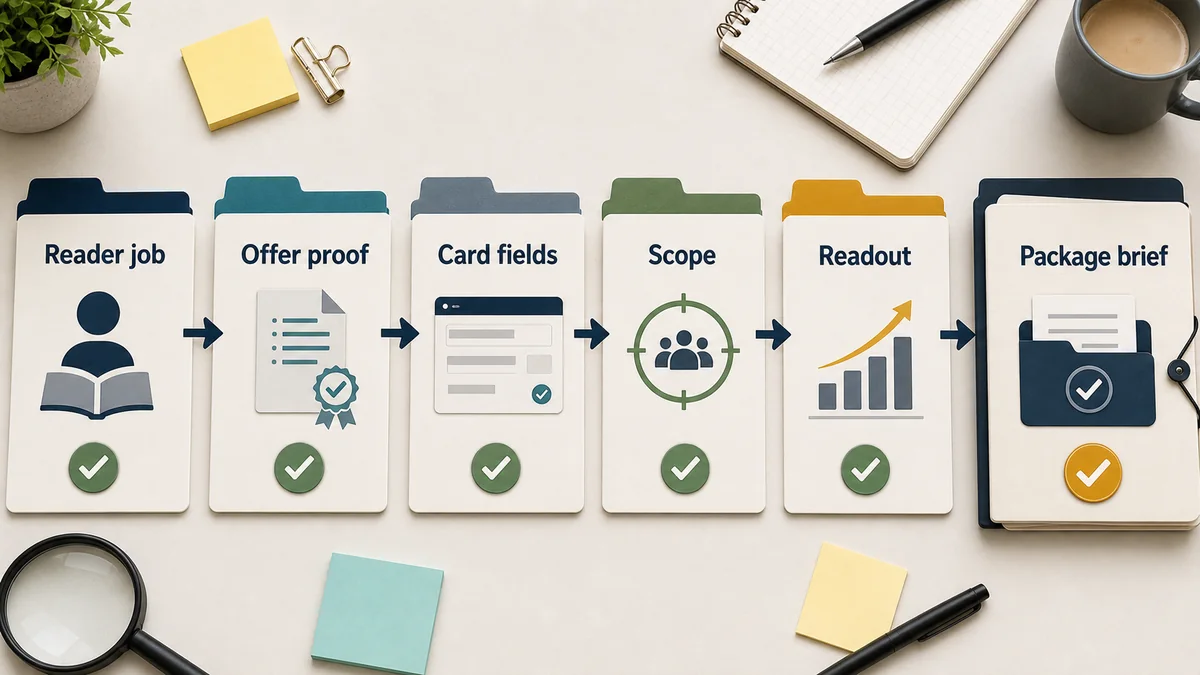
Before the proposal is accepted, make the five proof records below visible enough for sales, operations, analytics, and the buyer to carry forward without reinterpreting the offer.
Reader-job fit is explicit
Tie the buyer offer to a professional task the page set already serves, and name contexts where the offer should not run.
Native-card proof is reviewable
Keep paid label, sponsor identity, headline, body copy, image, click URL, and destination complete before approval.
The post-click path matches
Confirm the destination continues the card promise, offers useful context before a form, preserves source fields, and routes responses clearly.
Package boundaries are trafficable
Write eligible contexts, exclusions, placement type, device rules, and package owner in terms operations can execute.
Result language is bounded
Set the strongest allowed readout before launch so descriptive response is not rewritten as lift or business impact.
Where this packet fits
The proposal review belongs after the reader-job and source-quality fit check, but before the package becomes a launch record. It is narrower than the full campaign readiness dashboard: the goal is to decide whether the offer, native module, destination, and context are worth carrying forward.
Source-use boundary: The FTC materials provide a disclosure and deception review frame; they do not certify a sponsor, product claim, or campaign. Google AdSense policy governs publisher ad presentation separately from a direct sponsorship proposal. The IAB playbook is an industry reference, not a substitute for applicable law or current platform rules. Keep the proposal record factual, and escalate legal or platform-specific questions to the responsible reviewer.
| Workflow moment | Use this page when | Carry forward to |
|---|---|---|
| Fit check | The buyer category looks plausible, but the actual offer, source trail, or destination needs review. | Advertiser source-quality standards. |
| Proposal review | A direct sponsorship, native card, or contextual package needs a ready, revise, context-limited, or hold decision. | This packet. |
| Package proof | The proposal is accepted enough to define eligible contexts, placements, exclusions, and reporting grain. | Contextual package proof sheet. |
| Launch QA | The package, creative, destination, inventory, and reporting fields need final operational approval. | Campaign readiness dashboard. |
Proposal gate
Review these fields before accepting a direct sponsorship or native placement. If the proposal fails one material field, write the revision request before any launch date, floor, or reporting promise is treated as final.
| Field | Accept when | Return for revision when |
|---|---|---|
| Reader job | The proposal names the professional task the reader is already doing: choosing a method, reviewing evidence, planning a report, comparing tools, or studying a failure mode. | The proposal depends on broad awareness language with no page-level reader task. |
| Offer fit | The offer is a report, event, product explainer, service page, template, course, or tool that helps the reader continue the same job. | The offer is only a lead form, generic sales page, or broad promise unrelated to the selected context. |
| Source trail | Claims on the card and destination can be supported by named methods, clear examples, visible limits, or plain scope language. | The creative or destination uses superiority, certainty, or outcome claims that cannot be checked from the page. |
| Native card | The sponsor label, headline, body copy, image, destination, and tracking fields are complete and plainly paid. | The card could be confused with editorial judgment or hides the buyer, offer, or destination. |
| Destination | The landing page matches the card, gives useful context before a form, loads cleanly, and preserves source fields. | The destination changes the promise, hides the resource, runs slowly, or makes lead quality hard to interpret. |
| Package scope | Eligible contexts, excluded contexts, placements, device rules, and native status can be written without guessing. | The proposal says contextual but cannot name included pages, excluded pages, or placement boundaries. |
| Reporting boundary | The strongest allowed readout language is set before launch: descriptive response, directional comparison, or designed lift. | The buyer expects lift, pipeline, or business impact language from clicks, visits, or form fills alone. |
One-page review packet
Fill these fields before a proposal becomes a package brief or campaign record.
Native card acceptance checks
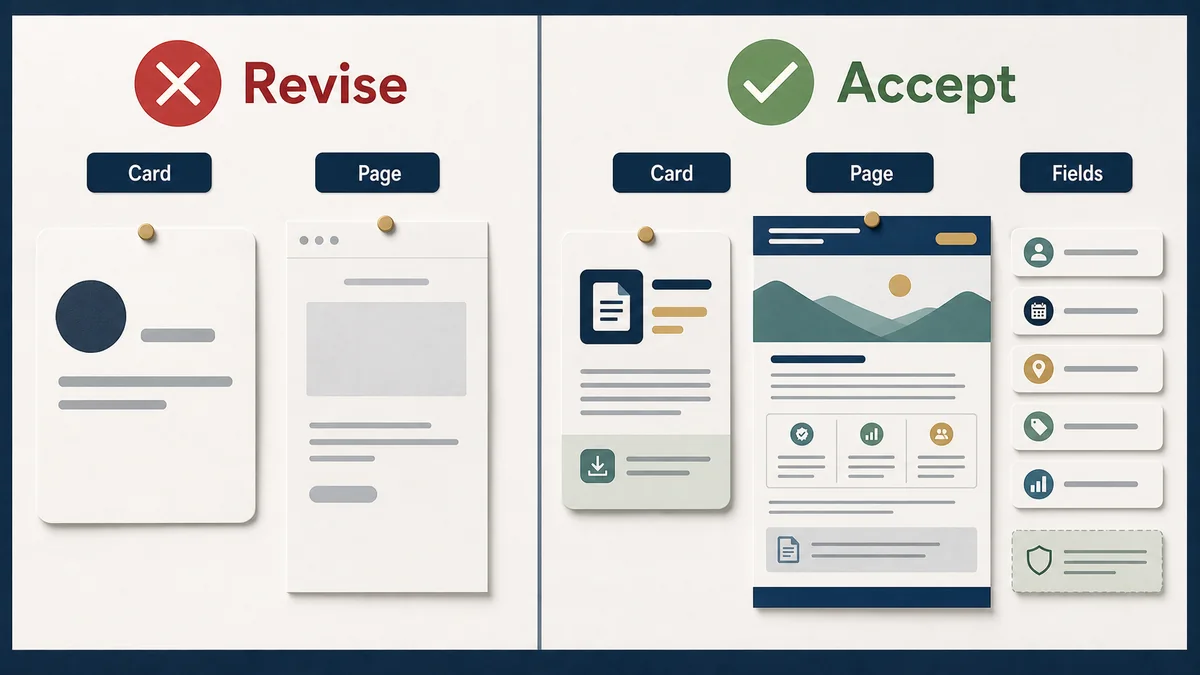
| Native element | Ready pattern | Revision note |
|---|---|---|
| Paid label | The paid nature of the unit is visible before the headline and travels with the module on mobile. | Move the label above the headline or rebuild the module if the label separates from the card. |
| Sponsor identity | The sponsor name or buyer category is clear enough for the reader to understand who is speaking. | Add a sponsor line when the reader would otherwise infer editorial authorship. |
| Headline | The headline names a concrete report, webinar, template, product explainer, service, or course. | Replace broad claims with the actual resource and the professional job it helps with. |
| Body copy | The copy explains the resource without copying editorial voice or implying endorsement. | Remove phrases that make the card sound like the article's conclusion. |
| Image | The image is work-safe, relevant, legible, and consistent with a serious reference page. | Replace images that are distracting, vague, or unrelated to the reader task. |
| Destination | The landing page continues the same promise and includes useful context before the first form ask. | Return the proposal if the destination changes the offer or hides the resource. |
| Report fields | Creative ID, destination ID, placement ID, package ID, and comparison rule are ready before launch. | Do not approve the card if native response will be pooled with unlike formats or contexts. |
Destination quality checks
The destination does not need to be long. It does need to be useful before it asks the reader to register, schedule, download, or request contact.
Ready destinationThe page opens with the promised resource or explainer, names the method or scope, gives enough context to evaluate the offer, keeps the form understandable, and preserves campaign source fields.
Revise destinationThe page changes the promise, hides all substance behind a form, uses broad outcome language, omits the expected source fields, or makes lead quality difficult to interpret.
Worked proposal scoring pass
Use the scoring pass when a proposal has a strong commercial reason to continue, but the evidence record is mixed. Score the weakest material field, not the average mood of the meeting. A single unsupported outcome promise can move an otherwise useful sponsorship from ready to revise or hold.
| Review lane | What the reviewer sees | Decision pressure | Action before acceptance |
|---|---|---|---|
| Reader job | The offer helps readers compare measurement methods and plan campaign readouts. | Ready signal. | Carry the eligible article group into the package proof sheet. |
| Native card | The headline names a useful resource, but the body copy implies the publisher recommends the buyer. | Revise signal. | Rewrite the card so it describes the resource without borrowing editorial authority. |
| Destination | The page has a useful summary below the form, but the promised checklist is not visible before registration. | Revise or context-limited signal. | Ask for a useful preview, method summary, or sample section above the form. |
| Scope | The buyer wants all measurement pages, including claim-review articles where the offer would feel adjacent but not useful. | Context-limited signal. | Limit the package to buyer-readiness and campaign-planning pages; exclude public-claim audit pages. |
| Readout boundary | The buyer asks for language about generated pipeline from clicks and form fills alone. | Hold signal until fixed. | Set the readout ceiling to observed response and qualified lead status unless a designed lift test is added. |
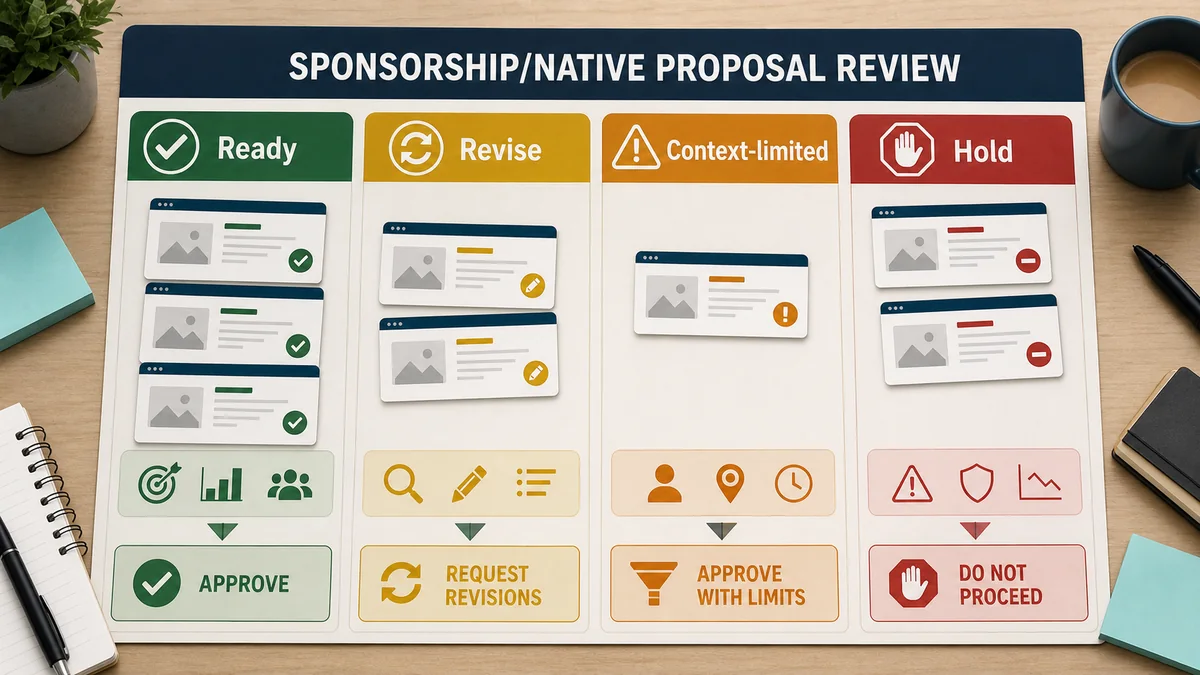
Decision bands
| Status | Use when | Next action |
|---|---|---|
| Ready to carry forward | The proposal has a clear reader job, acceptable card, useful destination, defined scope, exclusions, and reporting boundary. | Create or update the package proof sheet and campaign readiness dashboard. |
| Revise before acceptance | The fit is strong but one card, destination, tracking, or wording item needs correction. | Send the buyer a specific revision note and recheck only that field. |
| Context-limited | The offer fits one desk, guide group, or format but not the broader package. | Narrow the context and make the limitation visible in the package brief. |
| Hold | The proposal conflicts with the reader job, uses unsupported claims, has a weak destination, or expects stronger readout language than the setup can support. | Rework the proposal before pricing, trafficking, or launch scheduling. |
Choose the next sponsorship-quality check.
Use these routes when a proposal exposes a missing source-quality, native-card, package-scope, destination, launch, or reporting field.
Source qualityReview the offer trailCheck advertiser fit, source support, destination substance, and claim quality before acceptance.
Native examplesCompare card patternsUse accepted and revise examples before approving paid labels, headlines, images, and destinations.
Package proofName the scopeWrite eligible context, exclusions, placement scope, package owner, and reporting grain.
DestinationTest the post-click pathConfirm speed, message match, form path, source fields, consent, and routing before traffic.
LaunchApprove the campaign recordCheck package proof, creative approval, destination QA, inventory, and readout fields.
ReportingPreserve field labelsKeep package, placement, creative, traffic-quality, outcome, and comparison records aligned.
Pair with
Start with the audience intent map and advertiser source-quality standards. Use the native card and landing page example gallery for accepted and revise examples, the sponsor fit and ad adjacency checklist for page-context review, the landing page launch QA worksheet for destination checks, the contextual package proof sheet for scope, the private marketplace reporting field dictionary for report fields, and the campaign readiness dashboard before launch.
Takeaway
A direct sponsorship or native card is not ready because the category looks relevant. It is ready when the proposal helps the reader's actual job, the paid unit is clear, the destination is useful, the context is bounded, and the final readout cannot claim more than the campaign was designed to show.