Retail media
Retail media measurement needs a buyer-would-have-bought-anyway check.
Organization byline: Measurement Press editorial desk. This page does not list an individual author or reviewer. Read the editorial method and corrections policy.
About 10 min read
Retail media can connect ad exposure to store, app, and ecommerce purchases in a way many channels cannot. That makes it valuable. It also makes overclaiming easy when attributed sales are treated as incremental sales.
The practical question is not whether a retailer, marketplace, delivery platform, or commerce partner can observe purchases after exposure. The question is whether the campaign changed what shoppers bought, when they bought it, or where they bought it compared with a credible baseline.

The first distinction
| Metric or claim | What it can show | What it cannot prove alone |
|---|---|---|
| Closed-loop attributed sales | Purchases matched to exposed or clicked shoppers inside the retailer's reporting window. | That the ad caused those purchases or that the same shoppers would not have bought anyway. |
| iROAS | Estimated incremental revenue divided by spend, if the incrementality method is disclosed and credible. | That the estimate is stable across products, seasons, audiences, bids, or offsite inventory. |
| New-to-brand sales | Purchases from shoppers not seen buying the brand in a defined lookback period. | That the shopper is truly new to the brand outside the retailer's observable environment. |
| Basket or category lift | Whether purchase value, units, or category behavior moved during the campaign window. | That the movement came from the media rather than price, promo, distribution, or seasonality. |
| Clean-room match | Whether advertiser and retailer data can be compared under controlled access rules. | That matching solved selection bias, missing identifiers, or a weak counterfactual. |
The buyer-would-have-bought-anyway check
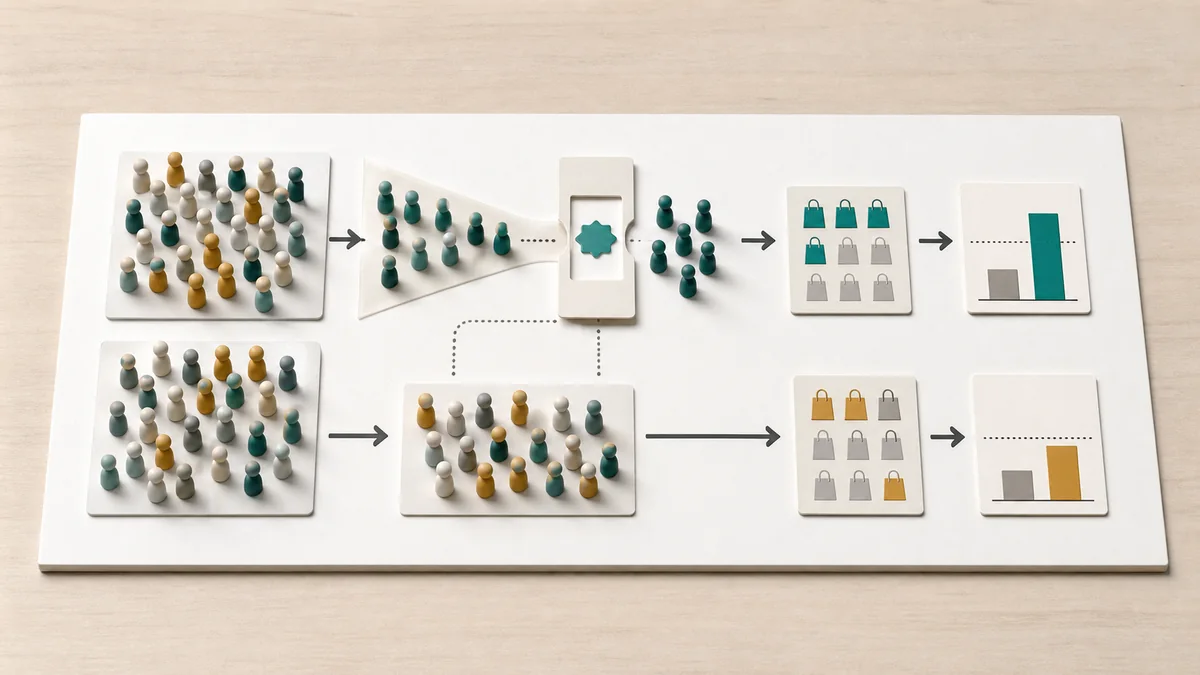
Retail media often targets shoppers with strong commercial signals: recent category visits, cart behavior, loyalty history, search intent, coupon use, or prior purchases. Those signals help campaigns perform. They also make naive exposed-versus-unexposed comparisons fragile.
Pre-period intentAsk how treatment and control shoppers behaved before the campaign. Prior category purchases, search queries, product-page visits, cart additions, store visits, and loyalty status should not be wildly different unless the analysis accounts for them.
Offer and price overlapSeparate media from merchandising. A promotion, endcap, coupon, price drop, shipping change, or inventory improvement can produce sales that an ad report later captures as campaign value.
Audience eligibilityName who could enter the campaign and who was excluded. If high-value buyers, lapsed buyers, loyalty members, or recent browsers are handled differently, the readout should say so.
Outcome windowCheck whether the window matches the purchase cycle. A short window can miss delayed sales; a long window can absorb normal replenishment that would have happened anyway.
Minimum vendor disclosure
| Ask for | Useful answer | Weak answer |
|---|---|---|
| Incrementality design | Randomized holdout, geo test, store test, switchback, or pre-stated matched design with clear assignment rules. | "We compare exposed shoppers to shoppers who were not exposed" without showing why they are comparable. |
| Unit of assignment | User, household, loyalty account, store, market, product group, or time period, with leakage controls named. | Assignment is described only as audience targeting or reporting segmentation. |
| Primary outcome | One outcome tied to the decision: incremental sales, margin, units, repeat purchase, category growth, or new buyer acquisition. | A readout switches between sales, clicks, add-to-cart, reach, and ROAS until one looks strongest. |
| Baseline behavior | Pre-period category buying, brand buying, store activity, and search or browse intent are balanced or adjusted. | The report starts at campaign launch and hides pre-campaign differences. |
| Uncertainty and exclusions | Intervals, sample sizes, match rates, outlier rules, and suppressed cells are visible enough for a decision. | A single point estimate is shown without power, variance, or population caveats. |

When each test design fits
| Design | Best retail media use | Main risk to inspect |
|---|---|---|
| User or household holdout | Onsite, app, email, loyalty, or addressable offsite media where eligible shoppers can be withheld cleanly. | Suppressed shoppers still receive the message through another campaign, device, household, or seller route. |
| Geo or store test | Market-level launches, local store pushes, regional offsite media, or shopper marketing that cannot be held out by person. | Treatment and control markets differ in pre-period trends, distribution, pricing, or competitive pressure. |
| Switchback | Alternating bidding, merchandising, or media conditions across pre-set time windows. | Carryover from one period affects the next period, especially for replenishment or delayed purchase categories. |
| Matched audience analysis | Directional readouts when randomization is unavailable and the stakes are modest. | The match is tuned after results are visible, or it matches demographics while ignoring purchase intent. |
| MMM calibration | Budget planning across retail media, trade, search, social, CTV, and promotions over longer horizons. | Retail media spend is correlated with promos, distribution, seasonality, or brand demand in ways the model cannot separate. |

Retail media incrementality scorecard
Use this scorecard before a renewal memo or budget increase. It keeps purchase visibility separate from causal confidence, and it forces the readout to name which parts of the evidence are strong enough for decision language.
| Review field | Green | Yellow | Red |
|---|---|---|---|
| Counterfactual design | Assignment, holdout, market test, or pre-stated matched comparison is visible before results are read. | The comparison is plausible, but one assignment or matching rule still needs documentation. | The report compares exposed shoppers to whoever was not exposed without showing why they were comparable. |
| Buyer-intent balance | Pre-period category buying, brand buying, search, browse, cart, loyalty, and store behavior are balanced or adjusted. | Some intent fields are shown, but at least one high-intent signal is missing from the balance check. | Treatment shoppers were selected because they were closer to buying, and the report does not adjust for that fact. |
| Promotion and price separation | Price, coupon, endcap, distribution, shipping, inventory, and merchandising changes are named and separated from media. | Known retail changes are disclosed, but their effect is handled only as a caveat. | A promotion, availability shift, or merchandising change overlaps the campaign and is folded into media value. |
| Leakage and overlap | Suppression, household/device spillover, offsite retargeting, seller messages, and other campaigns are checked. | Leakage is possible, but the readout includes a downgrade rule for affected segments. | Held-out shoppers still received similar messages or offers through another route. |
| Match and outcome coverage | Match rate, suppressed cells, return handling, pickup/store attribution, and outcome maturity are visible. | Coverage is directionally useful, but one population or outcome gap limits broad claims. | The readout hides match loss, missing sales channels, immature outcomes, or suppressed result cells. |
| Uncertainty and action threshold | Intervals, sample sizes, minimum useful lift, and the scale/renewal rule are stated together. | The point estimate is useful for learning, but interval width or threshold alignment limits the action. | A single iROAS or attributed-sales number is used as proof without precision or a decision threshold. |
If any row is red, do not describe the readout as proof of incremental retail sales. If two or more rows are yellow, use the result to shape the next test, audience, or offer plan rather than to justify broad budget scale.
Readout language that stays inside the evidence
| Overstated claim | Cleaner claim |
|---|---|
| "Retail media delivered $4.20 ROAS." | "The campaign attributed $4.20 in sales per ad dollar during the reporting window; incrementality depends on the holdout or comparison described below." |
| "The network proved incremental lift." | "The reported lift is credible if assignment, leakage, baseline balance, outcome capture, and uncertainty pass inspection." |
| "New-to-brand sales show acquisition." | "New-to-brand is defined inside this retailer and lookback window; broader brand acquisition needs additional evidence." |
| "Offsite media drove store sales." | "Matched store sales rose among the measured group; causal confidence depends on the comparison group and other retail changes during the window." |
Worked readout downgrade
A retail media report shows strong closed-loop attributed sales and a positive iROAS estimate for an offsite campaign. Before renewal, the reviewer finds four limits: treatment shoppers had more pre-period category searches, a coupon overlapped the campaign, some holdout shoppers received a similar seller message, and the confidence interval crosses the brand's minimum useful lift threshold.
The right conclusion is not that the campaign failed. The right conclusion is that the evidence is not strong enough for a broad scale claim. The memo can say that measured shoppers bought after exposure and that the result is directionally encouraging, but it should not say the campaign proved incremental sales until the next test protects the holdout, separates the promotion, and shows the effect clearing the action threshold.
The practical next step is to rerun the readout with a cleaner comparison: freeze the offer calendar, pre-state the eligible audience, suppress overlapping messages where possible, and define the lift threshold before the report is visible.
Simulated worked example: hold, learn, or scale?
This is a simulated example, not a report from a real retailer or campaign. It shows how to keep a positive-looking attributed result inside the evidence when the counterfactual is not yet clean.
| Input or check | Illustrative value | Calculation or reading |
|---|---|---|
| Eligible treatment shoppers | 50,000 | 50,000 ad-eligible shoppers assigned to treatment before the readout. |
| Eligible control shoppers | 50,000 | 50,000 comparable shoppers held back from the measured ad exposure. |
| Treatment conversions | 650 (1.30%) | 650 / 50,000 = 1.30% |
| Control conversions | 520 (1.04%) | 520 / 50,000 = 1.04% |
| Absolute lift | 0.26 percentage points | 1.30% - 1.04% = 0.26 pp, or 130 more conversions at this sample size. |
| Relative lift | 25.0% | 0.26% / 1.04% = 25.0%; this percentage is sensitive to a small control denominator. |
| Illustrative spend and value | $18,000 spend; $42 average conversion value | 130 × $42 = $5,460 incremental value; $5,460 / $18,000 = 0.30x iROAS. |
| Reported uncertainty | 95% interval: -0.05 pp to +0.57 pp | The interval crosses zero, so the point estimate is not enough to claim positive incremental lift. |
| Holdout contamination | 4% of control shoppers saw a similar seller message | Investigate overlap before scaling; contamination can move the control result and usually makes the treatment/control contrast less trustworthy. |
Decision: hold broad budget scale, preserve the result as directional learning, and rerun after the message overlap is closed. The arithmetic supports a 25.0% relative-lift estimate under the stated assumptions; it does not establish that the estimate is causal, stable, or profitable beyond this simulated window.
Reproduction notes: replace the simulated counts with final treatment and control denominators, calculate each conversion rate, subtract treatment and control rates for absolute lift, divide absolute lift by the control rate for relative lift, and calculate iROAS only from incremental value rather than attributed revenue. Keep the study-reported interval, conversion lag, match coverage, promotion calendar, and exclusions beside the arithmetic.
A simple score before scaling
- Green: assignment is controlled, leakage is checked, pre-period behavior is balanced, uncertainty is visible, and the result clears a pre-set business threshold.
- Yellow: the result is useful directionally, but selection, leakage, promotion overlap, sample size, or match coverage limits the decision.
- Red: attributed sales, ROAS, or new-to-brand reporting is presented as causal proof without a credible counterfactual.
Takeaway
Retail media measurement is strongest when purchase visibility is paired with comparison discipline. Closed-loop reporting tells you what happened after exposure. Incrementality work asks the harder question: what changed because the exposure happened?