Event-order framing
Timeline and event-order framing checklist
Organization byline: Measurement Press editorial desk. This page does not list an individual author or reviewer. Read the editorial method and corrections policy.
About 11 min read
Chronology is evidence, but it is not a verdict. A story can put true events in a true order and still lead readers toward a causal explanation the record has not earned.
Use this checklist when a headline, article, chart, campaign report, public statement, or research summary leans on words like after, amid, following, sparked, triggered, prompted, led to, or as a result. The goal is to separate event order from mechanism, timing from cause, and plausible explanation from demonstrated comparison.
Work example: imagine a campaign report that says sales rose after a new message launched. That sentence may be accurate about the calendar and still be weak evidence about the message. Before approving the claim, ask what sales were doing before launch, how long the message could take to work, what else changed in the same window, and what a comparable audience did.
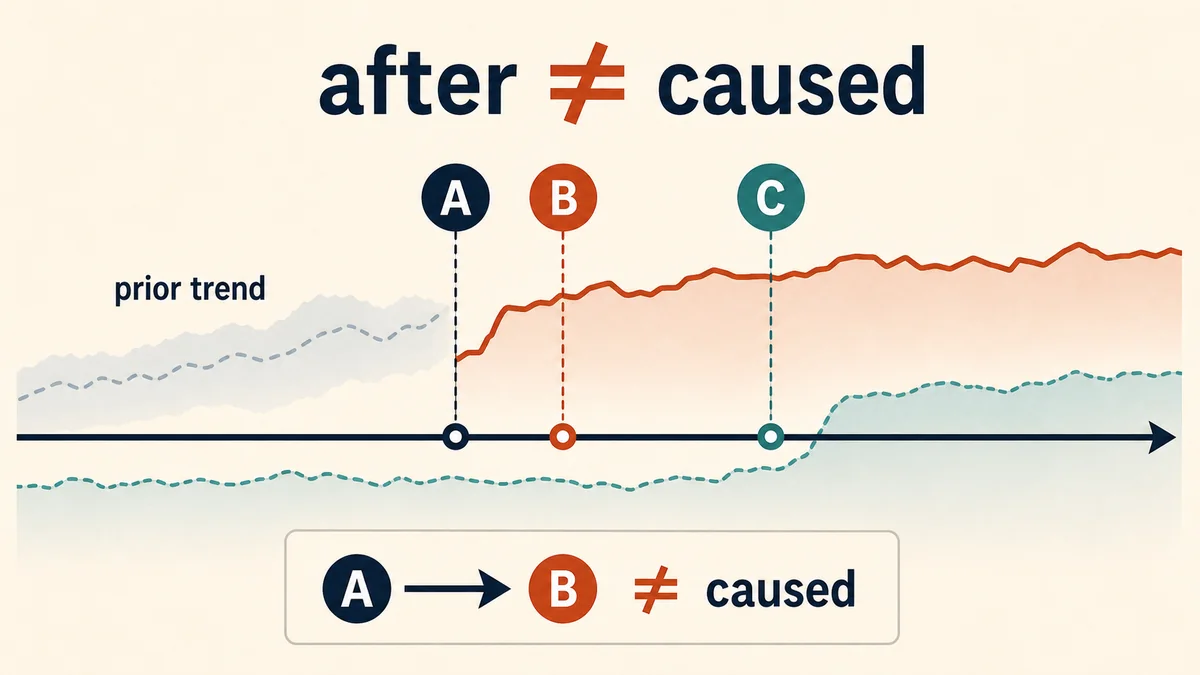
Start with the sequence claim
First write down the exact order the story is asking the reader to accept. Then test whether that order is doing more argumentative work than the source trail supports.
| Framing move | Question to ask | Careful first read |
|---|---|---|
| "After the event..." | Was the later change already underway, seasonal, or expected before the event? | The event came before the change, but the counterfactual is still missing. |
| "Amid the controversy..." | Is the article using proximity in time to imply connection without naming a mechanism? | The events share a window; the relationship still needs evidence. |
| "The decision sparked..." | How many responses are documented, who responded, and were similar responses common before? | The story documents reaction, not necessarily scale or representativeness. |
| "The report prompted action..." | Was the action planned, required, budgeted, or discussed before the report appeared? | The report may be part of the timeline without being the cause. |
| "The campaign lifted outcomes..." | What comparison shows what the outcome would have done without the campaign? | Observed timing is not incremental lift without a comparison rule. |
| "The policy reversed the trend..." | What lag would the policy need, and does the timing match that mechanism? | A plausible mechanism still needs a plausible lag and alternate explanations. |
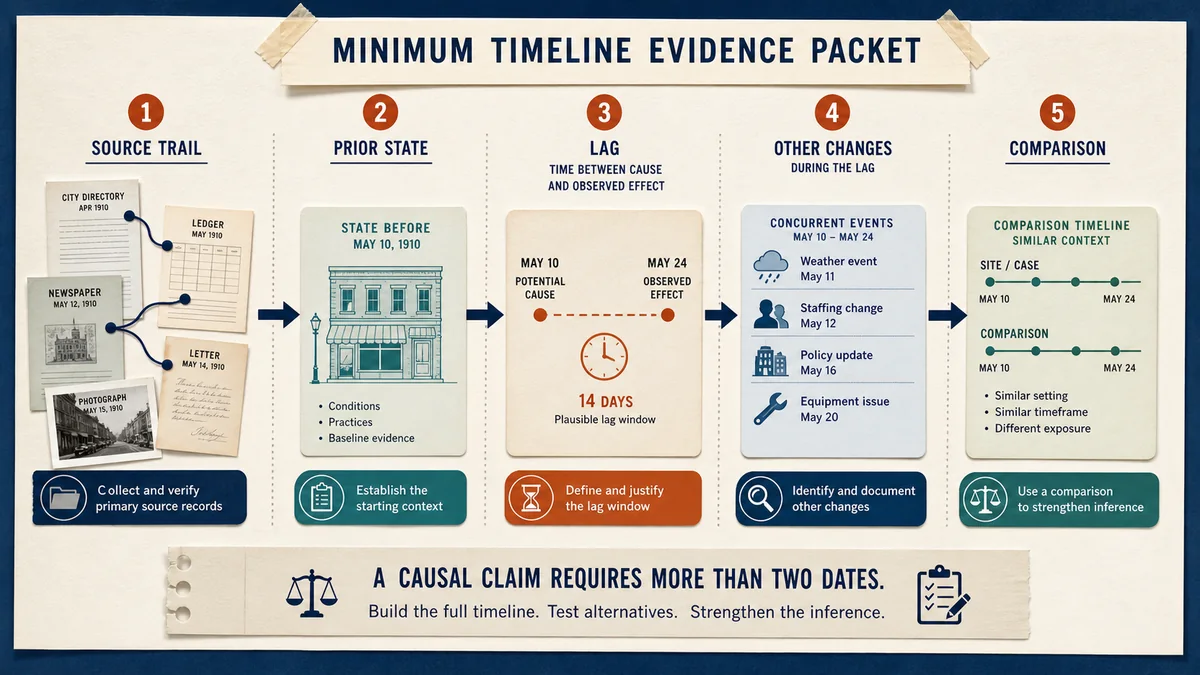
Minimum timeline packet
A useful chronology gives readers enough material to see what happened, when it happened, what was already in motion, and what evidence would weaken the causal story.
Think of the packet as a small audit trail, not a decorative list of dates. Each item should answer a different question: what is directly documented, what was already true, how much lag the mechanism needs, what else moved, and what comparison keeps ordinary movement from looking like an effect.
Timestamped source trailThe article, document, meeting note, data release, statement, filing, dashboard export, or public record closest to each event, with dates and time zones when timing matters.
Claim chronologyThe order in which the article presents events and the order in which the underlying record shows they occurred. These can differ when a story opens with the most vivid event.
Prior stateEvidence of what was already happening before the highlighted event: trend direction, planning records, earlier complaints, prior approvals, forecasted changes, or recurring cycles.
Mechanism and lagThe path by which the first event would affect the second, plus the expected delay. A same-day reaction, a seasonal trend, a budget cycle, and a behavior change do not operate on the same clock.
Concurrent eventsOther changes in the same window: pricing, leadership, demand, enforcement, reporting definitions, weather, outages, competing campaigns, media attention, staffing, or data backfills.
Comparison timelineA peer group, prior period, matched market, holdout, forecast, or documented note that no credible comparison exists. Without this, the sequence can only support bounded language.
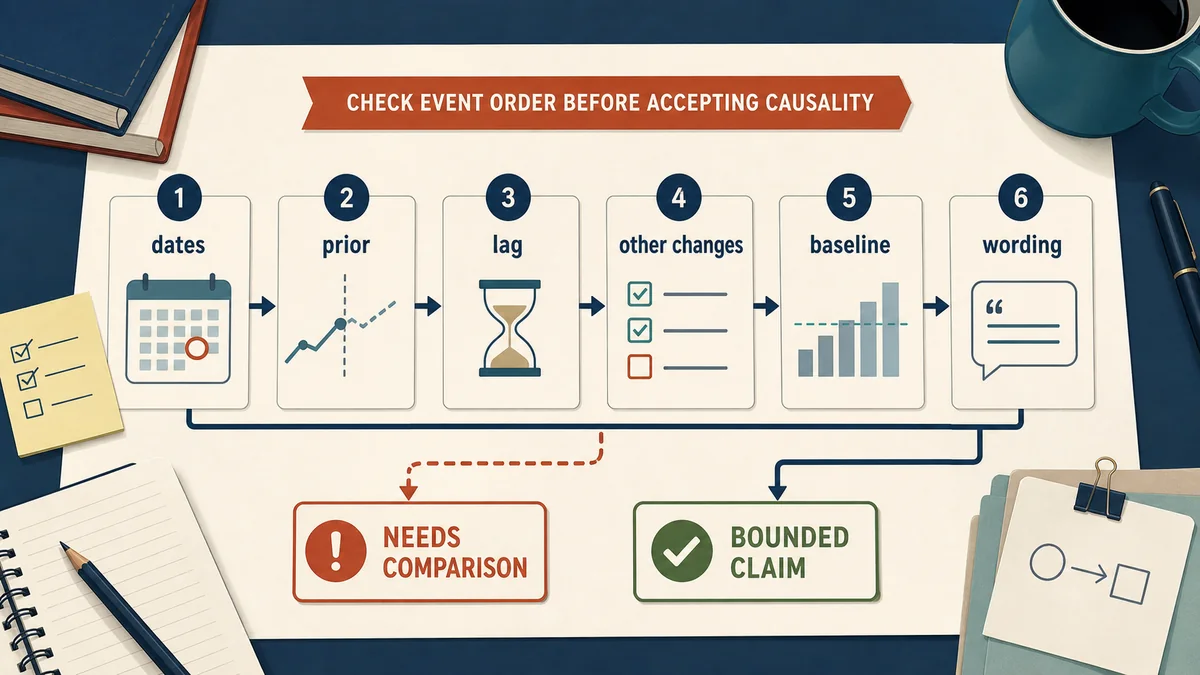
Event-order checks
| Check | Raise confidence when | Lower confidence when |
|---|---|---|
| Order is documented | Dates come from primary records or direct disclosures, and material uncertainty is visible. | The timeline depends on paraphrase, memory, or a secondary summary. |
| Earlier causes are checked | The story shows whether the later action was already planned, budgeted, required, or underway. | The first visible event is treated as the first relevant event. |
| Lag is plausible | The claimed effect has enough time to operate and fits the expected process. | The effect is too immediate, too delayed, or timed better to another event. |
| Concurrent changes are named | Other material events in the window are listed and tested against the same outcome. | The story highlights one convenient trigger and ignores surrounding changes. |
| Scale is measured | Reaction, adoption, decline, or improvement is tied to a denominator, eligible group, or comparison base. | A few examples stand in for the size of the response. |
| Comparison is visible | A peer, prior period, holdout, or forecast helps distinguish ordinary movement from event-driven change. | Before-and-after timing is the only evidence offered. |
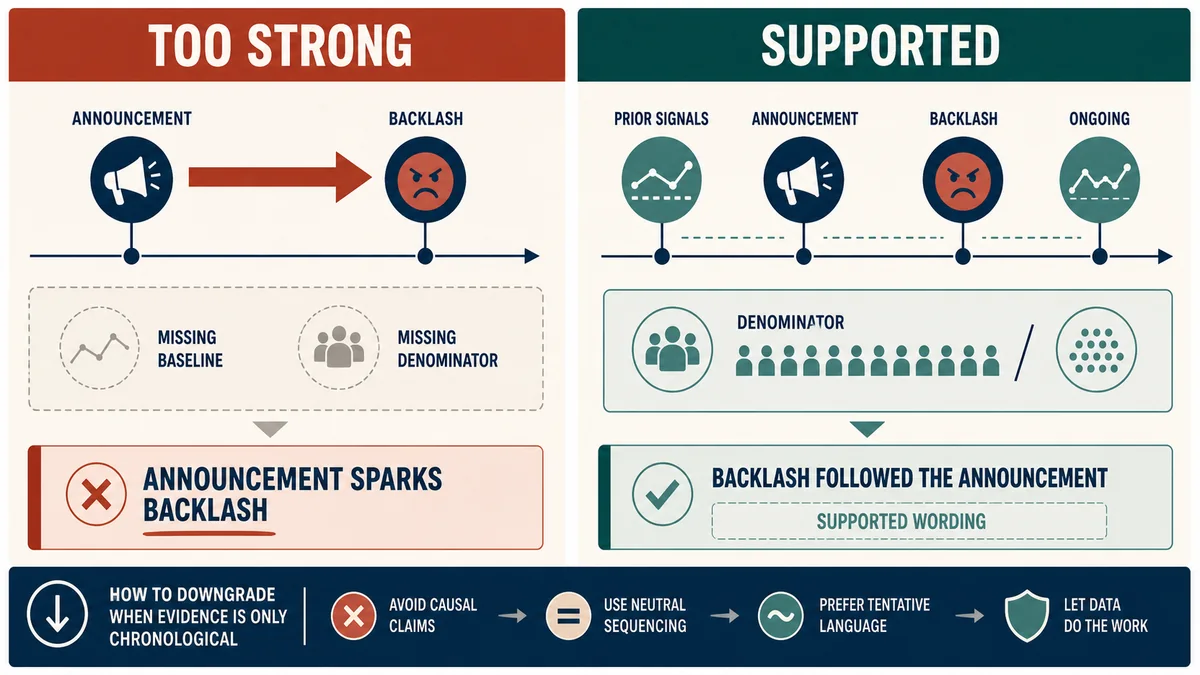
Causal language ladder
Match the verb to the evidence. The safest wording often keeps chronology visible while removing causal certainty the record has not earned.
| Evidence available | Supportable wording | Do not say yet |
|---|---|---|
| Only sequence. | "The change occurred after the event." | "The event caused the change." |
| Sequence plus plausible mechanism. | "The timing is consistent with this explanation, but other causes remain possible." | "The mechanism is proven." |
| Sequence, mechanism, and excluded alternatives. | "The record supports this as a likely contributor under the stated limits." | "This was the only driver." |
| Designed comparison or natural experiment. | "The comparison estimates the event's effect for this population and window." | "The same effect applies broadly." |
| Mixed or fragile timeline evidence. | "The timeline raises a question worth testing." | "The timeline settles the explanation." |
Source boundary and causal ceiling
The standards below shape this checklist but do not turn a chronology into proof. The Society of Professional Journalists Code of Ethics calls for verification, original sources, context, and clear source identification. The CDC Field Epidemiology Manual explains that an observed association can reflect chance, selection bias, information bias, confounding, or investigator error, and that temporal order is only one part of causal reasoning. Its causation guidance likewise treats temporality as one criterion among several and distinguishes association from irrefutable proof.
Use those references to set a claim ceiling: the source trail can support what happened and when; a comparison, mechanism, and checks for competing explanations are needed before choosing a stronger causal verb. These sources are methodological boundaries, not evidence about any particular organization, campaign, or event.
| Source boundary | Apply it here | Reader decision | What it cannot establish |
|---|---|---|---|
| SPJ Code of Ethics | Verify before release, use original sources where possible, preserve context, identify source motives, and provide relevant source material. | Attach the closest record to each event and label the difference between a documented date and an interpretation of that date. | It is an editorial ethics guide, not a causal-design test or proof that a timeline is accurate. |
| CDC Field Epidemiology Manual | Use temporal order as one input among multiple causation criteria, and make missing evidence visible before escalating the claim. | If only order is documented, keep the verb at “followed” or “occurred after” and name the lag, comparison, or competing explanation still needed. | Its public-health framework does not validate a media or campaign claim, and association is not irrefutable proof. |
How to use this boundary: treat it as a claim ceiling, not a pass/fail score. In the simulated example above, the +0.5 percentage-point comparison-adjusted change is reproducible arithmetic; it is not proof that the message caused lift while the overlapping promotion and assignment remain unresolved.
Reader rule: record the exact source, date, and claim each link supports. If the only verified fact is that event B followed event A, keep the wording at that ceiling even when the sequence feels persuasive.
Source-use ruleLink the record closest to each event, preserve the original wording where it matters, and label any interpretation as an interpretation. If the primary record is unavailable, say so instead of treating a secondary retelling as equivalent.
Simulated worked example: audit a timeline claim
This is a fictional example for reproducing the method, not a report of a real campaign. A headline says, “The new checkout message caused conversion lift after launch.” The packet contains 5,000 eligible treatment sessions before launch with 250 conversions, and 5,000 after launch with 300 conversions. A comparable control group has 5,000 sessions and 250 conversions before the same window, then 5,000 sessions and 275 conversions after it.
| Measure | Calculation | Result | What it supports |
|---|---|---|---|
| Treatment pre-period | 250 ÷ 5,000 | 5.0% | Baseline conversion rate for the fictional treatment group. |
| Treatment post-period | 300 ÷ 5,000 | 6.0% | Observed increase of 1.0 percentage point; relative change is 1.0 ÷ 5.0 = 20.0%. |
| Control change | (275 ÷ 5,000) − (250 ÷ 5,000) | +0.5 percentage point | Some movement occurred without the new message. |
| Comparison-adjusted change | +1.0 − +0.5 percentage point | +0.5 percentage point | A directional difference-in-changes estimate, not proof of causation. |
Run six checks before changing the verb: timestamps documented (yes), prior baseline quantified (yes), mechanism and lag plausible (yes), concurrent changes isolated (no—an email promotion overlapped the post-period), comparable control present (yes), and independent corroboration present (no). The packet scores 4/6 = 66.7% and remains on hold for the causal wording because the overlapping promotion is unresolved.
Bounded conclusion“Treatment conversion rose from 5.0% to 6.0% in the simulated window, while control rose from 5.0% to 5.5%; the comparison-adjusted change was +0.5 percentage point.” Do not upgrade that sentence to “the message caused lift” until assignment, contamination, the promotion overlap, seasonality, and uncertainty are checked.
Reproduction: copy the six counts into a worksheet, calculate each rate as conversions ÷ eligible sessions, subtract pre from post within each group, then subtract the control change from the treatment change. The example assumes stable eligibility definitions and no missing conversions; it does not estimate confidence intervals, test random assignment, or establish that the fictional promotion affected both groups equally.
Build the timeline before debating the frame
A short timeline can prevent a meeting, article review, or public-data readout from accepting the first plausible story. Keep it factual and mark gaps explicitly.
| Timeline field | What to record | Why it matters |
|---|---|---|
| Date and time | Exact timestamp, date range, or unknown timing. | Prevents broad sequence language from hiding uncertainty. |
| Event type | Decision, statement, data release, behavior change, operational change, media report, or measured outcome. | Separates actions, claims, and results that should not be treated as the same evidence. |
| Source | Primary record, direct statement, public dataset, dashboard, article, or secondary account. | Shows whether the chronology is built from direct evidence or interpretation. |
| Prior signal | Earlier trend, draft, approval, warning, plan, complaint, budget, forecast, or baseline. | Tests whether the highlighted event was actually the start of the story. |
| Alternate cause | Any other event in the window that could explain the same outcome. | Keeps the strongest competing explanation visible. |
| Confidence note | What the timeline supports, what remains unknown, and what would change the conclusion. | Turns chronology into bounded claim language. |
Common failure modes
First visible event bias
The story begins with the first event readers can easily see, not the earliest event that materially shaped the outcome.
Reverse chronology
The article opens with the outcome, then presents earlier events in an order that makes one explanation feel inevitable.
Lag mismatch
The claimed cause could not reasonably create the observed effect inside the reported window.
Reaction scale drift
A documented response by a few sources becomes a broad public reaction without a denominator.
Data-release confusion
The date a number was published is treated as the date the underlying event happened.
Concurrent-change silence
The story names one event while leaving pricing, staffing, definition changes, seasonality, or other policy moves out of view.
Rewrite the claim
| Weak wording | Cleaner wording | Evidence needed to go stronger |
|---|---|---|
| "The announcement triggered the backlash." | "The article documents responses after the announcement; the scale and earlier signals need checking." | Response denominator, prior reaction baseline, and comparable events. |
| "The report forced the organization to act." | "The action followed the report; planning records would show whether it was already underway." | Internal timeline, prior approvals, or statements connecting the report to the action. |
| "The campaign caused sales to rise." | "Sales rose during the campaign period under this reporting window." | Holdout, matched market, randomized test, or calibrated model with sensitivity checks. |
| "The policy immediately reversed the trend." | "The trend changed after the policy date; lag, seasonality, and concurrent changes should be tested." | Longer pre-period, peer comparison, and mechanism-consistent lag evidence. |
| "The controversy led to departures." | "Departures occurred after the controversy; the record should show prior plans, normal turnover, and stated reasons." | Baseline turnover, direct statements, prior notices, or comparable periods. |
Meeting questions
- What exact sequence is the story asking us to accept?
- Which event is first in the article, and which event is first in the record?
- What was already happening before the highlighted event?
- What mechanism would connect the events, and what lag would that mechanism require?
- What else changed during the same window?
- What comparison would show whether the later change was unusual?
- What wording would remain true if the causal explanation were removed?
Pair with
Use this checklist with the headline and source-mix framing checklist when the first frame depends on sequence, the before-and-after trend checklist when a chart implies cause from timing, the disconfirming evidence checklist when a missing fact would weaken the frame, and the evidence-to-claim language matrix when the final wording needs to match the evidence.
For measurement claims, pair it with the campaign readout QA checklist, attribution window and conversion lag checklist, and incrementality test plan template before treating timing as lift.