Buyer readiness
Ad yield and deal-readiness checklist
Organization byline: Measurement Press editorial desk. This page does not list an individual author or reviewer. Read the editorial method and corrections policy.
About 13 min read
A contextual package is not deal-ready just because it has a name, a placement list, and a buyer category. It also needs enough supply evidence, floor-price logic, refresh boundaries, sell-through fields, and renewal signals to keep pricing, trafficking, and reporting from drifting apart.
Use this checklist before setting a private marketplace floor, quoting a direct sponsorship package, or renewing a contextual buy. It is written for publishers, buyers, and ad operations teams that need credible yield decisions without promising performance the inventory cannot prove.
Picture a seller preparing a package for a mid-quarter advertiser brief. The package has strong editorial context, but the team still needs to know whether the forecasted impressions, accepted creative sizes, refresh rule, report fields, and renewal evidence all point to the same offer. If one of those pieces is missing, the floor price becomes a guess instead of a defendable decision.

Deal-readiness routes
Choose the weak deal field before setting the floor.
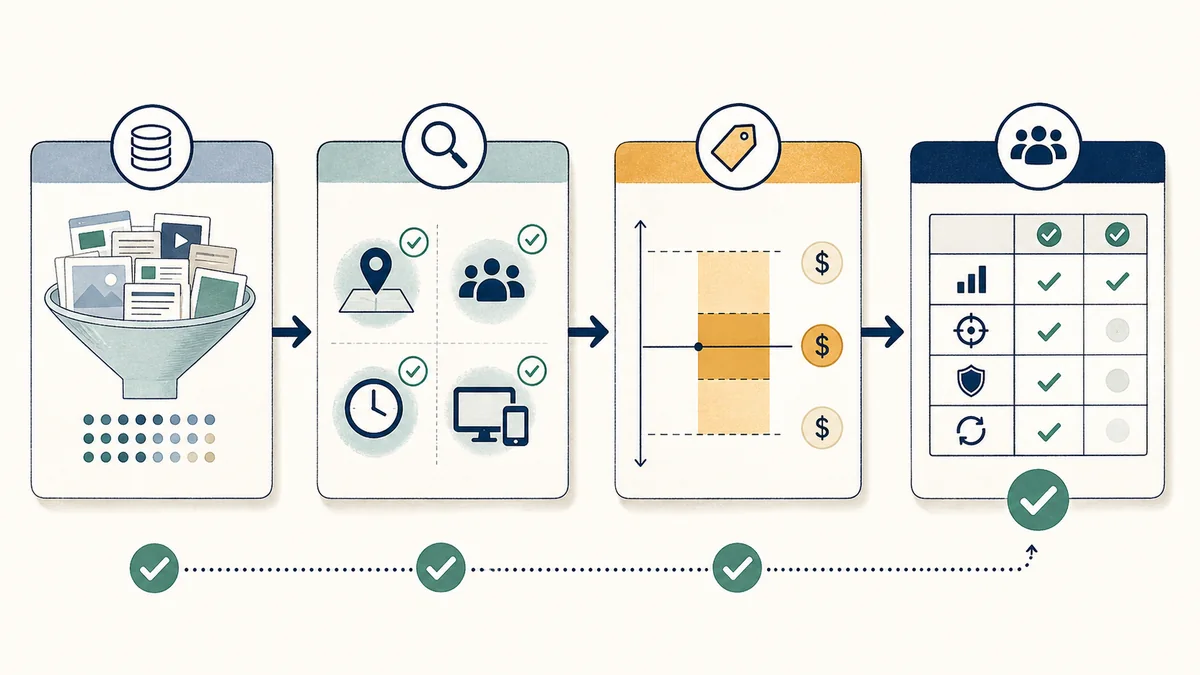
Use the route that matches the missing proof: package context, placement contract, page-speed budget, seller path, reporting fields, or renewal language.
Context proofShow why this package fitsUse when reader job, included pages, exclusions, and package thesis need one buyer-facing record.
Placement contractConfirm trafficable inventoryUse when package IDs, deal keys, placement IDs, sizes, and reporting keys need a shared source.
Experience budgetProtect load and stabilityUse when ad load, lazy loading, refresh rules, script weight, or layout shift need limits.
Seller pathMake supply evidence inspectableUse when authorized-seller rows, seller records, SupplyChain paths, and exceptions need review.
Report fieldsPreserve what actually ranUse when package, placement, creative, device, refresh, outcome, and conclusion fields must survive readout.
RenewalScore the next package callUse when delivery quality, context fit, outcome maturity, and comparison strength need one decision.
Deal-readiness questions
Start by deciding whether the package is ready to sell, ready after revision, or not yet priced. The answer should come from the package evidence, not from a desired rate.
| Question | Ready evidence | Hold or revise when |
|---|---|---|
| What reader job anchors the package? | The package names the desk, guide set, case-study group, or buyer-reference context that explains why the reader is there. | The package depends on broad audience language without included URLs or reader tasks. |
| How much eligible supply exists? | Forecastable impressions are separated by placement ID, device class, page type, and expected seasonality. | Supply is pooled across unlike contexts or counted without device and placement boundaries. |
| Which placements are sellable together? | Eligible units share a clear reader context, accepted sizes, refresh rule, and reporting key. | A package mixes rail, inline, native, and post-content units without explaining how they will be reported. |
| What sets the floor? | The floor logic uses context fit, scarcity, viewability, demand history, direct opportunity cost, and renewal evidence. | The floor is copied from another package or chosen before supply and response fields are visible. |
| What will prove renewal value? | The brief names the renewal decision, primary signal, comparison rule, and fields needed after the flight. | The campaign can only report served impressions, clicks, or raw leads with no context or quality fields. |
Yield input fields
These fields should be available before a package gets a floor or a proposal commitment. They are planning inputs, not public promises.
| Input | What to preserve | Why it changes the deal |
|---|---|---|
| Eligible impressions | Forecasted impressions that match the package, placement, device, geography, and page-type rules. | Separates actual package supply from run-of-publication volume. |
| Sell-through state | Reserved, forecasted, sold, unsold, makegood, house, and remnant states by placement and week. | Shows whether a package can absorb demand without crowding existing commitments. |
| Viewability expectation | Recent measured viewability or the reason a placement lacks enough viewability history. | Helps distinguish scarce high-quality inventory from merely available inventory. |
| Refresh boundary | Pageview-only, viewability-qualified optional, or no-refresh status by unit. | Prevents yield from being inflated by impressions that weaken reader experience or report quality. |
| Creative eligibility | Accepted sizes, native fields, backup mobile assets, destination type, and approval status. | Stops a package from being priced before the buyer can actually traffic into it. |
| Outcome handoff | Qualified visit rule, lead status, survey signal, matchback option, or no buyer-side outcome available. | Defines whether renewal will be judged by delivery, response, leads, or designed lift. |
| Change log | Page edits, placement moves, creative swaps, pacing changes, pauses, or reporting corrections. | Explains discontinuities before sell-through or response trends become a story. |
A simple rule helps keep this practical: do not raise the floor because one field looks strong if another field makes the package hard to traffic or hard to explain later. Strong reader context cannot rescue missing placement IDs, and high sell-through cannot rescue a report that hides refreshed impressions or weak creative fit.
Floor-price logic
A floor should protect scarce context and clean operations. It should not imply that the package guarantees business outcomes. Google Ad Manager describes pricing rules as thresholds that can filter eligible auction demand, and its current guidance says overlapping rules and demand type affect how a floor behaves; use a directional floor band internally, then make the proposal language about the package scope and reporting lane. See the Google Ad Manager pricing-rules guidance.
| Floor input | Raises confidence when | Lowers confidence when |
|---|---|---|
| Context scarcity | The package includes a small, coherent set of high-intent pages that buyers cannot easily buy elsewhere. | The package relies on broad inventory with weak reader-task proof. |
| Supply reliability | Forecasted supply has enough delivery history by device and placement to support the flight. | Inventory is new, volatile, or concentrated in one placement with uncertain delivery. |
| Exposure quality | Measurability, viewability, invalid-traffic review, and device mix are visible before pricing. | Quality fields are missing, pooled, or only available after the campaign ends. |
| Buyer fit | The offer helps the reader complete the same job that brought them to the context. | The destination or claim is adjacent to the category but weakly connected to the page task. |
| Renewal path | The buyer and publisher agree which evidence will support renewal, revision, or a stronger test. | Renewal will be judged by whichever metric looks best after launch. |
Refresh boundaries
Refresh can change yield math and measurement interpretation at the same time. The package should state refresh eligibility before launch, then keep refreshed impressions visible in the readout if they exist. Google requires publisher declarations to match the actual trigger and minimum interval, and the declaration itself does not implement the page behavior; see Declare inventory that refreshes.
Pageview-only by default
Article inline, archive leaderboard, post-content, native, and case-study inline units should be planned as pageview-only unless a separate reader-experience review supports another rule.
Rails need extra context
Right-rail refresh should be considered only when the unit has enough viewable time, clean device separation, and reporting that can distinguish refreshed impressions from initial impressions.
Do not hide the denominator
If refresh is used, reports should separate initial impressions, refreshed impressions, viewable refreshed impressions, clicks, and qualified visits.
Sell-through readout
Sell-through is useful when it shows whether the package is underpriced, oversold, underpromoted, or too narrow. It is weak when it is treated as a single utilization percentage without context. For Private Auctions, Google exposes impressions, ad requests, match rate, and modeled revenue lift; those metrics are useful diagnostic inputs, not proof of incremental advertiser outcomes. See Measure and troubleshoot Private Auctions.

| Field | Good readout use | Decision it can support |
|---|---|---|
| Forecasted eligible impressions | Compare sold demand with the package supply that was actually eligible. | Expand, narrow, or re-time the package. |
| Reserved impressions | Show which supply was already committed before a new buyer entered. | Protect direct commitments and avoid overbooking. |
| Delivered impressions | Compare delivery with forecast by week, placement, and device. | Adjust pacing, availability, or makegood expectations. |
| Unsold eligible impressions | Find high-fit inventory that did not clear at the current floor or sales motion. | Test floor, packaging, or buyer category changes. |
| Blocked or ineligible impressions | Show supply that could not serve because of creative, device, category, or package constraints. | Fix creative specs, size mapping, or package rules. |
| Renewal-quality impressions | Separate delivery that met viewability, traffic-quality, and context rules from raw served volume. | Renew, revise, or add a designed lift test. |
Deal-readiness scorecard
Score each area from 0 to 2 before a package is priced or renewed. A low score in operations can make even a strong audience-context package difficult to sell cleanly.
| Area | 0 points | 1 point | 2 points |
|---|---|---|---|
| Context proof | No clear reader job or included URL set. | Reader job is clear, but inclusions or exclusions need work. | Reader job, desk, page set, exclusions, and package thesis are clear. |
| Supply forecast | No placement, device, or week-level forecast. | Partial forecast with some pooling or unknown seasonality. | Forecast is separated by placement, device, week, and package rules. |
| Floor rationale | Floor is chosen without context or quality evidence. | Floor uses some scarcity or quality evidence but weak renewal logic. | Floor reflects scarcity, quality, buyer fit, opportunity cost, and renewal signal. |
| Creative readiness | Accepted sizes, native fields, or destination fit are unknown. | Creative can run after revisions. | Creative, destination, tracking, and backup assets are ready. |
| Reporting readiness | Only delivery totals are expected. | Delivery and traffic fields are available, but outcome or comparison fields are thin. | Package, placement, device, creative, traffic, outcome, and comparison fields are defined. |
| Reader experience | Placement or refresh choices may weaken readability. | Reader experience is acceptable with limits. | Ad load, placement, refresh, and disclosure support the page's reference value. |
Decision bands

| Total score | Deal state | Next action | Proposal language |
|---|---|---|---|
| 10-12 | Ready to price | Quote the package, preserve fields, and set the renewal readout before launch. | Contextual package with defined supply, placements, creative requirements, and readout fields. |
| 7-9 | Ready after revision | Fix the weak field before quoting a firm package or renewal recommendation. | Package under review with named supply, creative, or reporting condition. |
| 4-6 | Hold for proof | Run a smaller proof flight, improve supply history, or narrow the eligible context. | Exploratory package, not yet a stable private marketplace lane. |
| 0-3 | Do not sell as packaged | Rebuild the package around a clearer reader job, placement set, and reporting lane. | Not ready for buyer-facing pricing or renewal language. |
Simulated worked example: strong context, weak report
This fictional scenario shows how to turn the scorecard into a bounded package decision. It is not Measurement Press delivery data, a buyer result, or a forecast. Replace every illustrative value with a versioned export before pricing or renewal.
| Review area | Observed evidence | Score | Action before quote |
|---|---|---|---|
| Context proof | Included URLs match a specific reader job and exclusions are documented. | 2 | Keep package scope as written. |
| Supply forecast | Forecast is available by placement and device, but weekly seasonality is thin. | 1 | Quote with a conservative delivery band. |
| Floor rationale | Scarcity and buyer fit support a premium, but renewal evidence is not complete. | 1 | Use a test floor rather than a full renewal floor. |
| Creative readiness | Primary sizes and destination fit are ready. | 2 | Confirm backup mobile assets before trafficking. |
| Reporting readiness | Delivery fields exist, but response quality and refresh separation are missing. | 1 | Add the missing fields or call the flight exploratory. |
| Reader experience | Ad load is acceptable with pageview-only inline units. | 2 | Do not add refresh to force more volume. |
| Total | Ready after revision | 9 | Fix reporting language before presenting a firm renewal claim. |
The buyer-facing version should be plain: this is a contextual test package with defined supply and a conservative floor, not proof that the package will cause a business outcome. The renewal meeting can still be productive if the team agrees in advance which missing fields must be fixed before the second flight.
| Illustrative field | Fictional value | Reproducible calculation |
|---|---|---|
| Forecasted eligible impressions | 84,000 | Scenario denominator for the package; no real traffic is claimed. |
| Reserved impressions | 60,000 | 60,000 / 84,000 = 71.43% reserved coverage. |
| Delivered impressions | 54,000 | 54,000 / 60,000 = 90.00% delivery against reserved supply. |
| Unreserved eligible impressions | 24,000 | 84,000 - 60,000 = 24,000 still eligible but not reserved. |
| Renewal-quality delivered impressions | 43,200 | 43,200 / 54,000 = 80.00% met the fictional quality screen. |
Bounded decision: treat this as a 9-point package that is ready after revision: keep the coherent context and conservative delivery band, but hold firm renewal language until the export separates refreshed impressions, quality-screen rules, and the buyer outcome or comparison rule. The arithmetic is descriptive only; it cannot establish revenue lift, causality, or a safe production floor.
Activation gate: prove the deal can be explained
The scorecard is useful only when the underlying handoff is inspectable. Before a buyer-facing package is activated, record one artifact for each gate below and mark the gate pass or hold. This is a pre-flight decision, not a performance claim: a package can have strong context and still fail because its floor, creative, targeting, or comparison lane cannot be reconstructed.
| Gate | Pass evidence | Simulated readout | Decision if missing |
|---|---|---|---|
| 1. Deal identity | Deal ID, buyer, seller contact, included inventory, start/end window, and targeting export agree. | Deal ID and buyer are named; targeting export is dated. | Hold: do not price a package whose scope cannot be reproduced. |
| 2. Floor basis | Floor currency basis, revenue-share treatment, overlap review, and floor-change log are recorded. | CPM basis is recorded, but overlapping-rule review is absent. | Hold firm floor language; inspect overlapping pricing rules first. |
| 3. Creative contract | Expected sizes, creative types, destination, backup assets, and approval state match the targeted inventory. | Desktop sizes pass; mobile backup is not approved. | Revise before activation; a bid filtered for an ineligible size is not a demand result. |
| 4. Refresh declaration | Each refreshing unit has a page trigger, UI declaration, minimum interval, and separate report field. | Units are pageview-only in the scenario; no refresh field is required. | Hold any refresh claim until behavior and declaration match. |
| 5. Seven-day readout | Impressions, ad requests, match rate, and revenue-lift context are captured for the same dated window. | 54,000 delivered / 60,000 reserved = 90%; no revenue-lift readout exists. | Call delivery descriptive only; do not claim yield improvement. |
| 6. Failure path | Missing bids, below-floor bids, competing sources, and creative/targeting filters have an owner and next check. | Below-floor and competing-source checks are unassigned. | Hold renewal language until troubleshooting can separate setup failure from buyer demand. |
| Gate result | All six pass, or the package is explicitly conditional. | 3/6 pass; 2 are partial and 1 is missing. | Simulated result: revise before activation; no production conclusion. |
How to reproduce it: export the deal settings and targeting, compare every expected creative with the inventory contract, record the refresh rule beside the ad-unit behavior, then join the same seven-day deal report to the troubleshooting view. Count a gate as pass only when the artifact is dated, attributable to the package, and sufficient for another operator to reach the same decision. This scenario result is fictional; it does not represent Measurement Press inventory or buyer activity.
Primary source notes
These first-party references support the operational boundaries above. They do not supply Measurement Press performance data, establish buyer demand, or validate the simulated values, which remain fictional.
- Google Ad Manager pricing rules — explains floors, overlapping rules, and reporting on pricing-rule activity.
- Private Auctions overview — defines minimum CPM floors, expected creatives, targeting, and competition settings.
- Declare inventory that refreshes — documents refresh triggers, intervals, and the requirement that declarations match behavior.
- Measure and troubleshoot Private Auctions — describes impressions, requests, match rate, modeled revenue lift, and troubleshooting limits.
- About ads.txt/app-ads.txt — explains how authorized-seller declarations improve supply-path transparency.
- Understand Private Auction troubleshooting - separates competing sources and setup or technical issues that can explain underdelivery.
Pair with
Use this checklist with the media kit for placement specs, the ad inventory readiness matrix for package and placement contracts, the audience intent map for reader-job proof, the contextual package proof checklist and contextual package proof sheet before pricing, the creative asset acceptance checklist before trafficking, the private marketplace reporting field dictionary for field names, the private marketplace readout export sample for row-level delivery checks, and the private marketplace renewal scorecard before renewing or expanding a package.