Evidence standard
Case study generalizability checklist
Organization byline: Measurement Press editorial desk. This page does not list an individual author or reviewer. Read the editorial method and corrections policy.
About 10 min read
A case study can make a measurement problem concrete. It can also make one clean-looking result feel more repeatable than the evidence deserves.
Use this checklist when a story, vendor deck, campaign recap, renewal memo, or public example asks readers to carry a lesson from one setting into a broader decision. The question is not whether the case is useful. The question is what part of the case can travel: the mechanism, the warning sign, the observed result, the measurement design, or the causal estimate.
Generalization ladder

Start by naming the strongest claim the case can support. A detailed example is not automatically a representative pattern, and a measured result in one setting is not automatically a forecast for the next one.
| Evidence level | What it can support | What it cannot support alone | Upgrade needed |
|---|---|---|---|
| Illustrative example | What a problem, decision, or measurement failure can look like. | How common, costly, typical, or causal the pattern is. | Denominator, record universe, comparable cases, or sample disclosure. |
| Documented case | That the described events, fields, or results occurred under the stated source trail. | That similar results should be expected elsewhere. | Case selection note, baseline, and counterexamples. |
| Comparable case set | A recurring pattern across similar conditions. | A precise effect size or universal rule. | Inclusion criteria, excluded cases, common denominator, and variation range. |
| Designed measurement case | An estimate for one audience, window, outcome, and comparison design. | Future lift in different audiences, prices, channels, creative, or timing. | Replication, sensitivity, uncertainty, and transfer limits. |
| Repeatable decision pattern | A practical rule for when a team should ask for a stronger comparison. | Guaranteed performance or a settled causal mechanism in every setting. | Multiple settings, stable mechanism, and clear failure conditions. |
The transfer test

Before using one case to shape another decision, check which conditions are actually shared. The more the new setting differs from the case, the narrower the lesson should become.
| Transfer condition | Ask first | Downgrade the claim when |
|---|---|---|
| Audience intent | Were people already searching, comparing, buying, returning, or reachable before the campaign? | The next audience has different pre-existing intent or eligibility. |
| Channel and package | Is the inventory, placement context, frequency, format, and buying path comparable? | The original result came from a different channel, package, or delivery constraint. |
| Creative and destination | Did message, offer, page friction, form quality, or follow-up coverage shape the result? | The new creative, landing page, or routing path changes the response opportunity. |
| Timing and market context | Were seasonality, promotions, pricing, news cycle, or category demand stable? | The case window had unusual timing that could explain the movement. |
| Outcome definition | Was the outcome a qualified visit, lead, sale, survey response, matched conversion, or modeled contribution? | The new decision cares about a different outcome or a later status window. |
| Comparison design | Was the baseline, holdout, matched market, or model chosen before results were visible? | The case used a weaker comparison than the new claim requires. |
| Uncertainty and variation | How wide was the range, how noisy were slices, and what changed under sensitivity checks? | The case is reported as a point estimate with no decision threshold or range. |
Minimum case packet
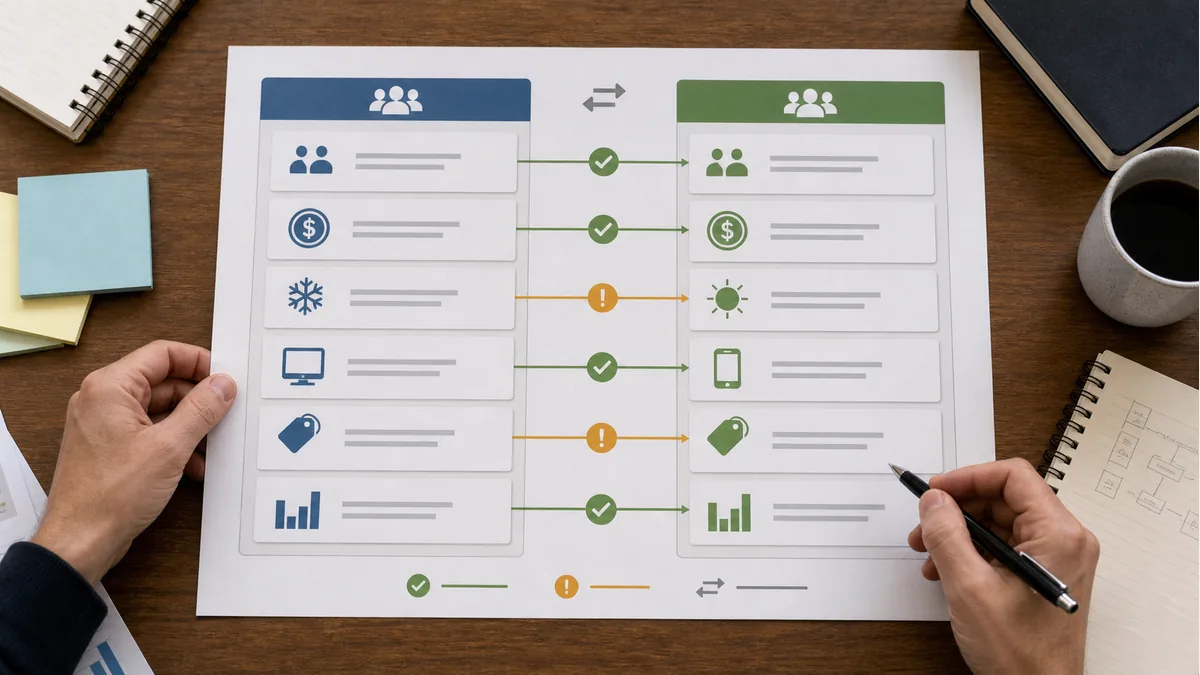
A case study is easier to judge when the source trail and boundaries are visible. Ask for this packet before letting one example become a rule.
Case selection noteState why this case was chosen, what universe it came from, what similar cases were excluded, and whether it is typical, extreme, recent, convenient, or methodologically clean.
Decision and claimWrite the exact decision the case is meant to inform and the exact sentence the evidence is supposed to support. Separate a teaching example from a forecast, recommendation, or causal claim.
Eligible universeName the population, audience, market, placement set, page set, lead universe, or respondent group that could have entered the result.
Baseline and counterfactualShow the prior period, matched context, holdout, model baseline, or explicit statement that no counterfactual was measured.
Outcome qualityDefine the counted outcome, denominator, quality filter, duplicate rule, conversion window, lead status, sales follow-up status, survey field dates, or matchback rule.
Transfer boundaryList the conditions that must remain similar before the case can inform another decision: audience, channel, price, creative, destination, timing, tracking, and comparison design.
Common overreads
Success story as proof
A useful result is written as if it proves repeatable lift, even though the comparison and transfer conditions are narrow.
Extreme cell as lesson
The strongest placement, market, creative, or audience slice becomes the headline without showing denominator, noise, or minimum cell size.
Mechanism drift
A case that demonstrates one failure mode is reused to explain different outcomes in settings where the mechanism may not apply.
Platform halo
A result from one channel, package, or measurement environment is treated as proof for broader media value.
Outcome substitution
Observed visits, leads, brand recall, or matched conversions are described as business impact without the needed outcome-quality checks.
Missing ordinary case
The case shows the memorable result but not the routine cases that would reveal whether it is typical or exceptional.
Rewrite the claim

| Overbroad wording | Cleaner wording | Evidence needed to go stronger |
|---|---|---|
| "This case proves the strategy works." | "This case documents a successful result under these conditions." | Preselected comparison, outcome quality, uncertainty, and repeated cases. |
| "The campaign drove demand." | "The campaign produced observed response; lift depends on the comparison design." | Holdout, matched baseline, or calibrated model evidence. |
| "This is a typical buyer journey." | "This journey illustrates one path; typicality depends on the broader eligible universe." | Journey distribution, denominator, and source-path disclosure. |
| "The winning slice should get more budget." | "The slice outperformed in this readout; action depends on minimum size, mix, and uncertainty." | Stable cell size, repeated performance, and comparable delivery conditions. |
| "The same result should happen again." | "The case can inform the next test if audience, timing, creative, destination, and measurement conditions are similar." | Replication plan, transfer checklist, and decision threshold. |
Meeting questions
- What broader claim is this case being asked to support?
- Was the case selected because it is typical, vivid, recent, successful, extreme, or easy to measure?
- What denominator would tell us whether this case is common or rare?
- What comparison would show whether the result was caused by the campaign, setting, timing, or audience?
- Which conditions must remain similar before the lesson can travel?
- What wording remains true if the case does not repeat?
Primary source trail and a simulated transfer check
The transfer test follows a simple evidence rule: define the case population, selection path, measurement process, and target conditions before treating a result as portable. AAPOR's Transparency Initiative asks researchers to disclose the population under study, recruitment or sampling method, dates, sample sizes, processing, and limitations. Census quality standards identify coverage, nonresponse, measurement, and processing errors as separate threats to interpretation; its coverage guidance explains why a result can misrepresent a population when eligible units are missing or duplicated. External-validity research likewise treats generalization as a comparison between the study population and a specified target population, not a property of a result in the abstract.
- AAPOR Transparency Initiative - specifies public disclosure of the population, selection or recruitment method, dates, sample size, processing, and design limitations.
- U.S. Census Bureau: Statistical Quality Standard D3 - identifies coverage, nonresponse, measurement, and processing error and calls for documented quality indicators.
- U.S. Census Bureau: Coverage Rates Definitions - explains under-coverage, over-coverage, and why missing or duplicated population units can bias interpretation.
- How to assess the external validity of therapeutic trials - frames external validity around the study population, the specified target population, and differences that could change outcomes.
What the sources support—and what they do not
| Evidence boundary | Supports in this checklist | Still requires case-specific evidence |
|---|---|---|
| AAPOR transparency | Request the population, selection or recruitment path, dates, sample size, processing, limitations, and any AI-use disclosure before treating a public result as inspectable. | That a particular case disclosed those items accurately, that its sample is representative, or that the method is rigorous. |
| Census quality standards | Check coverage, nonresponse, measurement, processing, duplicates, missing units, and record-linkage loss as separate ways a result can mislead. | The actual error rates, coverage ratio, record universe, or quality indicators for the case under review. |
| External-validity review | Compare the study population with the specified target population and inspect geographic, temporal, eligibility, and outcome differences before carrying a result forward. | That a result will generalize; replication in the target population or a defensible transfer analysis is still needed. |
| Measurement Press simulation | The 48/800 rate, 720/1,500 condition match, 16.7% gate result, and transfer questions are reproducible teaching calculations. | Any real campaign result, forecast, causal effect, typicality claim, or decision recommendation. |
Simulated worked example - not a real campaign, case study, or forecast: suppose a local pilot reports 48 qualified conversions from 800 eligible households under a defined audience, offer, channel, and 30-day outcome window. A proposed rollout has 1,500 eligible households, but only 720 share the pilot's key audience and timing conditions.
| Calculation | Result | What it supports |
|---|---|---|
| Pilot observed rate | 48 / 800 = 6.0% | The reported rate inside the simulated pilot definition. |
| Target-condition match | 720 / 1,500 = 48.0% | How much of the proposed target shares the stated pilot conditions. |
| Matched-condition planning count | 720 x 6.0% = 43.2 | An illustrative planning quantity for the matched subset, not a promised result. |
| Naive whole-target extrapolation | 1,500 x 6.0% = 90.0 | What a broad extrapolation would imply before checking transfer conditions. |
| Extrapolation gap | 90.0 - 43.2 = 46.8 | The difference created by applying a pilot rate to unmatched target conditions. |
The narrow conclusion is that a case rate cannot become a target forecast until the target population, outcome definition, selection path, and relevant conditions are shown to match. The arithmetic does not estimate a real rollout, establish causation, or correct for unmeasured differences. The conclusion changes if the pilot denominator excludes eligible households, the 720 matched units are not identified before results, the conversion window differs, or the pilot rate is unstable. A real transfer memo should publish the inclusion rules, condition-match method, outcome-quality checks, and a replication or holdout plan.
Simulated transfer decision gate
Use the same packet to decide how far the simulated pilot may travel. This is a reader-facing acceptance test, not a score for a real case. A single hold keeps the result from becoming a forecast.
| Gate | Simulated readout | Decision |
|---|---|---|
| Case population and outcome window named | 800 eligible households; qualified conversions; 30 days | Pass |
| Selection or exposure path documented | No recruitment, eligibility-screen, or exposure rule is supplied | Hold |
| Target-condition match measured | 720 / 1,500 = 48.0% share the stated conditions | Hold |
| Outcome quality and duplicate rules disclosed | Qualified conversion is named, but validation and duplicate handling are not | Hold |
| Counterfactual or comparable baseline shown | No holdout, matched baseline, or predeclared comparison is supplied | Hold |
| Replication, uncertainty, or failure conditions shown | No repeat case, interval, sensitivity range, or failure threshold is supplied | Hold |
Gate result: 1/6 = 16.7%. The only supported use is an illustrative teaching example and a request for a stronger transfer packet. Do not use the simulated 6.0% pilot rate to forecast the full target, rank channels, or claim causal lift. To move beyond illustration, add the selection path, outcome-quality rules, a predeclared comparison, and a replication or uncertainty plan; document what changed if those checks fail.
Use with
Pair this checklist with the anecdote and exemplar checklist when one vivid example may be doing too much evidence work, the campaign baseline comparison checklist when observed response is being promoted into lift, the campaign readout QA checklist when a finished report needs evidence-level language, the outcome quality scorecard before outcome volume becomes value, the evidence-to-claim language matrix when a summary sentence needs narrower wording, and the case-study library when a reader wants worked examples of tempting but weak comparisons.
Takeaway
A credible case study makes the useful lesson easier to inspect and the transfer limit harder to miss. Let cases teach mechanisms, questions, and warning signs. Save broad performance claims for evidence that shows the pattern can travel.