Buyer readiness
Sponsor fit and ad adjacency review checklist
Organization byline: Measurement Press editorial desk. This page does not list an individual author or reviewer. Read the editorial method and corrections policy.
About 11 min read
Contextual advertising works best when the sponsor helps the reader keep doing the job that brought them to the page. A campaign can be technically traffickable and still be weak if the creative, destination, or nearby context asks the reader to trust a claim the page itself would challenge.
Use this checklist before a private marketplace, direct sponsorship, or clearly labeled native placement launches. The review keeps editorial context, sponsor promise, destination quality, page exclusions, and report language in the same handoff without turning the page into a sales script.
Picture a team reviewing a sponsor package for a serious measurement guide. The seller sees a clear buyer category, the ad operations lead sees a trafficable unit, and the editor sees a page that warns readers against overclaiming evidence. The campaign should launch only when those three views can agree on the same fit thesis and the same limits.
Start with fit evidence
Fit is not a vague preference. It should be visible in the reader task, the page context, the creative claim, the landing-page usefulness, and the strongest report language the campaign can support.

| Review area | Ready evidence | Revise or hold when |
|---|---|---|
| Reader task | The campaign helps a reader evaluate evidence, choose a method, plan a report, compare tools, or learn a measurement failure mode. | The offer depends on broad curiosity, impulse response, or a promise unrelated to the page's professional job. |
| Page context | The package names eligible desks, article groups, case-study groups, and any pages excluded from the flight. | The package is sold as contextual but trafficked across unrelated inventory with no context log. |
| Creative claim | The headline and body copy make a bounded, supportable promise that fits a careful evidence environment. | The creative uses sweeping performance language, unclear proof, or urgency that conflicts with the reader's need for careful judgment. |
| Destination | The landing page gives the reader a useful report, explainer, demo, template, event, or service page tied to the same job. | The destination is thin, mismatched, slow, confusing, or optimized only for lead capture without enough context. |
| Native label | Sponsored or native modules are plainly labeled and visually separate from editorial judgment. | A reader could reasonably mistake the paid module for Measurement Press's editorial conclusion. |
| Readout boundary | The brief states whether the report can support delivery quality, qualified traffic, lead quality, directional comparison, or designed lift. | The readout is expected to claim business impact from clicks, visits, or matched leads alone. |
Fit-to-action handoff
Use this handoff when a sponsor looks broadly relevant but the launch team still needs a concrete decision. Each row names what the evidence permits before any campaign outcome is visible.
| Fit signal | What a strong record shows | Decision it supports | Decision it does not support |
|---|---|---|---|
| Reader task match | The offer helps the reader do the job named by the page or desk. | Include the page group in the package. | Assume every page in the category is safe. |
| Claim alignment | The creative promise uses the same evidence discipline the article asks of readers. | Approve the copy or request a narrow edit. | Let paid language contradict the editorial standard. |
| Destination depth | The landing page gives useful context before asking for a form, demo, or meeting. | Send qualified traffic to the destination. | Blame the page context for weak lead quality. |
| Exclusion clarity | Weak-fit pages and sensitive case groups are named before trafficking. | Launch with a controlled eligible set. | Backfill exclusions after delivery problems appear. |
| Readout boundary | The report can separate delivery quality, response quality, and claim confidence. | Describe what worked and what needs revision. | Use clicks or leads alone as proof of sponsor fit. |
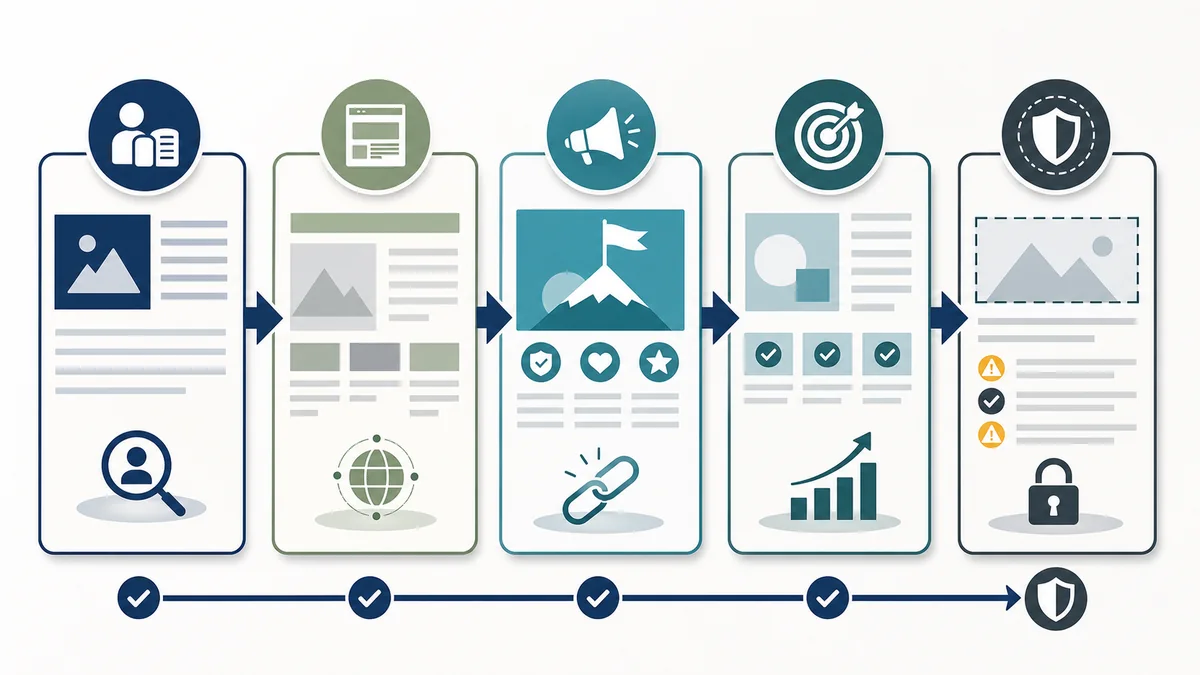
Adjacency review steps
1. Name the page job.Write the exact reader job for the eligible page set: auditing a claim, selecting a measurement method, reviewing a vendor, planning a campaign report, or studying a worked case. A sponsor should fit that job, not just the broad category label.
2. Check the neighboring argument.Read the section around the placement. If the editorial page is warning readers against overclaiming attribution, lift, survey results, or source quality, the creative should not make the same kind of overclaim beside it.
3. Keep exclusions explicit.Record excluded desks, sensitive article groups, narrow case-study contexts, weak-fit pages, and any pages where the destination would feel off-task. Exclusions should be visible before trafficking, not rediscovered after a complaint or poor readout.
4. Match destination depth to reader effort.A reader who is deep in an MMM, lift-test, source-quality, or campaign-reporting guide expects a destination with real substance. A short form can work, but only after the page gives enough context for the ask.
5. Preserve paid-unit clarity.Display and native units should remain plainly labeled across desktop, tablet, and mobile layouts. The label should travel with the paid unit after responsive changes, creative swaps, and placeholder rendering.
6. Keep fit reportable.Package ID, placement ID, page group, creative theme, destination, device class, and exclusion status should survive the campaign export. Without those fields, the final report cannot show whether the fit thesis held.
Creative and destination review
Creative review should ask whether the ad respects the reader's decision process. Destination review should ask whether the reader can continue that process after the click.

| Item | Accept when | Revise when |
|---|---|---|
| Headline | The headline names a specific professional problem or useful resource. | It promises certainty, transformation, or guaranteed results that the evidence cannot support. |
| Body copy | The copy explains the offer without copying editorial voice or implying endorsement. | The copy borrows the publication's authority or makes the sponsor sound like the article's conclusion. |
| Visual asset | The image or design is clear, work-safe, and relevant to the reader's context. | The image is attention-seeking in a way that degrades a serious reference page. |
| Destination page | The page loads cleanly, explains the offer, names the next action, and matches the creative promise. | The page hides the offer behind a form, changes the promise, or creates friction that will distort lead-quality analysis. |
| Proof level | The sponsor can show why the claim belongs in a measurement, research, analytics, or professional-learning context. | The claim depends on unsupported superiority language or broad category fear. |
| Tracking fields | UTM values, creative IDs, package IDs, placement IDs, and destination IDs are ready before launch. | The final readout would be unable to separate context fit from creative or destination response. |
Exclusion log
Exclusions protect reader trust and make campaign reporting cleaner. The point is not to create a long list of forbidden topics. The point is to keep the sponsor promise from appearing beside contexts where the fit thesis is weak, confusing, or too easy to overread.
| Exclusion type | What to record | Why it matters |
|---|---|---|
| Context mismatch | Pages where the reader job differs from the sponsor's offer. | Prevents broad delivery from being mistaken for contextual fit. |
| Claim conflict | Pages that directly challenge a claim style used by the creative or destination. | Protects the page's evidentiary role and avoids confusing adjacency. |
| Case-study sensitivity | Worked examples where a sponsor category could look like the subject of the critique. | Keeps case studies educational rather than suggestive about a named advertiser. |
| Format limit | Placements or devices where the creative cannot render cleanly or keep its label attached. | Preserves reader clarity and avoids layout-driven confusion. |
| Destination issue | Pages with slow load, weak context, broken forms, unclear offer, or missing source fields. | Prevents destination quality from being misread as inventory quality. |
Native and sponsored module boundaries
Label first
The paid nature of the module should be visible before the reader evaluates the headline, image, or call to action.
Useful offer
Native modules should point to a resource, report, event, demo, or service page that fits the reader's current task.
Separate judgment
The module should not imply that Measurement Press has tested, ranked, certified, or endorsed the sponsor's claim.
Reporting handoff
A sponsor-fit review is only useful if it survives into the readout. Add these fields to the campaign handoff before launch.
| Field | Example value | Readout use |
|---|---|---|
| Fit thesis | Readers choosing measurement methods are likely to value an incrementality planning resource. | Tests whether delivery and response came from the intended reader job. |
| Eligible contexts | Measurement Science Desk, method selector, incrementality templates, campaign readout guides. | Separates planned context from accidental or makegood delivery. |
| Exclusions | Specific case-study group, unrelated media-framing pages, mobile rail, or native-only pages. | Keeps exceptions visible when reading delivery totals. |
| Creative theme | Planning guide, product explainer, webinar, research report, or service page. | Prevents creative response from being pooled across unlike messages. |
| Destination type | Report page, demo page, webinar registration, template, or advisory page. | Helps interpret clicks, form fills, and lead quality. |
| Strongest claim | Descriptive response, directional comparison, or designed lift estimate. | Keeps the final readout from using causal language the campaign did not earn. |
Decision bands

| Status | Use when | Next action |
|---|---|---|
| Ready to launch | Reader job, page set, creative claim, destination, labels, exclusions, and report fields are complete. | Traffic the campaign with the approved context and comparison rule. |
| Ready after revision | The buyer fit is strong, but creative, destination, labels, or tracking fields need correction. | Fix before launch and update the campaign handoff. |
| Context-limited | The offer fits one desk or guide group but not the broader package. | Restrict the flight and report the narrower context separately. |
| Hold | The offer, claim, destination, or native presentation conflicts with the page's reader job. | Rework the offer or keep it out of the package. |
Evidence boundaries for fit and labeling
Three primary references anchor this review, but each answers a different question. The Federal Trade Commission's Native Advertising guide supports the clear, prominent disclosure and proximity checks; it does not approve a sponsor's claims or establish campaign performance. Google's Ad Manager Protections overview documents brand, ad-content, inventory-exclusion, and manual-review controls; those account controls do not replace a page-level fit decision. Google's Ad review center guidance supports reviewing served creatives and blocking or reporting unwanted ads after delivery; it is not evidence that a proposed placement belongs beside a particular editorial argument.
Use these sources as boundaries for the handoff, not as endorsements. A fit record still needs the actual page set, creative version, destination, exclusions, label placement, and report fields that a reviewer can inspect.
Source-to-decision handoff
The references constrain different parts of the review. Record the local evidence that closes the gap between a platform control and a placement decision.
| Verified source | It can support | Local evidence still required |
|---|---|---|
| FTC Native Advertising guide | Test whether a native unit's commercial nature is clear, prominent, understandable, and close to its focal point across the publisher and click-through surfaces. | Rendered label placement, device captures, creative version, and the destination's commercial disclosure; the guide does not validate product claims or campaign results. |
| Google Ad Manager Protections overview | Use ad-content, competition, inventory-exclusion, and manual-creative-review controls to document account-level brand-safety boundaries. | Targeted page set, exclusion log, protection rule and value, and the editorial reason a neighboring argument is or is not a fit; protections do not approve an article adjacency. |
| Google Ad Manager Ad review center | Find served creatives with filters such as deal ID, destination, advertiser, creative ID, or status, then review or block an observed ad. | Observed ad export, placement/context identifier, review timestamp, and decision record; review-center coverage does not prove a proposed unit will fit before delivery. |
Simulated Worked Example: hold a weak adjacency packet
Simulated Worked Example - not a live campaign, sponsor review, or observed result. Assume a fictional sponsor package proposes eight placements across a measurement guide group. Score each placement as 1 when the check passes and 0 when it fails; the denominator is the eight planned placements, not impressions, clicks, or conversions.
| Check | Passes | Arithmetic | Reader-safe interpretation |
|---|---|---|---|
| Reader task matches the offer | 7/8 | 7 ÷ 8 = 87.5% | Seven placements help with the page's stated professional job. |
| Creative claim stays bounded | 6/8 | 6 ÷ 8 = 75.0% | Two versions still use stronger language than the supplied proof. |
| Destination continues the reader task | 5/8 | 5 ÷ 8 = 62.5% | Three destinations switch to a lead form before giving enough context. |
| Paid label is clear and near the focal point | 8/8 | 8 ÷ 8 = 100.0% | The label check passes, but a label cannot repair a mismatched destination. |
| Exclusions are recorded before trafficking | 6/8 | 6 ÷ 8 = 75.0% | Two sensitive or weak-fit contexts remain unlogged. |
| Report fields preserve fit evidence | 7/8 | 7 ÷ 8 = 87.5% | One placement is missing a stable context or creative identifier. |
The packet score is (7 + 6 + 5 + 8 + 6 + 7) ÷ (8 × 6) = 39 ÷ 48 = 81.25%. That aggregate is descriptive only. The decision is hold because destination continuity and pre-traffic exclusions are critical checks below 8/8, and two creative versions still exceed the available proof. If all destination rows were repaired, the total would become 42/48 = 87.5%, but the package would still remain on hold until exclusions reached 8/8 and the creative claim was narrowed or supported. Reproduce the review from the eight placement records, the final creative files, the destination captures, the exclusion log, and the report-field export; change the decision if any denominator, placement scope, or evidence definition changes.
Pair with
Use this checklist with the audience intent map to define reader jobs, the contextual package proof checklist to build the package proof pack, the contextual package proof sheet to create a one-page handoff, the creative asset acceptance checklist before trafficking files are approved, the landing page launch QA worksheet before paid traffic starts, the private marketplace reporting field dictionary for reportable fields, and the campaign readout QA checklist after results arrive.
Takeaway
A good sponsor fit is not just a clean ad slot. It is a chain of reader task, context, creative, destination, label, exclusion, and report language. When that chain is visible before launch, the campaign can fund the publication without weakening the page's evidence standard.