Buyer readiness
Private marketplace deal review checklist
Organization byline: Measurement Press editorial desk. This page does not list an individual author or reviewer. Read the editorial method and corrections policy.
About 13 min read
A private marketplace deal should be reviewed as a complete evidence handoff before it is activated. The buyer should be able to see the package proof, deal key, placement IDs, creative requirements, reporting fields, and renewal threshold in one place.
Imagine the buyer has accepted the package idea, the publisher is ready to traffic, and the campaign team wants the deal live before the next planning meeting. The review should slow down just enough to answer one plain question: if this deal runs exactly as approved, will the final report still explain what happened?
A private marketplace, often shortened to PMP, is a controlled buying path between a buyer and a seller. It can be valuable when the package is tied to a real reader context, but it can become low-quality evidence when the package name, deal key, placements, creative, destination, and report fields do not point to the same thing.
Use this checklist after the package brief is drafted and before deal activation, final trafficking, or signature. It is designed for contextual display, clearly labeled native cards, and sponsorship packages where the value is reader context and clean reporting rather than a broad performance promise.
Primary sources and scope
This checklist uses current Google Ad Manager documentation for the terms and mechanics that a buyer or publisher can verify. Google describes Private Marketplace deals as non-guaranteed Preferred Deals and Private Auctions, and its reporting documentation identifies Deal ID as the identifier used to identify a deal in reporting. Those sources establish the vocabulary; they do not validate the fictional records or performance values used below.
- Google Ad Manager: About Private Marketplace deals - distinguishes Preferred Deals and Private Auctions and their inventory-selection model.
- Google Ad Manager: Private Auctions overview - documents buyer invitations, floors, targeting, expected creatives, priority, and Open Auction competition.
- Google Ad Manager: Deal ID report dimension - documents the deal identifier used to identify a buyer-publisher deal in reporting.
- Google Ad Manager: Private Auction troubleshooting - explains that competing demand and mismatched deal setup can affect delivery and interpretation.
- Google Ad Manager: Measure and troubleshoot Private Auctions - defines match rate and describes revenue lift as a comparison against simulated alternative demand.
Source-to-decision handoff
Use platform documentation to define the mechanics, then use exported deal records to make the approval decision. Keeping those layers separate stops a platform rule from being mistaken for evidence that a particular package delivered or caused an outcome.
| Verified platform fact | Record to reconcile | Decision boundary |
|---|---|---|
| Preferred Deals use a fixed price and Private Auctions use a floor; both are non-guaranteed paths. | buying_path, price_rule, fixed_cpm_or_floor, deal_id. | Hold if proposal language and configured terms disagree. Do not restate a floor as a guaranteed price. |
| Private Auctions use buyer invitations, targeting, expected creatives, priority, and an Open Auction optimization setting. | buyer_id, targeting_snapshot, expected_creative_sizes, priority, open_auction_optimization. | Revise scope and freeze the configuration snapshot if a missing or changed setting could alter eligible demand. |
| Troubleshooting distinguishes bids for the deal, buyer bids through other sources, winning bids, and competing-demand outcomes. | deal_id, ad_request_total, bids_for_deal, buyer_bid_other_sources, winning_bids, reason_code. | Reconcile these categories before calling a delivery gap buyer demand, technical failure, or package quality. |
| Google defines match rate as impressions divided by ad requests and describes revenue lift as a simulation against other demand. | time_window, impressions, ad_requests, counterfactual_demand, revenue_lift_version. | Show the arithmetic and window. Do not turn platform revenue lift or descriptive response into causal user-outcome lift. |
Reproduction rule: save the proposal export, accepted deal configuration, placement and creative records, report query and field definitions, exception log, and timestamps together. Recalculate from raw counts using match_rate = impressions / ad_requests. If a denominator, category definition, targeting snapshot, or reporting grain changes, rerun the review and label the result non-comparable.

Where the review fits
The deal review is the last buyer-facing gate before activation. It should catch mismatches while they are still cheap to fix: a vague package, a missing deal key, a creative size that cannot run, a reporting field that will not survive export, or a renewal rule that is being invented too late.
Treat the review as a proof chain. Each layer should make the next layer easier to audit. If the package proof says the reader is in a planning mindset, the placement scope, creative message, destination, and report fields should all preserve that same context.
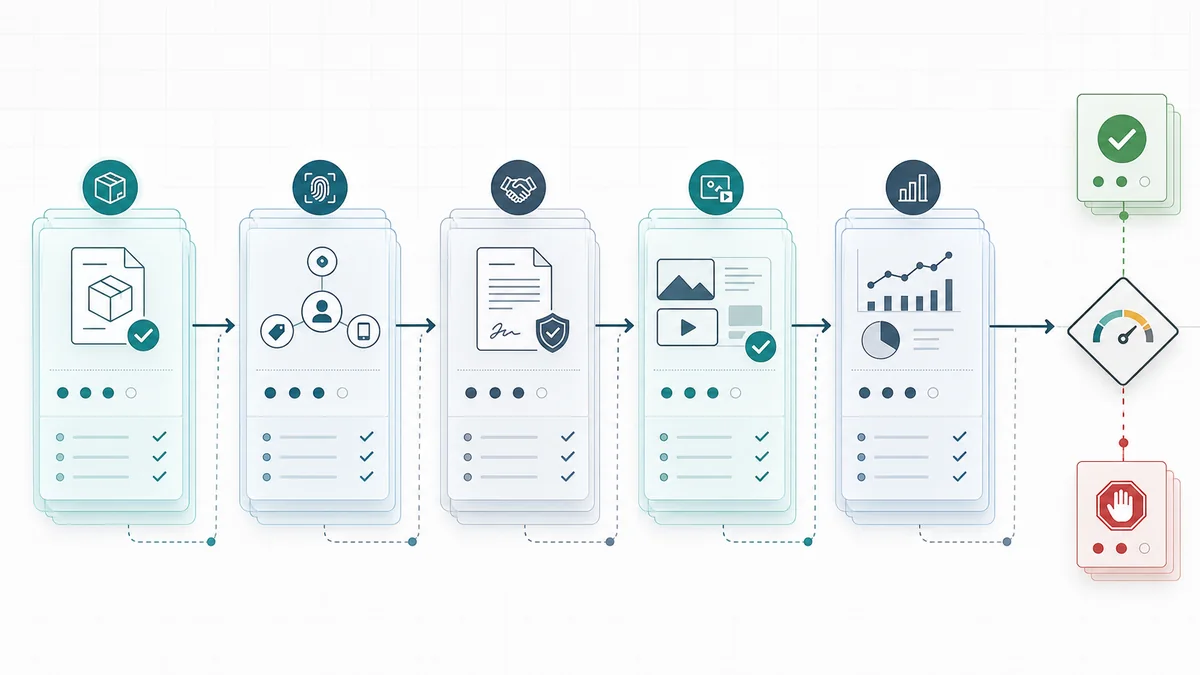
| Workflow stage | Review question | Required record | Decision if weak |
|---|---|---|---|
| Package proof | Does the reader job match the package being sold? | Reader context, included page groups, excluded contexts, and clean-fit rationale. | Narrow the package before pricing. |
| Deal setup | Can the buyer, publisher, and ad operations team name the same deal? | package_id, pmp_deal_key, package_reporting_key, buying path, dates, and owner. | Hold activation until identifiers are stable. |
| Placement scope | Are eligible placements, sizes, devices, and refresh rules explicit? | Placement IDs, creative sizes, device eligibility, exclusions, and refresh status. | Revise scope or remove unready placements. |
| Creative and destination | Will the message and landing page fit the reader job? | creative_id, size set, native fields, destination_id, UTM structure, and destination QA state. | Approve only the ready creative and destination path. |
| Reporting and renewal | Can the final report support the decision being requested? | Reporting grain, quality flags, outcome status fields, comparison rule, and renewal threshold. | Change the claim language or add a stronger test design. |
The approval gate
Score each gate as ready, revise, or hold. A deal can launch with minor documented exceptions, but it should not launch when the missing item is needed to interpret the campaign.
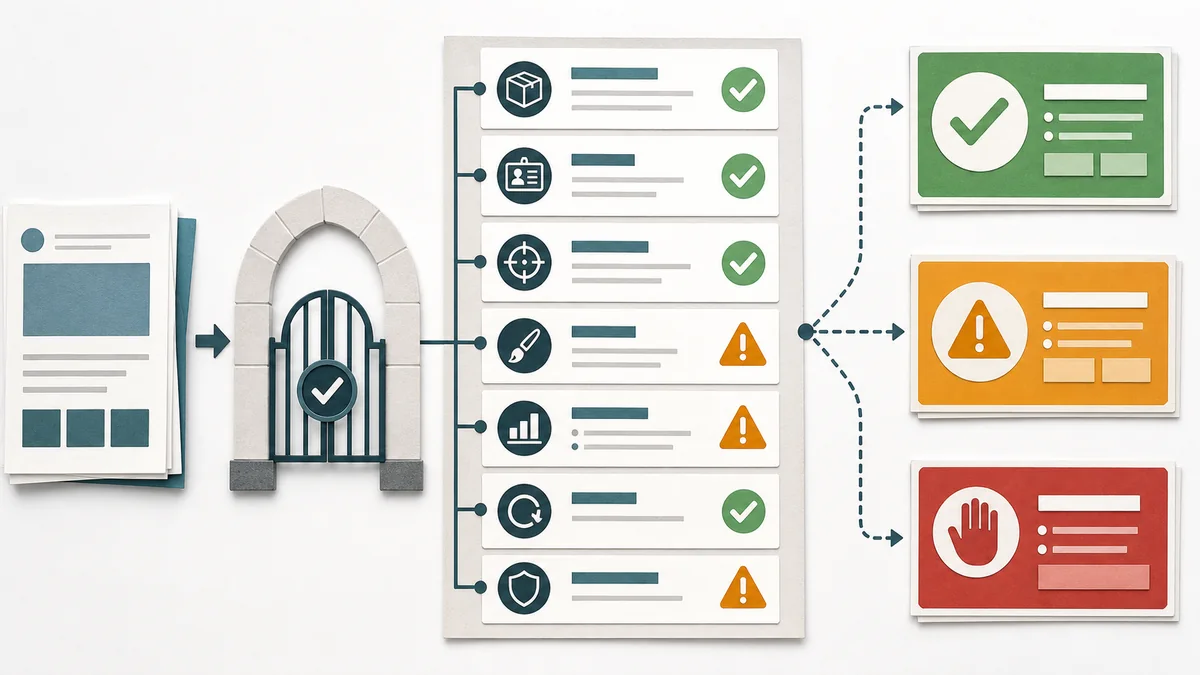
| Gate | Ready | Revise | Hold |
|---|---|---|---|
| Package proof | The reader job, package ID, included contexts, and exclusions are specific. | The package is sound but has a mixed context that needs a reporting split. | The package is a broad audience claim without page or reader-job proof. |
| Deal identifiers | package_id, pmp_deal_key, campaign_id, and reporting keys match across records. | One label differs but a translation table is included. | Deal setup depends on manual naming or future interpretation. |
| Placement contract | Every placement ID has format, size, device, refresh, and exclusion rules. | One placement needs a smaller scope or separate device rule. | Eligible inventory cannot be trafficked or audited as sold. |
| Creative handoff | Display or native assets, destination, click URL, and tracking values are complete. | Creative can launch after a stated asset, copy, or destination fix. | Creative or destination quality would make response uninterpretable. |
| Reporting fields | Delivery, exposure quality, traffic quality, outcome status, and comparison fields are defined. | Some fields are directional and must be labeled that way in the readout. | The buyer's expected decision depends on fields that will not exist. |
| Renewal threshold | The renew, revise, shift, test, or pause rule is written before launch. | The threshold exists but needs a minimum delivery or quality caveat. | The deal relies on choosing a favorable metric after results arrive. |
Required attachments
The deal review should point to the supporting records rather than restating every detail. If an attachment is missing, the approval note should say what decision cannot be made.
| Attachment | What it proves | Review field to copy forward | Risk if missing |
|---|---|---|---|
| Contextual package proof sheet | The package has a real reader job, eligible context, and clean-fit rationale. | reader_job, included_contexts, excluded_contexts. | The package may become run-of-publication by implication. |
| Inventory readiness matrix | Package contracts, placement IDs, sizes, and reporting keys are stable. | package_id, pmp_deal_key, placement_ids, placement_reporting_keys. | Delivery cannot be audited against the proposal. |
| Package brief | Buyer-facing scope, primary signal, comparison rule, and renewal evidence are visible. | primary_signal, comparison_rule, renewal_evidence. | The readout may answer a different question than the buyer approved. |
| Creative acceptance record | Display sizes, native fields, click URL, destination, and launch dates are complete. | creative_id, creative_size_set, destination_id, active_dates. | A creative or landing-page issue may be mistaken for package quality. |
| Landing page QA worksheet | The destination can receive traffic, preserve source fields, and support the promised action. | destination_status, form_path, source_field_state, change_log_owner. | Response quality may reflect destination friction rather than media context. |
| Reporting field dictionary | The report can keep package, placement, context, device, creative, traffic, and outcome fields aligned. | reporting_grain, quality_flags, outcome_status_fields. | The final report may collapse unlike signals into one metric. |
| Renewal scorecard | The next decision has a preplanned evidence threshold. | renewal_lane, minimum_delivery, decision_boundary. | Renewal may be driven by whichever metric looks most favorable. |
Simulated worked review: an activation decision
This is a simulated worked example, not a real buyer, publisher, or campaign record. The numbers are deliberately small so a reader can reproduce the decision. The rule is conservative: any hold lane blocks activation, while a revise lane requires a named fix and a narrower claim ceiling.
| Lane | Fictional evidence check | Calculation | Status |
|---|---|---|---|
| Deal identifiers | package_id, pmp_deal_key, campaign_id, and reporting key agree. | 4 matching fields / 4 checked fields = 100% | Ready |
| Placement contract | Eight of ten proposed placements have a complete device, size, refresh, and exclusion record. | 8 / 10 = 80% | Revise scope to the eight documented placements. |
| Creative and destination | Three of three approved creative/destination checks are complete. | 3 / 3 = 100% | Ready |
| Reporting fields | Five of six required fields are present; the outcome-status field will mature later. | 5 / 6 = 83.3% | Revise the first readout to delivery and observed traffic. |
| Renewal rule | No pre-written minimum delivery or comparison boundary is attached. | 0 / 1 required decision rule = 0% | Hold activation until the rule is written. |
Decision: hold the fictional deal. The identifier and creative checks are complete, but the missing renewal rule is a decision-critical gap; the 80% placement record and 83.3% reporting completeness also require scope and language changes. This is not a weighted quality score: the visible decision rule prevents a strong lane from hiding a blocking one.
Claim ceiling: after the missing rule is supplied, the example could support a bounded statement about delivery and observed traffic in the documented placement set. It could not support causal lift because the comparison is not a protected holdout. If outcome status is still immature, lead-quality language belongs in a later follow-up window.
Deal review record
This example shows the structure of the approval record. The values are examples for a contextual package review, not performance benchmarks.
| Field | Example value | Approval note |
|---|---|---|
| Decision | Approve a private marketplace package for activation. | Approval covers the stated package, placements, dates, and reporting grain only. |
| Package | measurement-science-desk, mp-msd-pmp, package.measurement_science_desk. | Reader job is method selection and campaign measurement review. |
| Eligible placements | archive-leaderboard, article-inline-1, article-inline-2, article-rail-1, post-content. | Device and size rules follow the inventory readiness matrix. |
| Creative and destination | Planning-guide creative in approved display sizes, destination_id measurement-report-demo. | Destination QA is ready; any landing-page version change requires a change-log entry. |
| Reporting grain | Package by context group, placement ID, device class, creative size, destination ID, qualified visit, and lead status. | Small cells will be marked directional or pooled before conclusions are written. |
| Comparison rule | Matched prior contextual flight, no protected holdout. | Supports descriptive or directional language, not causal lift language. |
| Renewal threshold | Renew if context delivery is complete, exposure quality is interpretable, and qualified visits are concentrated in agreed guide groups. | Add a holdout or matched-market design if the next decision requires lift language. |
| Exception owner | Operations owns placement exceptions; analytics owns reporting-field exceptions. | Exceptions must appear in the readout before package performance language. |
Worked review: when one lane is weak
The hardest approval meeting is not the obvious hold. It is the deal that is mostly ready but has one weak lane. The review should separate launch risk from claim risk. A package can sometimes launch with a limited exception, but the final report should not pretend the exception did not change the evidence.

| Review finding | Launch decision | Readout ceiling | Owner before activation |
|---|---|---|---|
| Package proof, deal key, placements, creative, destination, and field dictionary all match. | Approve the deal as scoped. | Package delivery, quality, and renewal evidence can be discussed inside the stated comparison limit. | Buyer, operations, and analytics sign the same approval note. |
| One placement is ready, but a second placement has a missing device rule or refresh exception. | Revise scope or launch only the ready placement lane. | Do not pool the revised and excluded placement as one package result. | Operations names the excluded placement and updates the forecast. |
| Creative and destination are ready, but outcome status will mature after the first report. | Approve launch with a follow-up outcome window. | The first readout can discuss delivery and observed traffic, not final lead quality. | Analytics adds the maturity date and follow-up owner. |
| Reporting fields are present, but the comparison rule is descriptive rather than causal. | Approve if the buyer accepts descriptive language. | The report can compare observed patterns, but cannot say the package caused lift. | Buyer lead confirms the claim ceiling in the approval record. |
| The deal key, package ID, or placement IDs do not match across proposal, trafficking, and reporting records. | Hold activation. | No buyer-facing performance language should be written until the source trail is repaired. | Operations and analytics reconcile IDs before trafficking. |
Exception log
Exceptions are not automatically blockers. They are blockers when they affect the buyer's decision or the strongest claim expected from the report.
| Exception | Can launch if | Must hold if | Readout language |
|---|---|---|---|
| One placement is excluded. | The buyer approves the smaller scope and forecast is updated. | The removed placement is central to the package proof. | The campaign delivered in the revised placement set. |
| Device reporting is partial. | The decision does not require device comparison and the gap is labeled. | The proposal promises device-level optimization. | Device results are directional where fields are incomplete. |
| Outcome status is delayed. | The first readout is delivery and traffic only, with a follow-up outcome window. | Renewal depends on lead or pipeline quality at the first readout. | Outcome quality was unavailable for the initial decision. |
| Comparison is descriptive. | The buyer accepts that the report will not use lift language. | The buyer needs a causal budget recommendation from this flight. | The readout describes observed response under the stated comparison limit. |
| Destination changes mid-flight. | The change is logged and results are split before and after the change. | The change removes the promised action or source fields. | Destination changes limit pooled interpretation. |
Limitations and evidence boundary
- Official platform documentation explains deal types, identifiers, and troubleshooting mechanics; it does not prove that any particular package delivered, reached the intended context, or caused an outcome.
- The simulated rows demonstrate a review method only. Replace them with exported records, preserve the reporting grain, and retain an exception log before using the method for a real decision.
- A matched prior flight or descriptive comparison can show observed differences under stated assumptions. It cannot by itself establish incrementality; a lift claim needs a stronger design and a documented decision boundary.
Buyer-facing signoff questions
- Can every reviewer name the same package ID, deal key, placement IDs, and buying path?
- Does the package proof show a reader job rather than a broad audience promise?
- Are creative sizes, native fields, destination state, UTM values, and change-log ownership complete?
- Will reporting preserve package, placement, context, device, creative, destination, traffic quality, and outcome status?
- Is the renewal threshold written before launch, and does it match the available comparison rule?
Pair with
Use this deal review with the private marketplace readiness index for the complete fit, activation, launch, reporting, and renewal sequence, the media kit for placement specs, the audience intent map for reader-job proof, the inventory readiness matrix for package contracts, the contextual package proof sheet for package evidence, the contextual package proof export template when proof fields need to survive into reporting rows, the private marketplace package brief template for buyer-facing scope, the campaign readiness dashboard for launch status, the creative asset acceptance checklist and landing page launch QA worksheet for launch inputs, the private marketplace reporting field dictionary for field names, the private marketplace readout export sample for row-level reporting, and the private marketplace renewal scorecard before renewal, creative-change, budget-shift, or lift-test decisions.