Campaign diagnosis
Campaign issue log and renewal register
Organization byline: Measurement Press editorial desk. This page does not list an individual author or reviewer. Read the editorial method and corrections policy.
About 12 min read
The renewal meeting is two days away. The report shows useful response, but the strongest slide also depends on pooled placements, a mid-flight creative change, missing lead-status rows, and a comparison that cannot support lift language.
A register is the shared issue log that prevents those caveats from disappearing. It says which rows can support renewal, which rows need repair, which rows are excluded, and which claims must wait for a stronger test.
Use this page after the readout QA pass and before the renewal meeting. It is designed for publishers, advertisers, agencies, and analysts who need one shared record for weak evidence lanes, owner actions, fix deadlines, retest requirements, and final supportable claim language.
Reader outcomeBy the end, you should be able to turn a mixed campaign readout into a bounded decision: renew only the verified scope, name the rows that remain unresolved, and reserve causal language for a designed comparison.
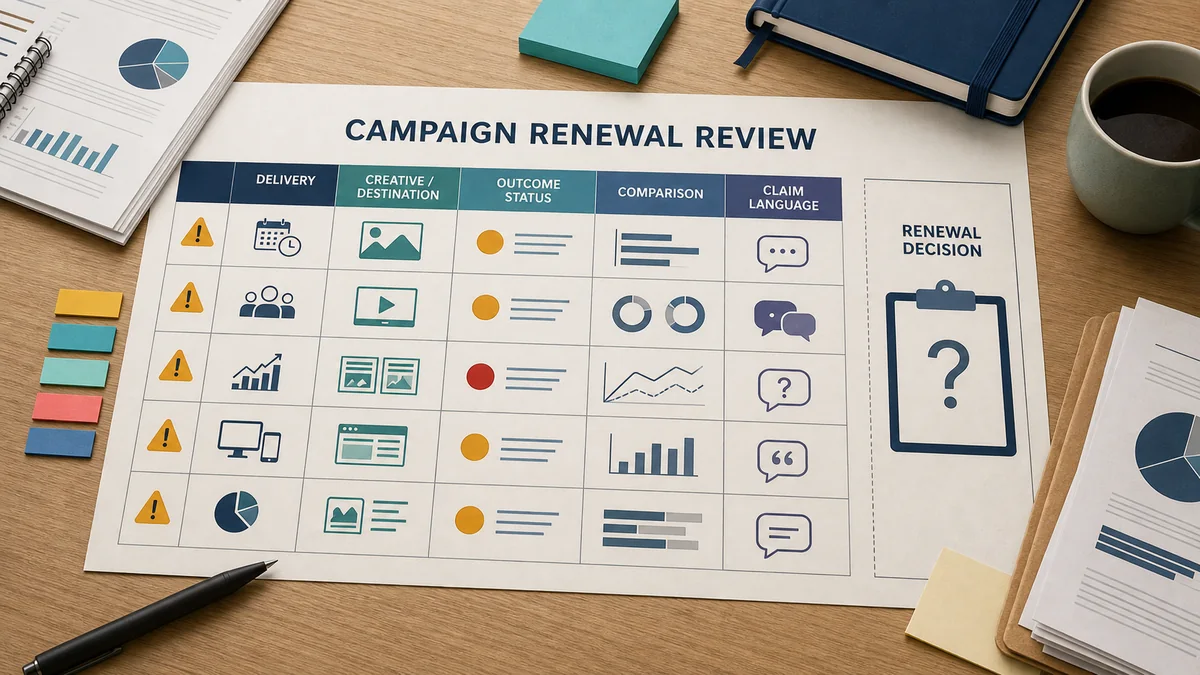
When to open a register
Open a register whenever the next decision is stronger than the current evidence. A register is most useful when the team is tempted to solve every issue in the final slide instead of assigning each weak lane to a concrete next action.
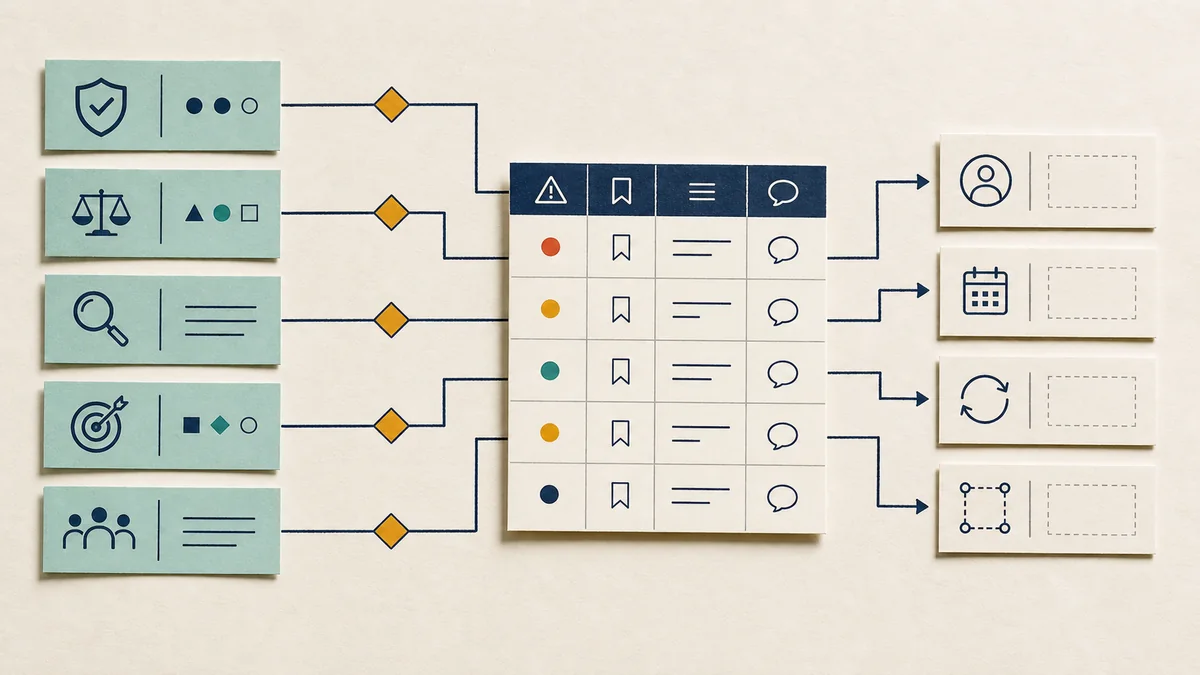
| Signal in the readout | Why it needs a register | Best immediate action |
|---|---|---|
| Delivery was mostly in scope, but some placements, dates, or devices were pooled. | The renewal may need a narrower package definition. | Log the affected rows and decide whether they are excluded, repaired, or reported separately. |
| Creative, destination, or offer changes happened during the flight. | The result may mix media quality with changed message or page conditions. | Separate the change window and assign the creative or page owner. |
| Clicks or visits were strong, but qualified outcomes were weak or incomplete. | Traffic, form, routing, and follow-up evidence may point to different fixes. | Log the downstream break point and require status coverage before the next claim. |
| Attribution looks strong without a protected comparison. | The renewal may be reasonable while lift language remains unsupported. | Log the comparison gap and attach the next test requirement. |
| One slice looks like a winner with low delivery or uneven rotation. | The slice may be useful for diagnosis but too fragile for budget shift. | Log minimum-cell thresholds and retest before scaling. |
| The report recommends renewal, revision, and a lift test at once. | Different actions require different evidence and owners. | Split each action into its own row with a claim boundary. |
Minimum register fields
The register should be short enough to use in a meeting and specific enough to survive handoff. These fields keep the decision tied to evidence instead of opinion.
Issue ID
A stable label for the weak lane, such as delivery-scope-01, mobile-form-02, or comparison-gap-01.
Evidence lane
Delivery, exposure quality, traffic quality, creative, destination, lead status, comparison, or claim language.
Affected rows
Package, placement, creative, device, date, geography, destination, or outcome rows that are included in the issue.
Decision risk
The exact recommendation the issue could change: renewal, narrowing, creative revision, destination fix, budget shift, or lift test.
Owner and date
The person or team responsible for the fix, the evidence due date, and the meeting where the issue will be closed or carried forward.
Claim boundary
The strongest sentence allowed until the issue is fixed, excluded, or tested with a stronger comparison.
Register template
The values below show structure, not benchmarks. Replace the example IDs with the campaign's actual package, placement, creative, destination, and outcome records.
| ID | Evidence lane | Issue | Owner | Due | Retest rule | Decision status | Claim boundary |
|---|---|---|---|---|---|---|---|
| delivery-01 | Placement scope | Three lower-volume placements were pooled into the package total. | Ad operations | Before renewal note | Report scoped and pooled rows separately next flight. | Renew narrower package only. | Observed response is strongest in the verified placement set. |
| creative-02 | Creative and destination | Mobile creative drove clicks to a slower page variant than desktop. | Creative and web | Before relaunch | Retest after page speed and message match are corrected. | Fix before mobile scale. | Mobile response is limited by destination readiness. |
| lead-03 | Outcome quality | Lead status is missing for part of the second week. | Buyer analytics | Within status window | Do not compare lead quality until status coverage reaches the agreed threshold. | Hold lead-quality claim. | Submitted leads are reported; qualified lead quality is not complete. |
| comparison-04 | Baseline fit | Prior-flight comparison used different seasonality and a different offer. | Measurement | Next test plan | Reserve a matched baseline or holdout before lift wording. | Plan incrementality test. | The campaign produced directional response, not proven lift. |
| slice-05 | Small-cell readout | One creative-device cell ranks first but has limited delivery. | Campaign analyst | Readout revision | Keep the cell as a hypothesis until minimum delivery is met. | Do not shift budget yet. | The cell is a candidate for retest, not a proven winner. |
Simulated worked example: scope the renewal before calculating the claim
This is a simulated worked example, not a report from a real advertiser or campaign. The numbers are intentionally small and reproducible so the register logic can be checked by hand.
Assumptions: the verified package contains 10,000 in-scope impressions, 220 visits, 22 submitted leads, and 11 qualified leads. A separate pooled slice contains 4,000 impressions and 100 visits, but its lead-status rows are incomplete. The prior-flight comparison has 9,000 impressions and 180 visits, but the offer and season are different, so it is descriptive context rather than a protected control.
| Calculation | Formula | Result | Register interpretation |
|---|---|---|---|
| Verified visit rate | 220 visits ÷ 10,000 impressions | 2.20% | Usable for the verified scope if delivery and visit definitions are consistent. |
| Verified lead rate | 22 submitted leads ÷ 10,000 impressions | 0.22% | Report as a descriptive response rate, not incremental impact. |
| Qualified-share rate | 11 qualified leads ÷ 22 submitted leads | 50.00% | Usable only for rows with complete status coverage. |
| Contextual visit-rate change | (220 ÷ 10,000) − (180 ÷ 9,000) | +0.20 percentage points | Directional context; the different offer and season block a causal renewal claim. |
| Relative context change | 0.20 percentage points ÷ 2.00% prior rate | +10.00% | Do not label this lift without a protected comparison. |
Bounded decisionRenew the verified package for the rows with complete delivery and outcome-status records. Exclude the pooled slice until status coverage is repaired, fix the mobile destination before scale, and treat the +10.00% contextual change as directional only. A controlled experiment or lift study is required before the note can claim incremental impact.
Limitations: these calculations do not estimate uncertainty, account for user overlap, or prove that media caused the visits or leads. They show how a register separates a valid descriptive denominator from an unsupported causal conclusion. If the missing statuses change the qualified-lead conclusion, the outcome row remains a blocker rather than an optimization note.
Primary source trail for the register rules
The register’s boundaries are anchored to first-party measurement guidance, not a generic checklist convention. Google Ads’ conversion-status troubleshooting guidance says to verify tag firing and account for reporting latency and attribution differences; that is why this page separates delivery, submitted outcomes, qualified outcomes, and status-window closeout. Google Ads’ experiment guidance recommends a clear hypothesis, testing one variable at a time, preselecting success metrics, and keeping experiment records; that is why unresolved rows receive an owner, due date, retest rule, and claim boundary. For incrementality, Google’s Experiment Center guidance distinguishes ordinary experiments from controlled lift studies that compare randomized or geographically split treatment and control groups.
Source boundary: these Google Ads documents help diagnose platform implementation, reporting delay, and experiment structure. They do not certify a CRM status, deduplicate a lead export, establish buyer quality, or turn an unresolved register row into incremental evidence. Those claims still require the campaign’s own definitions, row-level reconciliation, and an appropriate comparison design.
Severity bands
Severity should describe decision risk, not how embarrassing the issue feels. A small operational defect can be high severity if it changes the renewal claim.
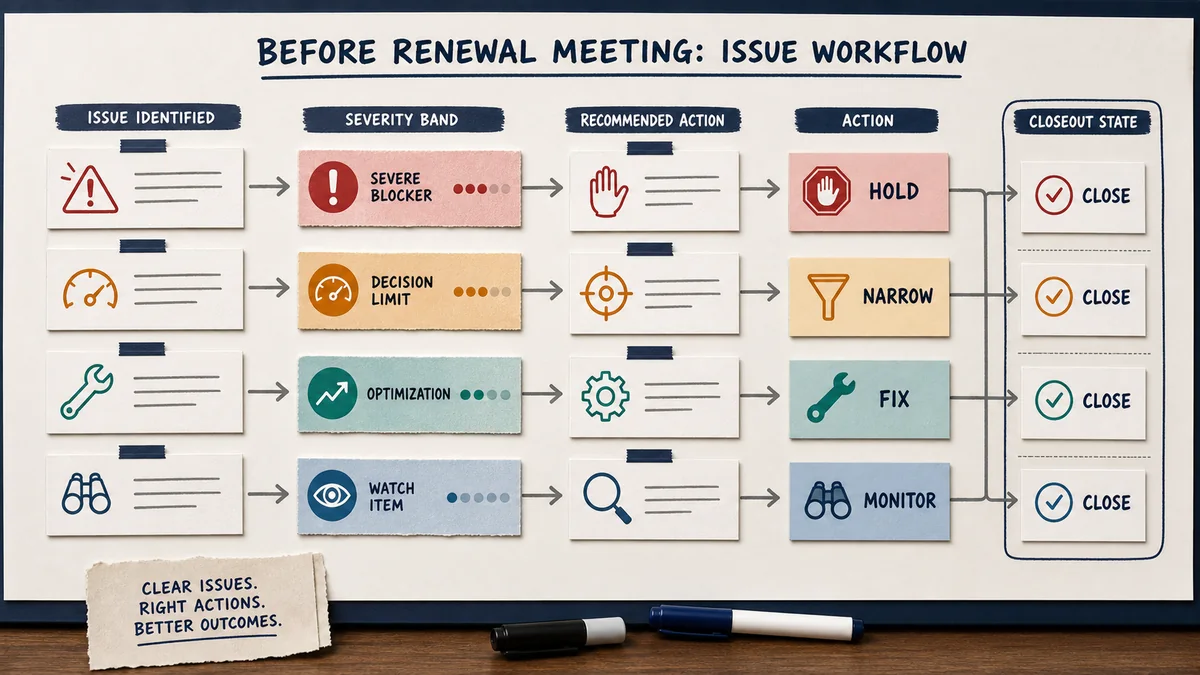
| Severity | Use when | Allowed action | Do not do |
|---|---|---|---|
| Blocker | The issue prevents a decision-grade readout for the action being requested. | Hold renewal, rebrief, or exclude the affected scope until evidence is repaired. | Hide the issue in a caveat while recommending scale. |
| Decision limit | The campaign can support a narrower action but not the broad recommendation in the deck. | Renew a verified package, fix a weak lane, or plan a test with bounded language. | Let the strongest slice define the whole campaign. |
| Optimization | The issue changes how the next flight should run but not whether the current result was useful. | Assign a fix and make it a condition for the next report. | Treat the fix as proof that the previous result was causal. |
| Watch item | The issue is plausible but not yet large enough to change the recommendation. | Track the field and require a threshold before acting. | Use a weak warning to dismiss useful evidence. |
Renewal decision map
The register is useful only if it changes the meeting outcome. Read each row against the decision being requested, then use the lowest supportable action instead of averaging good and weak evidence into one broad yes.
| Register pattern | Decision to make | Supportable renewal action | Language boundary |
|---|---|---|---|
| Clean delivery, complete status, and comparison caveat limited to one excluded slice. | Renew the verified package. | Renew the verified scope and leave the excluded slice out of the claim. | Use performance language for the verified rows only. |
| Useful response, but one fix is required before the next flight can be trusted. | Renew with a condition. | Approve the next flight only if the named field, page, creative, or routing fix is in place before launch. | Say the prior result supports a focused renewal, not proof that the unfixed lane will scale. |
| The best result comes from a small cell, changed offer, or uneven rotation. | Decide whether to shift budget. | Keep the finding as a retest hypothesis until minimum delivery and stable rotation are met. | Call it a candidate signal, not a winner. |
| Descriptive response is positive, but no protected comparison exists. | Use or avoid lift language. | Renew for observed response if the buyer accepts that basis; plan a causal test before incrementality claims. | Say directional response, not incremental impact. |
| Missing outcome status could reverse the quality conclusion. | Decide whether to renew on lead or outcome quality. | Hold the outcome-quality claim until status coverage reaches the agreed threshold. | Report submitted or observed outcomes separately from qualified outcomes. |
Closeout rules
Every row should end in one of five states. The closeout state should be visible in the renewal note so the final recommendation does not outrun the record.
| Closeout state | Use when | Final language |
|---|---|---|
| Fixed before decision | The missing field, trafficking record, destination issue, or status gap was repaired before the recommendation. | The row can support the decision, with the repair noted. |
| Excluded from decision | The issue could not be repaired, but the affected scope can be removed from the conclusion. | The conclusion applies only to the verified scope. |
| Condition for renewal | The result is useful, but the next flight requires a specific fix or field. | Renew only with the named condition and evidence due date. |
| Retest required | The result is a plausible signal but too confounded, small, or unbalanced for action. | Carry forward as a hypothesis for the next designed test. |
| Causal test required | The business decision needs lift, but the current report is descriptive or directional. | Use directional language and attach an incrementality test plan. |
Simulated action-permission check
This simulated check turns the five register rows above into a meeting-ready boundary. It counts requested actions that the current record can permit; it is not a campaign-quality score, a benchmark, or a substitute for the source fields and status rules recorded in each row.
| Requested action | Register row | Current closeout state | Permitted now? | Reason |
|---|---|---|---|---|
| Narrow-package renewal | delivery-01 | Excluded from decision | Yes | The verified placement set can carry a descriptive renewal when pooled rows are excluded. |
| Mobile budget scale | creative-02 | Condition for renewal | No | Destination and message-match repair must be retested before scale. |
| Qualified-lead claim | lead-03 | Condition for renewal | No | Incomplete status rows could change the qualified-share conclusion. |
| Incremental-lift wording | comparison-04 | Causal test required | No | A different offer and season do not provide a protected comparison. |
| Budget shift to the winning cell | slice-05 | Retest required | No | Low delivery and uneven rotation leave the apparent winner as a hypothesis. |
Reproduce the boundary: permitted requested actions ÷ requested actions = 1 ÷ 5 = 20%. The correct meeting decision is therefore a focused renewal of the verified scope, not a broad renewal, mobile scale, qualified-lead claim, lift statement, or budget shift. If status coverage is repaired, comparison design is changed, or the small cell reaches its minimum delivery rule, recalculate the count; the denominator also changes when the meeting requests a different set of actions.
Renewal note pattern
A useful renewal note names the clean evidence, the unresolved rows, and the next test without making the reader infer which caveats matter.

Recommended structureRenew the verified contextual package for the placements and devices with complete delivery, traffic-quality, and outcome-status records. Exclude the pooled placement rows from the renewal claim, fix the mobile destination before scale, and reserve a matched comparison before using lift language. The current readout supports a focused renewal and a retest plan, not a broad incremental-impact claim.
Meeting script
- Which unresolved row could change the renewal, creative, destination, budget, or test decision?
- Which issue is a blocker, which is a decision limit, and which is only an optimization note?
- Does every weak lane have an owner, due date, retest rule, and claim boundary?
- Which rows are excluded from the final recommendation, and which are conditions for the next flight?
- What exact sentence is allowed until the fix, status update, or comparison test is complete?
Pair with
Use this register after the campaign readout QA checklist and the creative and destination troubleshooting matrix. Pair it with the campaign reporting worksheet when the renewal meeting needs a one-page note, the private marketplace renewal scorecard when the decision needs scoring, the campaign renewal memo template when scored issues need final renew, revise, retest, or hold language, the campaign renewal evidence archive when closeout states must carry forward, the campaign renewal archive follow-up fields when archived issues need owners, due dates, and next-launch gates, the campaign status-window closeout checklist when unresolved rows depend on delayed lead, matchback, attribution, or survey status, the campaign status-window closeout register when those delayed rows need IDs, exclusions, and next-review dates, the private marketplace readout export sample when rows need a consistent field structure, the package performance readout when the buyer-facing narrative needs tighter language, the campaign baseline comparison checklist when the comparison is weak, the outcome quality scorecard when lead or matchback status is incomplete, and the incrementality test plan template when the next decision needs causal evidence.